

 Tiếng Việt
 日本語
 한국어
 中文 (中国)
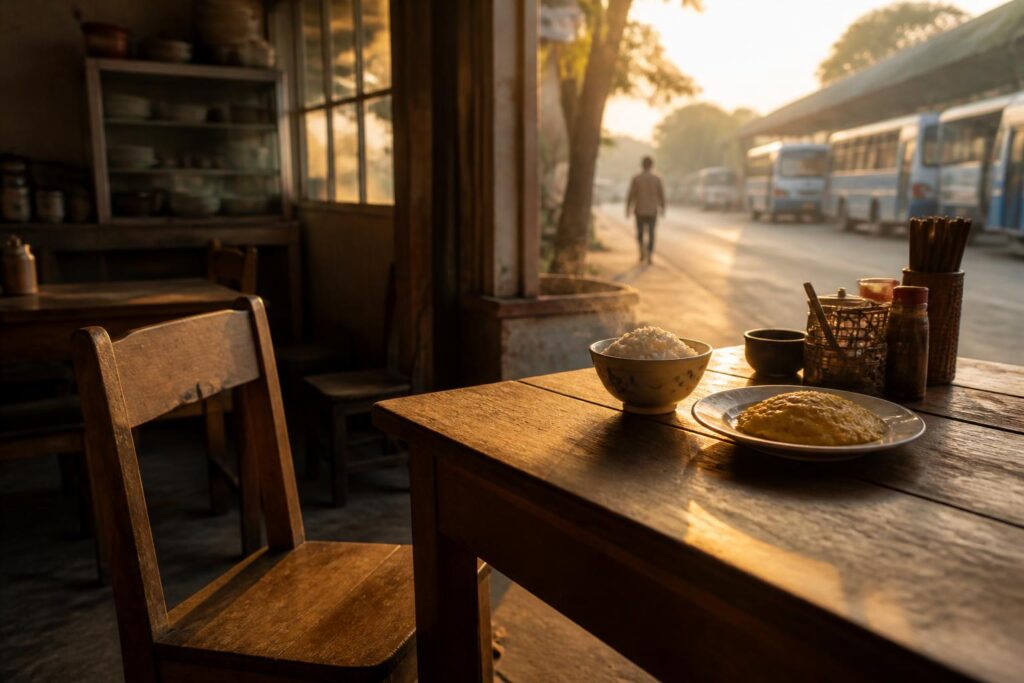
At the end of the road leading to the old bus station stood a small rice shop called Bep Chieu. The shop had no large sign, only a faded wooden board and a few four-o’clock flowers in pots along the porch. People in the neighborhood often stopped by for a bowl of hot soup, a dish of braised fish, or a simple bowl of white rice before going home. The shop opened at ten in the morning and stayed open until the last pot of rice was covered, but no one knew exactly when the owner would close.
Because in the innermost corner of the shop, there was always an empty chair.
The chair was not special. It was slightly lower than the others, its wooden seat had a crack running across it, and one of its legs had been propped up with a piece of cardboard. Even so, every afternoon, the owner, a woman named Hanh, wiped it thoroughly and placed it neatly beside the small table next to the window. No one was allowed to sit there casually. If the shop was crowded, people could share a table or wait a few more minutes, but that chair still had to remain empty.
The Customer Who Never Ordered
Newcomers often assumed it was reserved for an important customer. Some jokingly asked whether Mrs. Hanh was waiting for a wealthy owner, an old lover, or a family member who had gone away. She would only smile, pour more tea, and say, “That place is for whoever needs it.”
The answer only made everyone more curious, but no one asked further. Mrs. Hanh was not the kind of person who liked telling her own story. She had been widowed for a long time and lived alone; her daughter was married and lived in another city. The rice shop was the only property she had kept after moving several times, and it was also where she had become acquainted with most of the workers in the neighborhood.
About seven years earlier, on a rainy afternoon, a boy entered the shop. He was around twelve years old, his thin shirt soaked through, his sandals broken at the straps, and his face pale from the cold. He stood near the door for a long time but did not order anything. When Mrs. Hanh asked him, he only shook his head and looked toward the pot of rice.
She placed a bowl of rice with a fried egg and vegetable soup in front of him. He ate very quickly, so quickly that he nearly choked. When he finished, he put a few crumpled coins on the table and stood up. Mrs. Hanh pushed the money back toward him and told him that a customer had eaten without paying that day, so he could consider himself to have helped her clear the dishes.
The boy did not accept pity. He bowed his head in thanks, asked her name, and left in the rain. From that day on, he stopped by every few days. Sometimes he ate a bowl of rice; sometimes he only asked for a cup of warm water. He never clearly said where he lived, only that he was looking for his father. His father had once worked as a construction laborer around the bus station, but after an accident, he had left without leaving an address.
Mrs. Hanh did not know how much of the story was true. She also did not know whether the boy was running away from some home or truly had no family left. But she recognized the look in his eyes whenever he gazed out at the road. It was the look of someone always afraid of missing a familiar figure.
A Silent Promise
One day, the boy came to the shop when it was already dark. He did not eat; he merely sat by the window and watched the people passing by. After a while, he told Mrs. Hanh that the next day he would go look for his father at a distant construction site. If he found him, he would come back to thank her. If he did not find him, he would come back anyway, because this was the only place where someone remembered that he liked fried eggs with crispy edges.
Mrs. Hanh smiled and told him to go and come back. She said the chair by the window would be kept for him.
The next morning, he did not come. Nor did he come the day after that. A week passed, then a month. Mrs. Hanh asked several motorcycle taxi drivers at the bus station, but no one knew where he had gone. Some said he had joined a group of homeless children; others said a family had adopted him. Everyone had heard a different story, and none was certain enough for her to believe.
At first, she still placed a small bowl of rice on the table by the window every afternoon. When the rice grew cold, she gave it to the cats, and she saved the leftover food for her dinner. After a few weeks, she stopped putting out the rice, but she continued to wipe the chair and leave the place empty.
The regular customers gradually understood that this was a habit that could not be changed. Some thought she was too softhearted. Others advised her to use the seat for another customer, especially at the end of the month. She would only reply that the shop could do without one seat, but people should not make their hearts do without a place for hope.
Those Who Sat Beside the Chair
Strangely, after the chair was left empty, many other people began coming to the shop. An older motorcycle taxi driver often sat at the table opposite it while waiting for customers. He would not order anything if he had only enough money left in his pocket for gas, but Mrs. Hanh always brought him a bowl of rice and told him to pay later. A sanitation worker once sat crying by the window because she had lost her wallet. Mrs. Hanh lent her money for the ride home without asking for her address. An elderly man who had gotten lost came to the shop on a rainy night, and afterward everyone worked together to find his family.
No one was allowed to sit on the empty chair, but anyone could sit beside it. Gradually, the chair became a quiet sign. People who entered the shop naturally began speaking more softly, paying more attention to those sitting alone, and not rushing to turn away anyone who could not yet afford to order. Perhaps no one wanted to destroy the peace that the chair brought with it.
One late-year afternoon, a young man entered the shop. He wore a dark jacket and carried an old backpack over one shoulder. He stood in front of the chair for quite a while before asking Mrs. Hanh, “Do you still remember me?”
Mrs. Hanh looked at him but did not recognize him right away. It was not until he ordered fried eggs with crispy edges and asked for extra vegetable soup that her hand stopped. The face of the boy from years ago had changed, his shoulders were broader, and his voice deeper, but the way he looked out at the road was exactly the same.
He told her that he had traveled through many places, worked as a laborer at construction sites, slept in cramped rented rooms, and often considered coming back but did not have the courage. His father had died before the two of them could meet. Later, an old craftsman had helped him, taught him electrical repair, and helped him find a stable job. He had returned not to repay the bowl of rice from long ago, because he knew that a bowl of rice could not be settled with money. He had returned to say that, back then, the promise to keep the chair had helped him believe that he still had somewhere to return to.
Mrs. Hanh did not ask how he had lived during all those years. She simply placed the plate of fried eggs in front of him, poured him a cup of hot tea, and said, “Eat before it gets cold.”
What a Seat Can Say
The empty chair in Bep Chieu did not change a person’s fate in any grand way. It could not replace a family, solve poverty, or guarantee that everyone who lost their way would find one another. But it reminded those who passed through that there were still places in this world that did not require us to prove we deserved acceptance before welcoming us.
In everyday life, people are easily judged by their ability to pay, their job, their clothes, or the way they appear before others. Those who are slow, awkward, poor, or carrying a story they are not ready to tell are often pushed aside very quickly. A seat kept open may not solve every problem, but it creates a few minutes for someone to regain their composure, finish their bowl of rice, and think about tomorrow.
Kindness does not necessarily have to take the form of great actions. Sometimes it means remembering that someone likes fried eggs with crispy edges. It means not asking too many questions when the person facing you is not ready to tell their story. It means keeping a place for someone who may never return, while still believing that the waiting is not entirely futile.
Later, Mrs. Hanh handed the shop over to her daughter to manage, while she moved into a small house near the river. Her daughter once suggested getting rid of the old chair because it had rotted, but Mrs. Hanh shook her head. She said that if the chair was broken, they should repair it; if it could not be repaired, they should find another one. What mattered was not the piece of wood, but whether people still remembered why that place needed to remain empty.
Bep Chieu still has a chair by the window. Every afternoon, when the sunlight slants across the porch, a thin streak of light appears on the seat. The young customer from years ago occasionally comes back, usually sitting at the table opposite it and ordering a bowl of rice as before. He never sits in the empty chair.
Because he understands that the chair is no longer reserved for him alone. It is for someone who is tired, someone who does not know where to go, someone who needs a meal but does not want to bow and beg, or anyone who still hopes to be remembered by someone. And in a world that is often too quick to leave vulnerable people behind, a seat kept open can also become the simplest message of all: you have not been forgotten.

ARTICLES IN THE SAME CATEGORY
The Empty Seat Beneath the Station Eaves
The Postman on the Nameless Slope
The Lamp That Never Goes Out at the End of the Slope
The Ferry Landing Behind the Bamboo Grove and the Keeper of Promises
The Wooden Box That Held the Rainy Season
The Watch Repairman and the Day Without Chimes
ARTICLES IN THE SAME GENRE
The Girl and the Wind Chime
The Wind Chime That Kept Promises
The Lamp Beneath the Station Eaves
Little Hedgehog and the Moonlight Garden
The Seedling Who Knew How to Listen and the Forest That Awoke
Brown Squirrel’s Raincoat