

 Tiếng Việt
 日本語
 한국어
 中文 (中国)
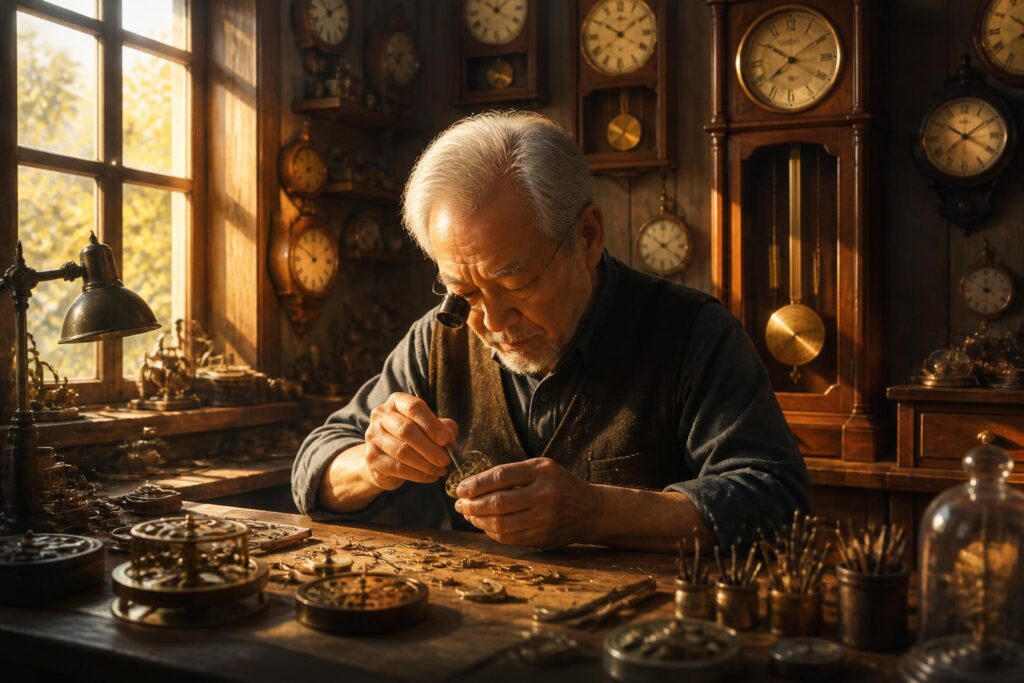
At the end of a small street stood a narrow shop, its faded wooden sign bearing the words: “Watch repairs – battery replacement – cleaning and servicing.” People in the neighborhood knew it as Mr. Lam’s shop. Its door usually opened early in the morning, when the trees were still covered in dew, and closed just as the streetlights came on. For more than forty years, Mr. Lam had bent over all kinds of clocks and watches: wristwatches, pendulum clocks, alarm clocks, and even old timepieces kept only because they had once belonged to a loved one.
His eyesight was gradually failing, but his hands remained astonishingly precise. Just by listening to an uneven ticking sound, he could tell which gear was misaligned. If a watch ran fast, he found a way to slow it down. If one ran slow, he cleaned every speck of dust from its mechanism. Some people said he did not merely repair clocks and watches; he also repaired forgotten days and months.
The Watch That Refused to Run
One late afternoon at the end of the year, while Mr. Lam was removing the back cover of a pocket watch, a young woman walked in. She wore a gray coat and held a small wooden box in her arms. Placing the box on the counter, she said:
“I’d like to ask you to repair this watch. It stopped exactly at eight fifteen.”
Mr. Lam opened the box. Inside was an old wristwatch, its crystal scratched and its leather strap darkened with age. He turned it over and over, examined the hour and minute hands, and then asked:
“How long has it been stopped?”
“Nearly ten years.”
“Then why are you only bringing it in now?”
The young woman was silent for a moment before replying:
“It belonged to my father. He died on the day I left home to go to school. Eight fifteen was when he took me to the bus station. I kept it in the box for all those years and didn’t dare look at it closely. Recently, my mother said that if I still wanted to keep it, I should have it repaired, so I brought it here.”
Mr. Lam asked no further questions. He placed the watch beneath the lamp, removed each tiny component, and arranged them on a white cloth. The mechanism had dried-out oil, and several gears were oxidized. He could repair it, but it would take many days. Before the young woman left, he asked her to come back at the weekend.
The Habits of an Old Repairman
That evening, Mr. Lam took the watch home. The house behind the shop had only a living room, a kitchen, and a bed placed beside the window. His wife had died several years earlier. Their only son worked in another city and could return only a few times a year. Mr. Lam often said he was used to the quiet, but in truth, he had grown used to not waiting for anyone.
On a wooden shelf in the living room stood a large pendulum clock. It had stopped running on the day his wife died. Mr. Lam had never repaired it. When she was alive, she often reminded him to dust the clock and wind it every Saturday evening. After she died, the sound of the pendulum swinging through the house made him feel empty, so he left it standing still.
That night, as he looked at the young woman’s watch, he suddenly remembered a distant morning. His wife had stood by the door, holding a bag of food, and called after him: “Remember to come home early. I’m cooking your favorite dish today.” He had replied that he would be home before dinner. But a customer’s watch had been badly damaged, and he stayed at the shop longer than planned. By the time he got home, the meal had gone cold. His wife did not reproach him; she simply put the food away in the cupboard.
There had been too many instances of “we’ll talk about it tomorrow,” “we’ll go this weekend,” and “I’ll come home early when I have time.” People often think such words merely delay something, but sometimes they quietly take away an entire opportunity.
The Day the City Had No Chimes
The next morning, something strange happened. Every clock and watch in Mr. Lam’s shop stopped. The clocks hanging on the walls, the alarm clock by the window, the digital clock on the desk, even the old clock on his phone no longer displayed the time. Outside, people grew agitated because buses arrived late, shops opened at the wrong time, and children did not know when they were supposed to go into class. No one heard the sound of an alarm or the familiar ticking.
Mr. Lam thought the neighborhood might have lost power, but even the wind-up clocks would not run. He tried repairing them one by one. Their mechanisms were not broken, the batteries still had power, and the springs were still wound, yet the hands would not move.
At noon, the young woman from the previous day returned. She looked at the row of motionless clocks and asked:
“Do you know what’s happening?”
Mr. Lam shook his head.
“Perhaps time has taken the day off,” he said, half joking and half serious.
The young woman smiled, but her expression remained sad. She explained that, because she did not know the time, she had missed an important appointment with her mother. The two of them had planned to meet at the hospital to complete some paperwork together, but she arrived late. Her mother was not angry; she had simply sat waiting on a long bench in the hallway.
Hearing this, Mr. Lam suddenly felt that his words were no longer lighthearted. A day without clocks could make people realize how dependent they were on numbers, but it could also show them that what mattered was not what time the hands pointed to. The regrettable thing was not arriving late once, but allowing necessary meetings to be postponed too many times.
What a Screwdriver Cannot Repair
That afternoon, Mr. Lam finished repairing the young woman’s watch. He replaced a small gear, oiled the mechanism, and cleaned the crystal. When he wound it, the second hand moved one step and then stopped at eight fifteen.
The young woman looked at the watch, her eyes turning red.
“It still doesn’t run, sir.”
Mr. Lam lifted the watch and listened to it. Indeed, the mechanism was working, but the second hand could not pass a certain point on the dial. He took it apart and examined it again. A very small crack in the hand’s shaft was causing it to catch. If he tried to fix it, he could replace the entire shaft, but then part of the watch’s original character would be lost.
“Do you want it to run like new, or do you want to preserve your father’s watch?” he asked.
The young woman thought for a long time.
“I want to keep it as it is. But I also want it to run, so that every time I look at it, I won’t remember only the day my father died.”
Mr. Lam nodded. He replaced a small component without erasing the old marks on the crystal. When the watch began running again, the second hand passed eight fifteen, slowly but steadily.
“You can’t turn time back,” he said. “But you can begin another stretch of time from today.”
The young woman held the watch in her hand. Before leaving, she asked him why the pendulum clock at home had stopped. Mr. Lam was surprised, because he did not remember telling her about it. She pointed to an old photograph on the shelf, showing him and his wife standing in front of the shop.
“I saw the dust on the clock,” she said.
That night, for the first time in many years, Mr. Lam dusted the pendulum clock. He removed the glass, inspected the spring, and put the pendulum back in its proper position. The mechanism was old, and several parts needed replacing, but it was not damaged beyond saving. He worked until almost dawn. When the clock hands began to move, the ticking echoed through the empty house.
Appointments Spoken Aloud
The next morning, the clocks throughout the city all began running again. No one knew why they had stopped, and no one could explain why they started working. People quickly returned to their work schedules, bus trips, and appointments. Only Mr. Lam carried one thing with him from that day: he no longer casually said, “some other time.”
He called his son and said:
“Can you come home this weekend? I’d like to have a meal with you.”
At the other end of the line, his son was silent for a few seconds before asking whether something had happened. Mr. Lam replied that nothing serious had happened; he simply wanted to see his son while they could both still arrange the time.
A few days later, the young woman brought her mother to the shop. The two of them asked Mr. Lam to replace the strap on the old watch. While they waited, they sat on the wooden bench outside and told each other about the things they had missed. The young woman could not meet her father again, but she could still tell her mother the things she had never said before. Her mother could not return the years her daughter had spent away, but she could hold her daughter’s hand that afternoon.
Time is not an object that can be taken apart, cleaned, and put back together exactly as it was. Losses that have happened still leave scratches, like the crystal of an old watch. Even so, a scratch does not necessarily make a keepsake less valuable. It only reminds us that the object has truly traveled through a stretch of life.
What matters is not confusing respect for the past with living forever in a moment that has already passed. We can keep our memories, but we still need to let the hands of the clock move forward. We may regret a missed appointment, but we should still take the initiative to call the person we love while the opportunity is still ahead.
From then on, Mr. Lam’s shop had a small notebook beside the toolbox. Whenever he finished repairing a watch, he wrote down one thing he would do that day: call his son, go home early, visit an old friend, or simply sit and have tea with a neighbor. He did not write down grand plans. He wrote only the things that, if he kept putting them off, might one day become wishes.
In the evening, the sound of the pendulum in his house rang steadily through every room. Outside, the clocks continued measuring the hours and minutes. And Mr. Lam understood that the value of time did not lie in whether it passed quickly or slowly, but in how people used the time they had in their hands. No one can repair yesterday, but each person can still wind up today with a word of concern, a meeting, and a decision not to postpone things any longer.

ARTICLES IN THE SAME CATEGORY
The Clock That Stopped at the Last Station
The Dry Well and the Keeper of the Rainy Season
The Meal with an Empty Chair
The Clock That Stopped at the Small Station
The Unsent Letter and the Art of Closing an Old Season
The Keeper of Seeds by the Front Porch
ARTICLES IN THE SAME GENRE
The Girl and the Wind Chime
The Wind Chime That Kept Promises
The Lamp Beneath the Station Eaves
Little Hedgehog and the Moonlight Garden
The Seedling Who Knew How to Listen and the Forest That Awoke
Brown Squirrel’s Raincoat