

 Tiếng Việt
 日本語
 한국어
 中文 (中国)
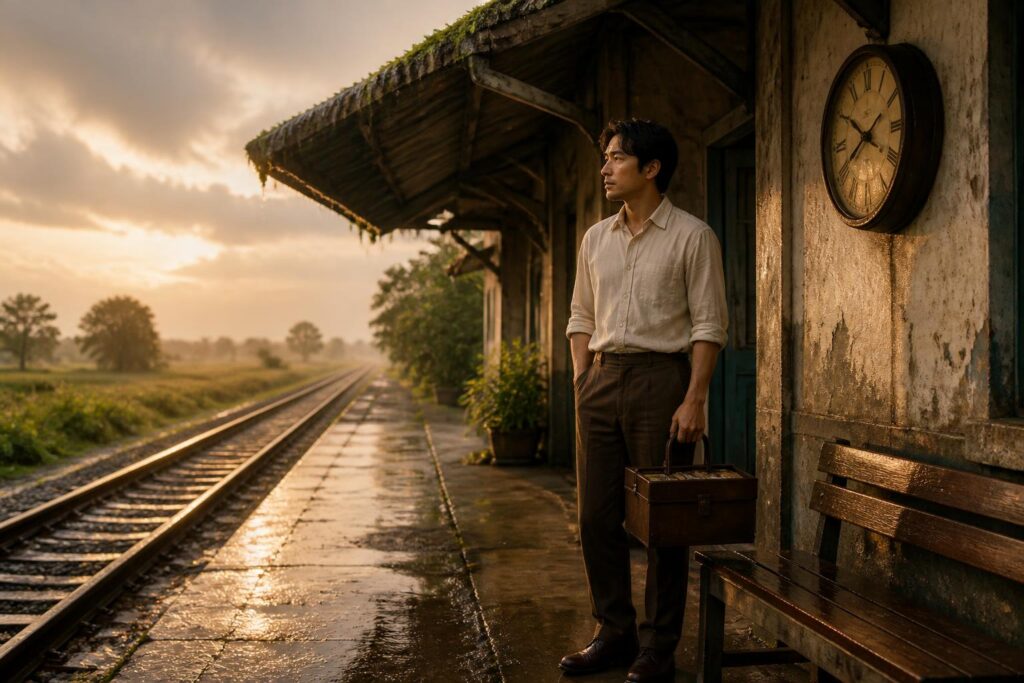
At the edge of the town stood a small train station that had almost been forgotten. Moss covered its tiled roof, the wooden bench outside had faded under the sun and rain, and the timetable hung crooked on a wall full of cracks. Trains still passed by from time to time, but they rarely stopped. The local people were used to calling it the last station, even though the tracks continued for many more miles toward the distant fields.
Minh had passed through the station many times during his youth. Back then, he always thought he would leave the town on some train, bound for a city large enough that no one would know him as the son of the poor clock repairman on Market Street. He did not hate his father, nor did he hate the place where he was born. It was just that, at twenty, people often mistakenly believe that a meaningful life must begin somewhere else.
Then Minh really did leave. He went to the city to study, stayed to work, started a family, and gradually grew accustomed to days filled with meetings, messages, bills, and appointments postponed until the following week. The old town receded behind him like a photograph tucked away in a drawer. Whenever his mother called, he always said he would come home at the earliest opportunity. Whenever his father sent a few brief lines, he would usually read them hurriedly and promise himself that he would call back that evening.
The Clock That No Longer Ran
One morning at the end of the rainy season, Minh received word that his father had died. There had been no major incident, no warning. He had simply gone to sleep after dinner and never woken up. His mother said he had passed peacefully, like someone who had finished his work and did not want to trouble anyone.
Minh drove back to the town that very day. The old road still passed through rows of low trees, the iron bridge, and the patch of land where children used to fly kites. When the car went by the last station, he instinctively slowed down. Through the window, Minh saw the round clock hanging beneath the station roof. It had stopped at some point, the minute hand tilted over the number six and the hour hand pointing near four.
He could not remember when the clock had first appeared. Perhaps it had been there before he left; perhaps his father had once repaired it and left it at the station. When he was little, Minh often sat on the wooden bench waiting for his father to finish at the market. The man always carried a small toolbox containing tweezers, screwdrivers, machine oil, and gears so tiny that one careless movement could make them disappear beneath the table. His father spoke little. He could sit for hours in front of a broken clock, patiently cleaning each part before putting it back in its proper place.
Minh had once asked why his father did not simply buy a new clock. His father smiled and replied that some things were not completely broken; they only needed to be listened to a little more carefully.
Many years later, those words returned to Minh’s memory, but they did not make him feel any lighter. He realized that he had not listened to his father for long enough.
The Things in the Drawer
After the funeral, Minh’s mother gave him a wooden box. It was small, with a chipped corner and a long scratch across the lid. Inside were no important documents or money. They were the trivial things that busy people usually consider unworthy of keeping: an old train ticket, a blue button, a photograph of Minh as a child, a wooden spinning top, and a wristwatch that had stopped running.
Minh recognized the watch immediately. It was the gift he had bought for his father before leaving the town. At the time, he had just received a job in the city and believed his father would be happy that his son had stepped into a brighter future. The watch was not expensive; its leather strap was stiff and there was a small scratch on the glass. His father wore it for a few days, then put it away.
“You don’t like it?” Minh had once asked.
“Of course I do. But I’m afraid of scratching it further.”
At the time, Minh only thought his father was trying not to hurt his feelings. He did not know that the watch repairman was accustomed to taking care of small things, even when they were no longer new. Perhaps his father saw in the gift not the value of the watch, but the moment when his son stood at the door and said he would work hard so that one day he could bring his parents to the city.
That promise was never fulfilled.
At the bottom of the box was a sheet of paper folded into quarters. His father’s handwriting was shakier than usual: “If Minh comes home, tell him to stop by the station. There’s something I’ve left there for him.”
His mother followed her son’s gaze and said that she had meant to give him the note long ago but had kept hesitating. She did not know what his father wanted to leave behind. In the weeks before his death, he often walked to the station in the afternoon. Some days he sat beneath the roof for a very long time; on others, he brought his toolbox and an old cloth.
Minh held the note, his heart heavy as though he were holding a question he had never had the chance to ask.
The Station Keeper and the Forgotten Story
The last station was just over a ten-minute walk from the old house. That afternoon, Minh followed the road along the canal. The rain had just stopped, and puddles reflected gray clouds and low rooftops. Uncle Tu, the station keeper, was still sitting at the table near the door. He was older than Minh remembered, but his voice remained strong and clear.
“You’re Mr. Hoa’s son, aren’t you?”
Minh nodded.
Uncle Tu did not ask anything more about the funeral. He simply poured a cup of tea, then opened a drawer and took out a brown cloth bag.
“Your father left it here. He said to give it to you when you came home.”
Inside the bag was a thin notebook. The first pages listed names, dates, and a few brief lines. Minh read slowly and realized that they were the names of people who had once asked his father to repair their clocks. Some had moved away, some were no longer alive, and some were identified only by nicknames. Beside each name was the condition of the clock and the date it was to be collected.
But the further Minh read, the more he realized that the notebook was not merely a repair ledger. On the final pages, his father had begun writing about other people. An old woman living alone needed someone to buy her medicine. The boy next door had to stop attending school because his family could not afford books. The ticket seller had a backache and needed someone to cover his shift. These were not great deeds, not enough to be called achievements. His father had written only a few words, as though afraid he might forget something that needed to be done.
The final page had no name on it. There was only one sentence: “A clock starts running again when people still want to wait for one another.”
Minh sat silently for a very long time. Uncle Tu told him that many years earlier, the clock beneath the station roof had broken. Minh’s father had managed to repair it but had not replaced its mechanism. He said the clock should remain stopped at a particular time, to remind those passing by that some trains could not wait forever.
“Your father used to come here around four o’clock,” Uncle Tu said. “Once I asked him whom he was waiting for. He said he wasn’t waiting for anyone, just sitting for a while to get used to waiting.”
Minh lowered his eyes to his hands. Those fingers were accustomed to keyboards, steering wheels, and phone screens, but they were clumsy before the old watch in his pocket. He understood that his father had waited for him in a very quiet way. Without blame or urging calls, he had simply kept an empty place in his day, as though believing that some train might still bring his son home.
The Last Station Is Not the End
In the days that followed, Minh stayed in town longer than he had planned. He and his mother cleaned the house and organized the clock repair shop. Some mornings, he opened the shop even though he did not yet know what he would do. People from the neighborhood brought in old clocks, not because they believed Minh could repair them, but because they wanted to tell him about his father.
A woman brought a wall clock that had been running slowly. She said Minh’s father had repaired it for free for her family during their most difficult year. An old man brought a pocket watch, saying he had found it in a cabinet and simply wanted to know whether it could still be saved. A boy stood outside the door, curiously watching the tiny gears on the table.
Minh began relearning his father’s work from the simplest things. He wiped away dust, sorted the tools, opened the mechanisms, and observed patiently. Some clocks could be repaired; others could not. With the ones that could not run again, he no longer hurried to throw them away. He set them aside, wrote down their owners’ names, and said he would try to find another way.
On Saturday afternoon, Minh took the toolbox to the station. He removed the round clock, opened its back, and discovered that the mechanism inside was not as broken as he had thought. A small wire had slipped away from a gear. Once he put it back in the right place, cleaned off the old oil, and wound the clock, its hands began to move little by little.
Uncle Tu stood beside him without saying anything. Minh said nothing either. The two of them listened to the ticking beneath the station roof. The sound was very faint, but it was enough to change the old space. It did not make time turn backward, nor did it bring his father back. Yet it opened a new rhythm, slower and clearer.
The clock had stopped near four o’clock, but Minh did not reset it. He kept it at that time. Not to live forever in regret, but to remember that someone had once devoted his afternoons to waiting, to things no one took credit for, and to the belief that people could find their way back.
What Remains After a Return
A few months later, Minh decided not to sell the house. He continued working in the city, but returned to town every weekend. The clock repair shop opened on those days. His mother planted a few more pots of flowers in front of the porch. Uncle Tu occasionally stopped by for tea and told old stories that had been told many times but had never truly grown old.
Minh also began calling the people he had once promised to call. Some conversations lasted a long time; others lasted only a few minutes. He learned not to listen while looking at another screen. He realized that sometimes being present required neither advice nor clever answers. Often, all the other person needed was to know that they had not been left alone.
In life, everyone has missed a train. It may be an opportunity that has passed, an apology spoken too late, a meeting postponed, or a loved one who no longer has enough time to wait. Not every train comes back. But that does not mean every door has already closed.
We can still begin with something small: returning to visit someone, listening to a story, repairing an old object, replying to a forgotten message, or sitting quietly beside someone without hurriedly looking at the clock. Time does not give us the chance to relive yesterday, but it always leaves room for today’s kindness.
Whenever he left town on Monday morning, Minh stopped by the last station. The clock beneath the roof continued to run, its hands slowly passing the position near four o’clock. He no longer saw it as a sign of something lost. To him, its ticking sounded like a simple reminder that the tracks ahead might lead to many places, but a person only truly knows where they are going when they do not forget the place where someone once stood waiting.

ARTICLES IN THE SAME CATEGORY
The Watch Repairman and the Day Without Chimes
The Dry Well and the Keeper of the Rainy Season
The Meal with an Empty Chair
The Clock That Stopped at the Small Station
The Unsent Letter and the Art of Closing an Old Season
The Keeper of Seeds by the Front Porch
ARTICLES IN THE SAME GENRE
The Girl and the Wind Chime
The Wind Chime That Kept Promises
The Lamp Beneath the Station Eaves
Little Hedgehog and the Moonlight Garden
The Seedling Who Knew How to Listen and the Forest That Awoke
Brown Squirrel’s Raincoat