

 Tiếng Việt
 日本語
 한국어
 中文 (中国)
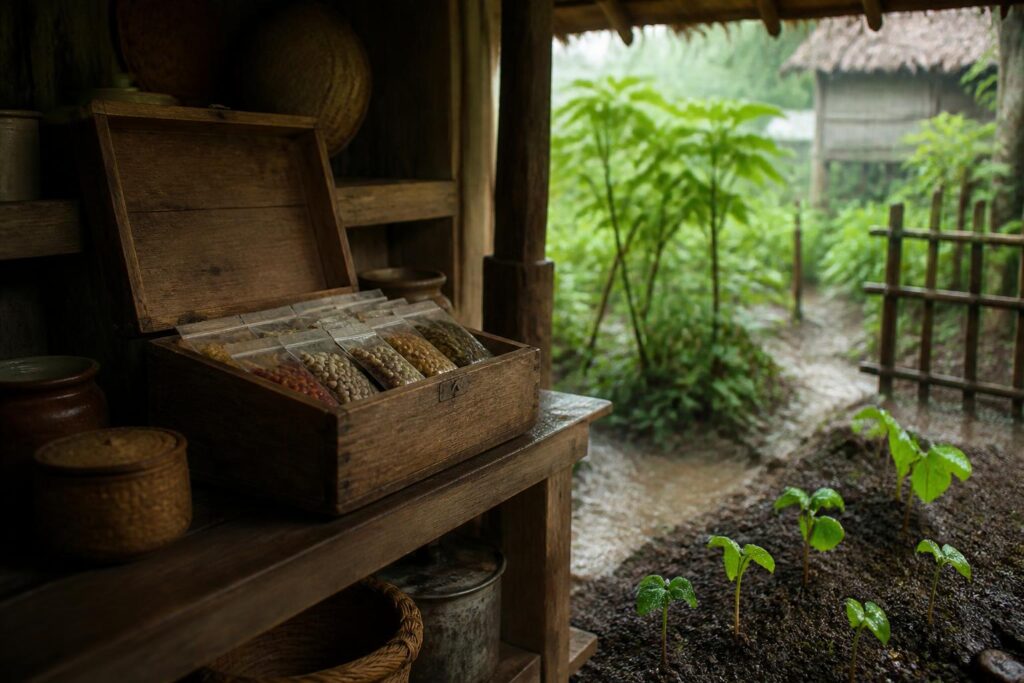
At the end of the dirt road leading into Moc Van Village stood a low-tiled-roof house, with two old star-fruit trees planted in front. The house was not large, nor did it contain anything valuable except a wooden box placed on a high shelf in the kitchen. The box had darkened over the years, its lid was slightly warped, and its four corners had been polished smooth by the touch of many hands. The villagers called it the box that held the rainy season.
No one knew when that name had first appeared. All they knew was that the person keeping the box was Mrs. Lanh, a woman in her sixties who lived alone after her husband passed away. Every year, after the harvest, she carefully selected the best seeds, dried them in the shade, and stored them in small paper bags. Bean seeds, squash seeds, corn seeds, melon seeds, and even vegetable varieties that seemed unremarkable were all remembered by sight, because she could barely read.
“Seeds are not merely something to sow in the ground,” she often said when someone asked why she went to so much trouble. “They also preserve the promise of a season to come.”
The Dry Season Comes Early
That year, the dry season arrived earlier than everyone had expected. The late-season rains grew less frequent and then disappeared. The canal running across the fields was reduced to a strip of cracked mud. In the mornings, the adults went out to the fields with heavy expressions, while the children were forbidden to run near the village well because the water level had fallen too low.
The first corn crop failed. The plants curled up as soon as they began to sprout leaves. The bean field on the other side of the bamboo hedge could not retain its green color either. Many families began selling some of their chickens and ducks to buy rice. Some impatiently dug new wells, while others left the village to look for work in town. Every day, the tea stall by the communal house filled with sighs.
In those circumstances, Mr. Tu Nghiem, the village head, proposed that every household contribute whatever food supplies remained so they could be distributed according to need. Many people supported the idea at first, but only a few days later, arguments began to arise. Families with more members believed they should receive more. Families that had contributed more rice felt it was unfair to divide everything equally. Words that had once been capable only of hurting people’s feelings suddenly became as sharp as dry cogon grass.
Mrs. Lanh did not take part in the quarrels. Every afternoon, she still sat beside the veranda, taking seeds one by one out of the little bags. No one understood what she could still do when the land was dry and the water had run out.
A Gift No One Could See
One evening, little Sen, the daughter of a neighbor, came to Mrs. Lanh’s house to ask for water. The girl was only nine years old, but her face had already grown old from the days of hunger. Mrs. Lanh poured her half a bowl of water, then took a small yellow bag of seeds from the wooden box.
“I’ll give you this.”
Sen looked at the bag of seeds and asked in confusion, “What is it for? Even if we plant them now, they won’t grow.”
Mrs. Lanh did not answer right away. She led the girl behind the house, where a small patch of land was still covered with several palm leaves. There, she had dug a shallow furrow, lined the bottom with a layer of old straw, and saved a little water from the earthen jar.
“We don’t always sow seeds so we can have vegetables right away,” she said. “Sometimes we sow them so that other people know we haven’t given up yet.”
The two of them planted the first bean seeds that evening. The next morning, Sen came back. Then she returned again the following afternoon. On the fifth day, a small green sprout pushed up through the soil. It was so slender that a strong gust of wind could have made it sway, yet it still stood there, carrying a rare touch of green amid the dry land.
Sen told her mother about it. Her mother retold the story to the neighbors. A few days later, the village children gathered in front of the tiled-roof house to see the bean sprout. At first, the adults only stood outside the gate, but then they came in as well. No one said much. They looked at the plant as if they were looking at something they had long thought was lost.
The Box Is Opened
Before long, a rumor spread throughout the village that Mrs. Lanh still had many seeds stored in the wooden box. Some people came to ask for them. She did not refuse, but neither did she distribute everything at once. She brought out bags of seeds suited to each plot of land, told everyone to sow them in shaded places, cover the soil with straw, and water only in the early morning or late afternoon.
Some people followed her instructions. Others thought the method was too slow and could not save their families in the days immediately ahead. A man named Phuc even said bluntly that Mrs. Lanh was hoarding seeds to make herself seem important.
She merely remained silent. The next morning, she took some of the little rice left in her house to Phuc and his wife, because their young child had a fever. She did not mention what he had said the day before. That made Phuc feel more ashamed than any reproach could have.
Gradually, the villagers began following the simple instructions Mrs. Lanh had given them. Families with jars collected rice-rinsing water to water the plants. Families that still had straw brought it out to cover the beds. Those with more labor helped dig a channel to carry water from the dry stream to the low-lying land. No one had enough ability to save the entire field, but every family could preserve a small patch of land.
Mr. Tu Nghiem also changed the way food was distributed. Instead of simply handing out rice according to the number of people in each household, he and the villagers made a list of families with elderly people, young children, and the sick, giving them priority. Households that still had the strength to work received only enough for their needs and took part in repairing the canal, tending the vegetable beds, and helping transport water. The new arrangement did not make everyone completely satisfied, but the shared work made the arguments less bitter.
What Grows in the Shade
After more than a month, the small gardens began to show patches of green. There were not many vegetables, and the fruit was not yet large enough to call it a harvest. Even so, a few handfuls of water spinach, several young squash, and the bean beds gave families additional food. More importantly, people were no longer sitting helplessly and waiting.
Little Sen named the plot behind Mrs. Lanh’s house the Waiting-for-Rain Garden. Every afternoon, the children took turns gathering dry leaves, chasing chickens away from the vegetable beds, and carrying small scoops of water to the plants. They learned to recognize which sprouts needed sunlight and which needed to be covered. These tasks kept them busy, but not with the kind of busyness born of fear. They began talking about the next season, about how large the squashes would grow, and about planting more flowers along the fence.
Then one noon, dark clouds appeared over the mountain range. At first, they were only a thin gray streak; then they thickened, spread, and covered the sun. The villagers abandoned their work and stood in their yards, looking up at the sky. When the first drop of water fell onto the tiled roof of Mrs. Lanh’s house, no one cheered. They simply stood still, listening as the rain gradually covered the roof, the road, and the cracked fields.
The rain continued throughout the night. The next morning, water was flowing through the canal. The soil softened beneath their feet. The small plant beds had been bent but remained intact. People began planning to sow a new crop, and this time no one waited for a single person to decide. Those who had seeds contributed seeds. Those who had buffalo contributed their strength to plow. Those with experience explained how to retain water. The children were assigned to pull weeds and care for the first sprouts.
The Promise of the Seeds
A few months later, Moc Van Village had a harvest that was not especially abundant but was enough that no family had to leave because of hunger. Nearly all the seeds in the wooden box had been distributed. Mrs. Lanh kept only one small bag, containing the first golden bean seeds Sen had planted.
Mr. Tu Nghiem proposed that the entire village make a communal cabinet for storing seeds. After each harvest, every household would set aside some of its best seeds, remember their source, and pass them on to anyone in need. Mrs. Lanh was invited to oversee it, but she refused to accept that it was her responsibility alone.
“This box does not belong to me,” she said. “It has only passed through my hands for a while. Seeds must be kept by many people, because a rainy season never falls on just one roof.”
From then on, the seed cabinet was placed in the communal house beside the village hall. Every year, the villagers added new bags of seeds to it. Sometimes, when the harvest was good, the cabinet grew full. Sometimes, when pests or the weather caused a poor harvest, people took seeds out to use and then found ways to replenish them in the following season. No one called it a reserve of wealth anymore. They called it a portion of memory set aside for a day that had not yet come.
The story of the wooden box does not teach people that if they only have hope, every difficulty will disappear on its own. The dry season may return. The land may still disappoint those who work it. A small gift cannot replace labor, organization, or fair decisions. But the story reminds us that in times of hardship, the thing most easily lost is not always food or drinking water. It is also the ability to look ahead.
A seed resting in the palm of a hand seems almost insignificant. It does not immediately ease hunger, provide shade, or guarantee that it will sprout. Yet when it is given at the right moment, it can help someone remember that today is not yet the final day. When many people sow, tend, and share together, a barren plot of land can gradually become the place where a new season begins.
And sometimes, what a community needs most is not someone to step forward and save everyone, but someone brave enough to open their small box so that everyone can see that a promise still remains inside.

ARTICLES IN THE SAME CATEGORY
The Ferry Landing Behind the Bamboo Grove and the Keeper of Promises
The Watch Repairman and the Day Without Chimes
The Clock That Stopped at the Last Station
The Dry Well and the Keeper of the Rainy Season
The Meal with an Empty Chair
The Clock That Stopped at the Small Station
ARTICLES IN THE SAME GENRE
Stepmother and Stepchild