

 Tiếng Việt
 日本語
 한국어
 中文 (中国)
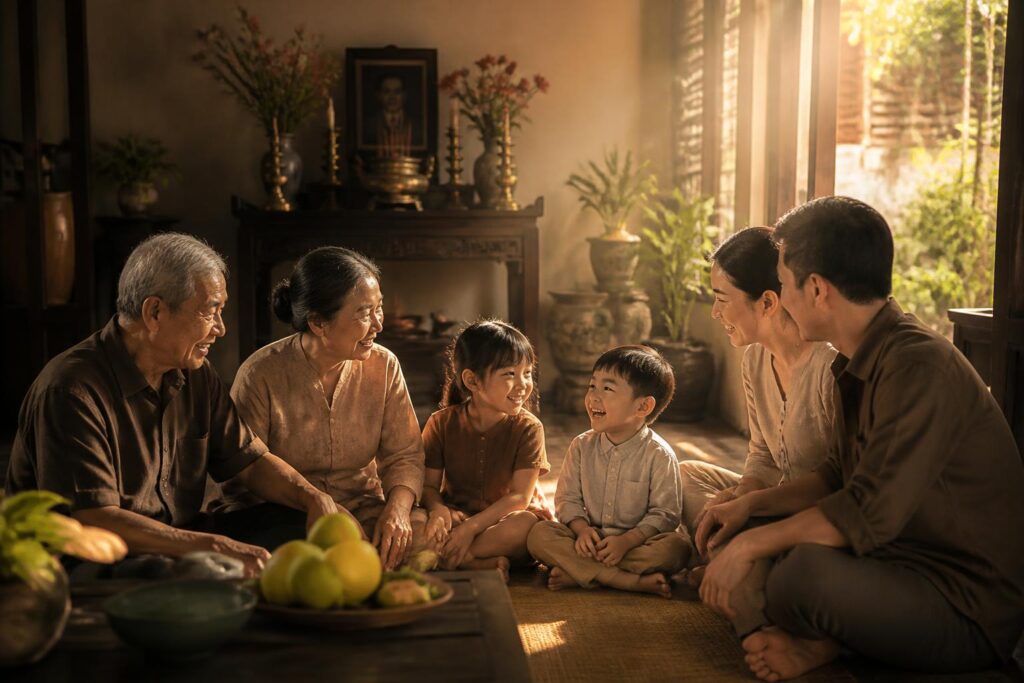
In a Tử Vi chart, there are palaces that are often mentioned when people want to learn about work, money, or relationships. The Phúc Đức Palace is less conspicuous, but it often raises very fundamental questions: Why do some people pass through upheavals while still remaining steady? Why, when faced with the same opportunity, does each person respond differently? What helps a family maintain its bonds across generations, even when circumstances are not always favorable?
From a traditional perspective, the Phúc Đức Palace is associated with blessings, family traditions, spiritual life, and profound influences from one’s lineage. However, it should not be understood as a fixed label used to conclude that someone is “blessed” or “lacking blessings.” The value of exploring the Phúc Đức Palace lies in its ability to open up reflection on how a person receives circumstances, nurtures inner strength, and transforms family influences into conscious choices in the present.
How is the Phúc Đức Palace commonly understood?
In common interpretations, the Phúc Đức Palace is seen as the area reflecting spiritual life, beliefs, peace of mind, and one’s connection with family traditions. This palace is also often considered alongside the story of a lineage’s blessings, the values passed down, and the ability to receive invisible support from one’s family foundation.
Concepts such as “blessings” and “virtue” can easily be understood in a mystical way or as being entirely dependent on luck. In reality, they can be interpreted more broadly. A family that values kindness, keeps its word, knows how to care for the elderly, and educates children often creates an environment that gives its members emotional support. Repeated over time, such behaviors become a way of life. That way of life, in turn, influences how later generations behave, choose life partners, work, and face adversity.
Therefore, when examining the Phúc Đức Palace, what matters is not finding an absolute answer about the future. More noteworthy is recognizing the emotional resources one already has, the family habits that are supporting one, and the patterns that need to change.
Phúc Đức is not merely about what one inherits
When many people hear the words Phúc Đức, they first think of advantages that have been inherited. This understanding reflects only part of the picture. If viewed practically, blessings do not exist only in property, status, or assistance from relatives. They may also take the form of the ability to remain calm, admit mistakes, having someone trustworthy to confide in, growing up in an environment that encourages learning, or having enough quiet time to think before acting.
A person with a stable family foundation may find it easier to develop their abilities, but that does not mean they will always avoid difficulties. Conversely, someone who has experienced deprivation may still develop valuable resilience, compassion, and self-reliance. The Phúc Đức Palace should therefore be viewed as a multidimensional foundation, not as a ranking of who is better or worse than anyone else.
Even when a family has conflicts, each individual can begin a new cycle by identifying the problem and choosing to respond differently. Not everything passed down from previous generations needs to be preserved unchanged. A household that once valued silence can gradually learn to engage in dialogue. A family that often avoided talking about emotions can begin with short, sincere, nonjudgmental conversations.
Reading the Phúc Đức Palace through spiritual life
One useful approach is to observe one’s relationship with peace of mind. When there are no external achievements to rely on, what do we turn to? Can we rest without feeling guilty? Do we know how to distinguish between our own desires and our family’s expectations? Do we usually respond with anxiety, control, avoidance, or calm efforts to find a solution?
These questions do not replace interpreting a chart according to Tử Vi methods, but they help bring the content of the Phúc Đức Palace closer to everyday life. A chart may suggest tendencies, while how those tendencies manifest depends on each person’s environment, experiences, and maturity.
Spiritual life does not necessarily mean religion or ritual. For one person, it may be spiritual faith. For another, it may be reading, spending time in nature, caring for family, doing useful work, or maintaining a clear life principle. What matters is whether a person has a value system that keeps them from being completely swept away by upheaval.
The influence of family and lineage
Families often pass down more than what is said aloud. The way adults resolve conflicts, their attitudes toward money, their ideas about success, how they care for vulnerable people, and their habit of keeping promises can all become silent lessons for children. These influences are not always positive, but recognizing them is the first step toward living more proactively.
For example, someone raised in a family that always emphasized sacrifice may easily place their own needs last. Someone who witnessed financial instability may develop an excessive fear of risk, even when a new opportunity suits their abilities. Others may carry the belief that they must succeed to deserve love. When we view these reactions through the lens of the Phúc Đức Palace, we can see that they are not merely personal traits but also traces of family history.
Recognizing these influences does not mean blaming one’s parents or denying one’s roots. Maturity means appreciating the good things one has received while also being sufficiently clear-minded not to repeat harmful ways of behaving. This is how a person continues to cultivate their own blessings through concrete actions.
Ways to cultivate Phúc Đức in present-day life
If the Phúc Đức Palace is viewed as a reminder of one’s spiritual foundation, cultivation does not need to begin with anything too grand. A family can create blessings by maintaining respect in communication, caring for loved ones when needed, and not turning affection into a tool for controlling one another. An individual can cultivate blessings by living honestly, working responsibly, knowing how to express gratitude, and not remaining indifferent to the difficulties of others.
What matters is that kindness must be accompanied by boundaries. Phúc Đức does not mean having to sacrifice unconditionally, take on everyone else’s problems, or accept insults in order to preserve an outward appearance of harmony. Sustainable kindness requires clear-mindedness. Knowing when to say no, protecting one’s mental health, and asking for fairness are also ways to preserve one’s own value and the value of a relationship.
Small habits such as taking time to listen to family members, acknowledging one another’s efforts, correcting one’s words when angry, fulfilling promises, and sharing household chores can create noticeable changes in the family atmosphere. For people who live alone, building a healthy network of friends, taking care of their living space, and maintaining a stable routine are also ways to create a foundation of peace.
The Phúc Đức Palace should not be used to judge fate
A common mistake when exploring Tử Vi is to treat a sign as a final conclusion. If one merely hears that the Phúc Đức Palace is favorable or unfavorable and then becomes complacent, fearful, or dependent on predictions, it is easy to overlook the role of personal choice. Tử Vi can provide a symbolic language for reflection, but it should not become a reason to abandon responsibility.
Nor should the Phúc Đức Palace be used to judge a family, assess the morality of those who have passed away, or attribute every present difficulty to the “karma” of one’s lineage. Such harsh conclusions are both difficult to verify and capable of creating additional shame and conflict. A cautious approach is to regard the chart as a tool for self-observation, combined with an understanding of actual circumstances, psychology, and the relationships currently unfolding.
In serious matters such as domestic violence, mental-health crises, or financial instability, support from trusted people and professional services is always more important than any prediction. Personal beliefs may give people additional hope, but they should not replace actions to ensure safety and seek appropriate help.
Phúc Đức is an ongoing process
The Phúc Đức Palace reminds us that people are shaped not only by what they possess but also by how they receive and pass on values. We may not choose the family into which we are born, but we can choose how to engage with the past. We may not be able to change every event, but we can train ourselves in how to respond to those events. Every kind action, every promise kept, and every conversation held with sincerity contributes to creating a new foundation.
Seen this way, blessings are not a gift that comes only from outside. Blessings also mean having the ability to live without unconsciously harming others, knowing when to seek help, and not losing oneself in expectations passed down through generations. Virtue is not a perfect image in the eyes of everyone else, but consistency between what we believe and how we act in our everyday choices.
Understanding the Phúc Đức Palace is therefore not about seeking an assurance that life will always be peaceful. Its more practical meaning is to help each person recognize the foundation on which they stand, what needs healing, and what they wish to leave for those who come after them. By learning to cultivate blessings through familiar, everyday actions, we not only strengthen our own spiritual lives but also help create a warm, mindful household capable of offering support through many seasons of upheaval.

ARTICLES IN THE SAME CATEGORY
The Phúc Đức Palace in Tử Vi: Spiritual Foundations and Understanding One’s Blessings
The Career Palace in a Tử Vi Chart: Career Direction and How to Build Your Position
The Career Palace in a Tử Vi Chart: Career Direction and How to Develop One’s Abilities
The Wealth Palace in a Tử Vi Chart: A Perspective on Money, Habits, and Management Skills
The Phúc Đức Palace in a Tử Vi Chart: Family Foundations and Mental Resilience
The Quan Loc Palace in a Tử Vi Chart: Understanding Career Through Ability, Choices, and Actions
ARTICLES IN THE SAME GENRE
The Bystander Effect: Why Do We Hesitate Before Helping Someone in Need?
The Default Choices Quietly Shaping Our Lives
Familiarity Is Not Always the Truth
Memory Is Not a Video Camera: Understanding It Clearly to Look Back at Ourselves
When Belief Guides the Way We See the World
Knowing When to Ask: A Skill That Opens the Door to Deeper Conversations