

 Tiếng Việt
 日本語
 한국어
 中文 (中国)
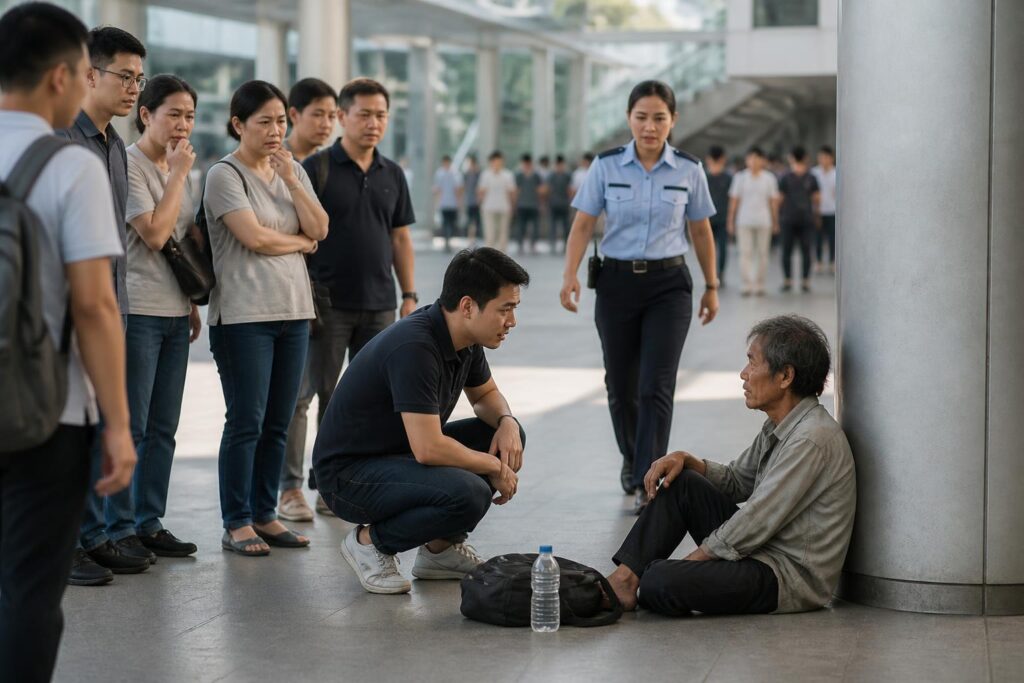
In everyday life, there are moments that last only a short time but put people before an important choice. An older person stumbles on the sidewalk, a passenger appears unwell, someone drops their belongings in a crowded place, or a person suddenly needs directions. Many people see what is happening, but there is not always someone who steps forward first. Each person may think that someone else will handle it, that the situation is not yet serious, or that intervening could make things more complicated.
This phenomenon is often called the bystander effect. It is not evidence that people are inherently uncaring. Much of the hesitation arises from a fairly natural chain of psychological reactions: we observe others to determine how serious the situation is, consider our own responsibility, and worry about the possibility of taking the wrong action. By understanding this mechanism, each person can recognize their own hesitation sooner while also learning how to make a clear and safe request for help.
When Many People Witness an Incident, Responsibility Is Easily Divided
In a situation involving only two people, the witness often feels that they are the only person capable of responding. But in a crowded place, responsibility seems to be spread among everyone present. No one is specifically assigned, so everyone may unconsciously wait for someone else to act first. That waiting may last only a few seconds, but in situations requiring assistance, a few seconds can allow a favorable opportunity to intervene to pass.
This feeling becomes even stronger when everyone remains silent. One person looks to the side and sees that the others are still standing still, and may conclude that the situation is not serious enough to worry about, or that someone else must already be handling it. The person next to them observes in the same way. Thus, a cycle forms: each person uses the silence of others as a signal to continue doing nothing.
What is noteworthy is that a crowd does not automatically create a spirit of mutual assistance. A crowd can provide many resources, but it can also make individual responsibility ambiguous. If no one clearly says what needs to be done, each person is more likely to remain an observer rather than become a participant in solving the problem.
Three Common Layers of Hesitation
Difficulty Determining Whether the Situation Is Truly Serious
Not every situation is immediately clear. A person sitting motionless may be tired, waiting for a friend, or experiencing a health problem. A loud cry could be a serious argument, but it could also be a mere misunderstanding. When information is incomplete, people often look at the reactions of those around them for an explanation. If everyone appears calm, the situation is likely to be judged as less serious than it really is.
This is why a simple question such as “Do you need help?” is more valuable than merely standing and watching. The question does not hastily assume that the other person is in danger, but opens an opportunity to check the situation respectfully. It turns a vague guess into a specific exchange.
Fear of Intervening Incorrectly
Many people do not act because they are afraid of doing the wrong thing. They worry that they have misunderstood the situation, might embarrass the other person, be seen as nosy, or unintentionally make things more tense. This concern can easily arise in public places, where one person’s actions may attract the attention of many others.
However, helping does not necessarily mean solving the entire problem oneself. In many cases, the appropriate action is simply to check on the person, create a safe space, find a staff member in charge, call someone with relevant expertise, or notify the appropriate authorities. Knowing one’s limits is part of being responsible, not a reason to do nothing.
Assuming Someone Else Is Already Taking Care of It
This is the most common form of thinking in a crowd. One person may think that a store employee has noticed, that the person accompanying the victim is handling it, or that someone must certainly have called for help. But if everyone makes that assumption, eventually no one may actually take action.
The way to break the ambiguity is to move from general thoughts to specific assignments. Instead of saying, “Has anyone called for help?”, a person can address one individual directly: “You in the blue shirt, could you call a staff member to help me?” When responsibility is given to a specific person, that person is generally more likely to respond clearly, while everyone else also knows what they can do next.
Intervening Is Not Always Beneficial: Helping Requires Awareness
Encouraging action does not mean promoting rashness. Before entering an unusual situation, it is necessary to observe risks that could affect oneself and others. If there are signs of violence, dangerous traffic, fire, sharp objects, or an uncontrolled threat, rushing in alone may increase the number of people in danger.
In such cases, a responsible choice may be to keep one’s distance, warn people nearby, find someone with authority, and provide accurate information. A call for help that clearly describes the location, the condition observed, and the existing dangers is often more useful than an impulsive action. If the person in distress is still conscious, ask what they need instead of touching or moving them without permission, unless an immediate danger requires taking them out of the area.
Support should also respect the dignity of the person being helped. Do not film or photograph them, or turn their difficulties into content to share. Do not pressure them to tell their story in front of a crowd if they do not want to. A calm inquiry, some privacy, and a connection to the right person who can provide assistance may sometimes be more practical than attention-grabbing gestures.
How to Turn Witnessing into Concrete Action
To move beyond simply standing and watching, we do not need to become heroes in every situation. What is more useful is to prepare a few simple principles to use when something unexpected happens.
First, name what you are seeing in neutral language. For example: “You don’t seem to be feeling well. Do you need help?” or “This situation seems dangerous. We should find someone in charge.” Saying it out loud helps you stop going around in circles with speculation and also helps those around you recognize that the situation requires attention.
Next, choose a task within your capabilities. One person can find a staff member, another can clear a path, and someone else can stay and check on the person. If you do not know what to do, say so clearly and find someone with relevant expertise. No one needs to know all the answers in order to begin helping.
Finally, check back after the first action. Is the person being helped now accompanied by someone? Has the responsible staff member arrived? Is the area still dangerous? Concern should not end with a gesture that makes us feel we have done enough. At the same time, it is also important to know when to hand the matter over to those responsible in order to avoid over-intervening.
From Personal Responsibility to a Culture of Mutual Assistance
The bystander effect is not only an issue for individuals. It is also related to how a community designs its spaces and develops its habits of conduct. In public places, clear signs, easily identifiable staff, transparent assistance procedures, and education in safety skills all help reduce confusion when an incident occurs. In families, schools, and workplaces, encouraging people to speak up when they notice something unusual also creates an environment where taking action is seen as normal rather than as meddling in someone else’s affairs.
Each person can also contribute by responding positively when someone takes the initiative to help. A word of thanks, a cooperative attitude, or sharing necessary information reinforces the feeling that helping one another is reliable and worthwhile. Conversely, ridiculing someone who intervenes or immediately attributing bad motives to them may make others even more afraid to act the next time.
What matters is distinguishing caution from indifference. Caution asks questions, assesses risks, and seeks the right source of assistance. Indifference sees a problem but tries to convince itself that it is not their concern. The boundary between these two states can sometimes be very thin, and it is often determined by a small action: checking on someone, reporting what happened, calling for help, or staying until the situation has been taken over.
Taking Initiative with Awareness
In a crowd, no one wants to be the person who overreacts, but no one wants to realize that they stayed silent when they could have done something either. Understanding the bystander effect helps us view hesitation with greater compassion, while also preventing us from using it as a permanent excuse.
Responsible action does not require extraordinary courage. Sometimes it is simply a well-timed question, a clear call to the right person, or the decision not to walk away when someone else needs to be connected with support. When each individual is willing to accept the share of responsibility they can reasonably handle, a crowd is no longer merely a group of people standing and watching. It can become a support network that knows how to observe, understands its limits, and knows when to act.

ARTICLES IN THE SAME CATEGORY
Kindness Has Limits: Helping Others Without Losing Yourself
The Pause Before Reacting: How to Regain the Power to Choose in Tense Moments
Disagreement Is Not Confrontation: How to Speak Differently While Maintaining Respect
When the Mind Is Fragmented: Why Being Busy Does Not Mean Being Effective
The Default Choices Quietly Shaping Our Lives
Familiarity Is Not Always the Truth
ARTICLES IN THE SAME GENRE
The Default Choices Quietly Shaping Our Lives
Familiarity Is Not Always the Truth
Memory Is Not a Video Camera: Understanding It Clearly to Look Back at Ourselves
When Belief Guides the Way We See the World
Knowing When to Ask: A Skill That Opens the Door to Deeper Conversations
Being Busy Doesn’t Mean Making Progress: Rethinking How We Use Our Time