

 Tiếng Việt
 日本語
日本語 한국어
한국어 中文 (中国)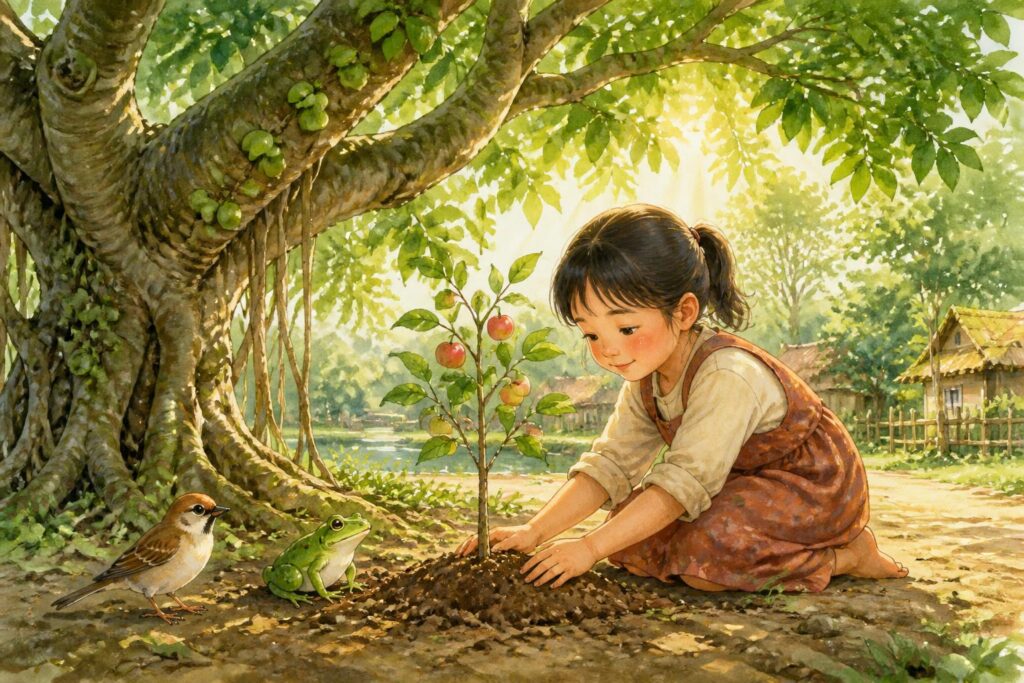
At the edge of White Cloud Village stood an old fig tree, its trunk so large that three children holding hands could barely circle it. The fig tree’s canopy spread wide like a green umbrella, providing shade for the children to play beneath in summer and dropping sweet purple figs in autumn. Beneath the tree was a patch of soft earth, covered year-round with dry leaves and little blades of grass.
Little Man loved sitting beneath the fig tree. Every afternoon after finishing her lessons, she would bring along a bamboo basket, a few cakes her mother had baked, and her sketchbook. Man could sit for hours drawing clouds, butterflies, or the calico cat basking in the sun beside the fence. Yet what Man loved most was caring for the seedlings in her little garden.
In Man’s garden there were mustard greens, chrysanthemums, several bushes of mint, and a guava tree that she had grown herself from a seed. Man often told her mother that every seed was like a sleeping baby. All it needed was water to drink, sunlight to welcome, and gentle words to hear, and then the seed would wake up and grow.
One morning at the beginning of the rainy season, while gathering leaves beneath the fig tree, Man saw a small brown object lying among the soil. She gently brushed away the mud and realized that it was a plump, round seed with a pale yellow vein running across its shell.
“I wonder what kind of tree you’re a seed from?” Man asked softly.
On a branch of the fig tree, a sparrow was preening its feathers. Hearing her, it tilted its head and looked down.
“It might be the seed of a red-flowering tree,” Sparrow guessed. “Or it could be the seed of a very tall tree, taller even than Uncle Tu’s roof.”
Man lifted the seed in both palms. It seemed tiny, dry, and ice-cold to her.
“I’ll plant you in the soil. I’ll take very good care of you.”
Man dug a small hole right beside the fig tree’s roots, placed the seed inside, and covered it with soil. She used a dipper to water the earth, then stuck a twig beside it as a marker. Before going home, Man bent down and said:
“Sleep well. When you wake up, I’ll be here.”
The Days of Waiting
The next day, Man ran to the fig tree right after breakfast. She squatted in front of the place where she had planted the seed and carefully examined every patch of soil. Nothing had changed. The earth was still flat, and the marker twig still stood in place.
“Perhaps the seed is still asleep,” Man told herself.
She watered it a little and went to school.
The second day was the same. On the third day, there was still no green sprout to be seen. By the fourth day, Man grew impatient and lightly prodded the layer of soil with her fingertip. The seed was still lying exactly where it had been, its shell hard and silent.
Sparrow flew down to a low branch and looked worriedly at Man.
“Maybe the seed doesn’t want to grow?”
“Every seed wants to grow,” Man replied, though she had begun to wonder about it herself.
On the sixth day, Man decided to dig up the seed. She thought perhaps it needed to be brought out into the sunlight or placed somewhere else. But just as her hand touched the soil, she remembered something her mother had once told her: “Some things need time. If you keep digging the seed up to look at it every day, it won’t have a chance to take root.”
Man pulled her hand back. She sat beneath the fig tree, propping her chin in her hands as she thought. She was used to seeing things happen very quickly. A cake could be baked in the morning, a picture completed in the afternoon, and a kite could rise into the sky after only a few minutes of running. But a seed was different. It said nothing, made no movements, and gave her no way of knowing what was happening beneath the ground.
That afternoon, Man told her grandmother about it. Grandmother smiled and took an old handkerchief from her pocket.
“Long ago, I once planted a plum seed too,” she said. “For many weeks, I thought the seed had died. But then, one early morning, I saw a tiny green streak poking up. It turned out that during all those silent days, the seed had been working beneath the ground.”
“How does a seed work, Grandma?”
“It drinks in water, splits open its shell, sends roots downward to search for nourishment, and pushes its shoot upward toward the light. Sometimes the most important things happen in places our eyes cannot see.”
Man listened very carefully. That night, she was no longer impatient. She placed the water dipper beside the window and reminded herself that tomorrow she only needed to water the seed just enough, not dig it up, and not urge it to grow at once.
The Rainstorm and the Lesson in Caring
In the days that followed, Man continued to visit the seed every morning. She watered it when the soil was dry, used a small stick to move withered leaves aside, and set the marker twig upright again whenever the wind bent it down. On some days the sun was scorching, so Man used a banana leaf to block some of the sunlight. On some days heavy rain fell, so she dug a small trench to keep water from collecting around the planted seed.
Sparrow often flew over to help Man pick worms out of the garden. In return, Man saved a few millet seeds for Sparrow in an earthen dish. The two friends worked together, but the seed beneath the soil still showed no sign of anything.
One noon, several children from the village came running to invite Man to play tag. Seeing her sitting beside the fig tree, they asked curiously:
“What are you waiting for?”
“For a seed to wake up.”
“How much longer will it sleep?”
Man shook her head. “I don’t know.”
One child laughed and said, “If I were you, I’d plant another seed already. Waiting that long would be so boring.”
Man was not angry. She had once thought the same way. But after hearing Grandmother’s words, she understood that the seed was not slow. It simply had its own way of growing.
That night, a very heavy rainstorm arrived. The wind shrieked across the roof, and the fig tree’s branches knocked against one another with a rustling sound. Man lay in bed worrying about the seed. The next morning, as soon as the rain stopped, she hurried out to the garden. The rainwater had swept the soil into little streaks. The marker twig had broken, and the leaves scattered around the fig tree’s roots were strewn everywhere.
Man nearly burst into tears. She knelt down and used both hands to mound the soil back into place. Sparrow flew in circles overhead, while Green Frog, who lived beneath the mint bushes, also hopped out to help push the wet leaves aside.
“I don’t know whether the seed is still there,” Man said sadly.
Green Frog blinked. “Just because you can’t see it doesn’t mean it has disappeared.”
Those words reminded Man of what Grandmother had said. She took a deep breath, fixed the marker twig, and patiently cared for the patch of earth as before. She did not dig it up to check. She simply did what someone caring for a plant needed to do.
The First Green Sprout
Three days after the rainstorm, the sky was crystal clear. Sunlight fell through the fig tree’s canopy in dancing spots across the ground. Just as Man reached the place where she had planted the seed, she suddenly stopped.
Right beside the marker twig, a tiny green sprout was poking up. It was so delicate that even a strong breeze could make it tremble, yet it stood straight, its first two leaves opening beneath the early sunlight.
Man was so happy that she forgot all about her mud-covered sandals. She ran once around the fig tree and shouted:
“Sparrow! Green Frog! The seed has woken up!”
Sparrow flew down and chirped around the sprout. Green Frog hopped onto a leaf and clapped its front feet together. Man sat down very close, but she did not dare touch the sprout. She was afraid her hand might hurt it.
That afternoon, Man brought her grandmother to see it. Grandmother bent down and looked at the sprout with kind eyes.
“See?” she said. “During all those days when you thought nothing was happening, the seed had quietly begun its life.”
Man nodded. She understood that waiting did not mean sitting still and feeling sad. Waiting in the right way meant knowing how to care, knowing how to observe, and trusting even when she could not yet see the result.
From that day on, Man cared for the sprout more carefully, but also more gently. She did not water it too much, tug at its leaves to examine them, or place stone mortars around its base to keep it standing straight. When the sprout grew larger, she stuck several bamboo sticks into the ground to form a small fence so the chickens in the yard would not scratch up the soil. Man also reminded the village children to walk around the fig tree, because a young tree beneath it needed protection.
A Tree Belonging to Many
When the dry season arrived, the sprout had grown almost to Man’s knees. Its lush green leaves spread out in the shape of stars. No one knew what kind of tree it would become. It might be a flowering tree, a fruit tree, or a species that no one in the village had ever seen before. But everyone enjoyed stopping by to look at it.
The children took turns bringing water to it. Sparrow carried dry blades of grass to make a layer of mulch around its base. Green Frog caught insects at night. Grandmother showed Man how to tell when the soil had enough moisture. Even Uncle Tu, who often passed the fig tree on his way to the fields, helped drive in a sturdy stake in case strong winds came.
Man realized that the tiny seed had not grown only because of water and sunlight. It had also grown because of the care of so many people. Each person contributed one small task, but when small tasks all worked toward something good, they could create a garden.
Many months passed, and the young tree grew taller than Man. In autumn, tiny white flower buds appeared on its first branches. The whole village waited eagerly. When the flowers bloomed, their gentle fragrance spread beneath the fig tree’s canopy, attracting yellow butterflies and tiny bees.
Not long afterward, small green fruits appeared. They gradually grew larger, turning yellow and then rosy red beneath the sunlight. Grandmother tasted one and smiled:
“It’s a wild apple tree. The fruit isn’t large, but it’s fragrant and sweet.”
Man picked the first fruit, cut it into many pieces, and shared them with Sparrow, Green Frog, the children, and everyone who had cared for the tree. She kept one apple seed, placing it in her palm just as she had on the first day when she found the seed beneath the fig tree.
Sparrow looked at the apple seed and asked:
“Will you plant it right away?”
Man smiled. “I will. But this time, I know I don’t need to hurry. Every seed has its own time to wake up.”
She dug a small hole beside the fence, placed the seed inside, covered it with soil, and watered it a little. Then Man stuck a twig beside it as a marker. She did not bend down to ask the seed when it would sprout. She simply said gently:
“Sleep well. When you wake up, we’ll take care of each other.”
Beneath the old fig tree, the wind blew through the green canopy. The wild apple tree swayed in the sunlight, while the earth lay quietly holding a new secret. Beneath the layer of soft soil, a little seed was beginning its journey.

ARTICLES IN THE SAME CATEGORY
Brown Squirrel’s Leaf Bridge
The Little Bell and Little Hedgehog’s Promise
The Seedling That Knew How to Listen
Brown Squirrel’s Raincoat
The Wind Chime Finds Its Chime Again
The Seed That Knew How to Listen to the Rain
ARTICLES IN THE SAME GENRE
The Button That Went Looking for Someone Who Keeps Their Word
Tam Cam Part 2: The Vengeful Spirits of the Palace
Tam and Cam: The Palace Intrigue and the Original Ending – Part 1
Tam Cam
Coconut Skull
Saint Giong