

 Tiếng Việt
 日本語
日本語 한국어
한국어 中文 (中国)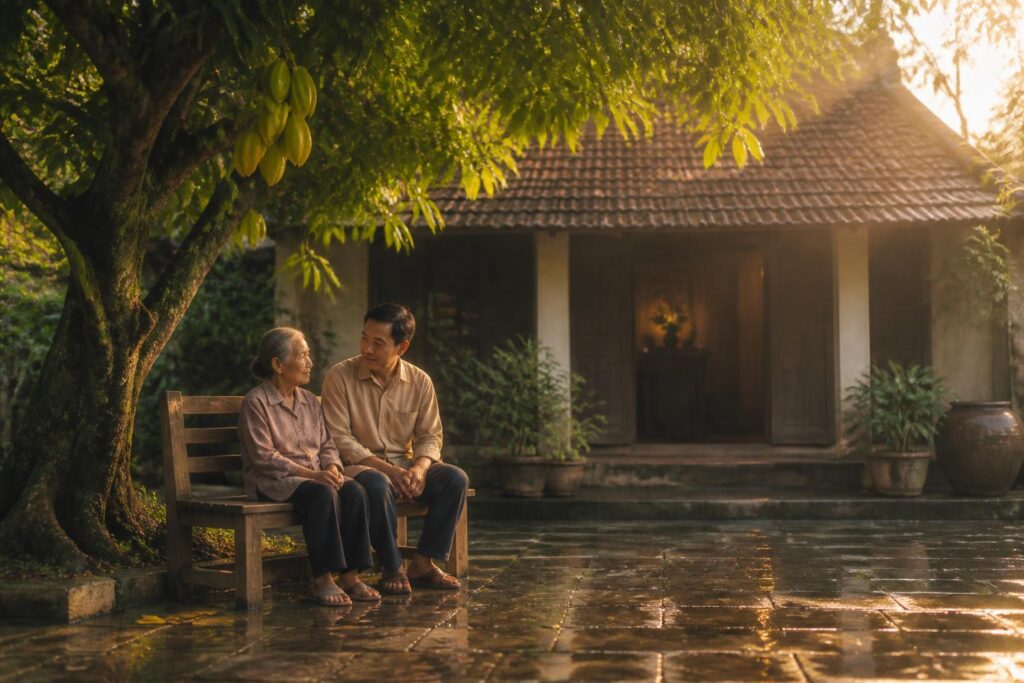
The Chair No One Had the Heart to Put Away
At the end of the dirt road leading into the small hamlet stood a tiled-roof house faded by time. In front of the veranda, beneath the starfruit tree, there was always a low wooden chair. The chair was so old that its seat was smooth and glossy in the middle, one leg leaned slightly to the side, and the back bore a long crack like an awkwardly sewn seam. Whenever it rained, Mrs. Lanh pulled it close to the veranda post. When the sun came out, she carried it back beneath the starfruit tree and placed it beside a white enamel cup.
No one in the hamlet asked why she still kept the chair. Everyone knew it had been Mr. Tu’s seat, her husband’s, before he died. Throughout the final years of his life, he often sat there in the afternoons, watching the road in front of the house and waiting for the sound of his only son’s motorbike. That son was named Minh, and he had left his hometown long ago after an argument with his father. From then on, Mr. Tu never mentioned his son, and Minh rarely returned.
The chair remained there through seasons when the starfruit tree shed its blossoms and through gusts of wind that changed direction. It was not valuable, nor did it hold any story recorded in books. Yet to Mrs. Lanh, it was the last thing connecting the present house to a chapter of life that had never been brought to a close.
A Farewell Without Goodbye
In the past, Minh had been a hardworking son. He learned how to repair machinery in the town and then opened a small shop near the market. Mr. Tu was a carpenter by trade, cautious by nature, and a man of few words. He did not object to his son making a living on his own, but he always believed Minh should stay in the countryside and take over the family woodworking shop. Minh, however, wanted to decide his own path. At first, those two desires led only to small arguments; gradually, they became a distance between them.
The real conflict arose in the year Mr. Tu developed back pain and could no longer accept many orders. At the time, Minh was borrowing money to renovate a new shop. He returned home and suggested that his father sell a piece of land behind the workshop to repay the debt and make further investments. Mr. Tu refused. He believed it was ancestral land and should not be sold because of a hasty decision. Minh felt that his father did not trust him. Mr. Tu, in turn, thought his son saw only immediate benefits and had forgotten everything the family had preserved.
The argument that day took place beneath the starfruit tree. Minh said that his father had never regarded him as an adult. Mr. Tu replied that some people grew old without ever learning to take responsibility for their choices. Those words left Minh silent. He walked away on a rainy afternoon, without saying goodbye to his mother and without turning back to look at the chair sitting beside the veranda.
A few months later, Minh’s shop struggled. He repaid part of the loan but had to move to another city to look for work. During that time, Mr. Tu suffered a mild stroke. His health gradually weakened, yet he stubbornly refused to let Mrs. Lanh call his son home. Whenever she mentioned Minh, he would simply turn his face toward the yard and ask an unrelated question: “Did many starfruits fall today?”
He died on a late-winter morning. Before closing his eyes, he called no one’s name. Sitting beside the bed and holding his already cold hand, Mrs. Lanh suddenly understood that some people spend their whole lives accustomed to enduring things, so that when the time comes to say a gentle word, they do not know where to begin.
The Return After a Rainstorm
Minh returned after the first anniversary of his father’s death. He arrived in the afternoon, just as the rain had stopped. The dirt road was slippery and muddy, and his motorbike came to a halt in front of the gate. Mrs. Lanh was gathering starfruit leaves in the yard. Hearing the sound, she looked up but did not come out right away.
Minh stood outside the gate for a long time. He had thought about the day he would return many times, imagining that he would say clear, straightforward things to his mother. He would tell her that he had been wrong to leave in anger. He would say that he had still missed his father throughout those years. He also wanted to ask why his father had never once called him. But when he truly stood before the old house, all the words became awkward.
Mrs. Lanh opened the gate. She did not ask how he had been living, nor did she reproach him for coming home so late. She only said, “There’s still a pot of hot rice in the kitchen.” Minh nodded and wheeled his motorbike into the yard. The smell of cooking smoke, damp earth, and starfruit leaves made him feel as though he had just returned from a long dream.
After the meal, Minh saw the chair beneath the veranda. It was still there, lower than he remembered. Mrs. Lanh placed a dry towel on it and said, “I meant to burn it several times, but I stopped every time.”
Minh sat down. One of the chair’s legs leaned slightly, just as it had before. He remembered the afternoons when his father sat sharpening chisels, occasionally looking up to watch him work. Mr. Tu rarely praised his son, but whenever Minh managed to repair a difficult machine, he would often quietly put the better piece of fish into his son’s bowl. At the time, Minh had thought it was perfectly ordinary. Only after leaving home did he understand that his father’s love often came through small gestures, so quiet that the person receiving them could easily overlook them.
What Remains Unsaid Does Not Disappear
Minh told his mother about his years in the city. He had changed jobs several times, sometimes failed, and sometimes felt he no longer had the strength to start over. He had not been able to keep the repair shop from before, but he was still working in his old trade at a small workshop. Life was not prosperous, but it was more stable. In those stories, Mrs. Lanh heard the maturity that Mr. Tu had perhaps been waiting for.
Then it was her turn to tell him that, before his death, Mr. Tu often went out to sit alone on the veranda. On some cold days, she told him to come inside, but he would not listen. He sat in the chair and stared at the gate for a long time. She did not know whether he was waiting for Minh or merely looking at a familiar road. She had not dared to ask, because Mr. Tu had never liked other people seeing his sorrow.
Minh lowered his head. He wanted to blame his father for that silence, but then realized that he himself had been no less silent. Both of them had waited for the other to take the first step. Both had regarded apologizing as a form of surrender, when what they had truly lost was not victory in an argument but the afternoons they could have spent sitting beside each other.
“Did Father ever mention me, Mom?” Minh asked.
Mrs. Lanh looked out into the yard. “He did. But he never called your name. He only asked when you were coming home.”
That brief answer made Minh feel his chest tighten. Over the past year, he had often intended to call his father. Once, he drafted a message and then deleted it, thinking his father was still angry. Another time, he stood at the bus station and bought a ticket home, but eventually returned it. He had convinced himself that waiting a little longer would make it easier to talk. He had not realized that time did not make words easier; it only reduced the opportunities to speak.
Forgiveness Is Not Forgetting
In the days that followed, Minh stayed to repair the veranda roof and build a small cabinet for his mother. He also took the chair to his workshop, replaced its leg, and reinforced the cracked back. While repairing it, he tried to preserve the old scratches. Mrs. Lanh asked why he did not remake it completely so that it would look beautiful, and Minh replied that some things did not need to become new again. They only needed to be sturdy enough to remain beside someone for many more years.
Repairing the chair took nearly half a day. While working, Minh found a thin piece of wood tucked beneath the seat, wedged into the crack. A few lines written in pencil had blurred with time. They were in Mr. Tu’s handwriting: “When Minh comes home, tell him to sit here and wait for Father.”
Minh held the piece of wood for a long time. Perhaps Mr. Tu had written it many years earlier; perhaps he had written it one day when he missed his son. No one knew what he had intended to say after that sentence. Perhaps he wanted to scold him, ask him something, or simply see his son sit in the old place. But the piece of wood had remained silent beneath the chair, preserving a message that was never delivered.
That evening, Minh told his mother. Mrs. Lanh wiped away her tears and said, “Your father was not good with words. You are like him in that way.”
Minh smiled sadly. He understood that forgiveness did not mean denying the wounds that had once occurred. He still remembered his father’s words in the rain, still remembered the feeling of being looked down on and the lonely years after leaving home. But he also remembered his father’s hands quietly repairing his bicycle, the extra food packed into his lunch each morning, and the times his father stood at the end of the lane waiting for him to return from school. A person is not defined only by one sentence that causes us pain. Someone can be rigid and loving at the same time; they can hurt us and also be the person who once protected us.
A Seat for the Present
Minh did not sell the land behind the workshop. Nor did he take over his father’s carpentry trade in the conventional sense. Instead, he built a small machinery-repair shed beside the house and also took on simple woodworking jobs. Mrs. Lanh did not ask whether he would succeed. She was simply happy that every afternoon, someone was sitting beneath the starfruit tree again.
The old chair was placed back in its original position. Minh repainted the legs but kept the dark wood and the scratches across the seat. Sometimes the children in the hamlet would run in and ask to sit there. On some days, Mrs. Lanh sat there sorting vegetables while Minh sat beside her repairing an old fan. The mother and son did not always talk. They had learned that being silent together was different from remaining silent in order to stay apart. One kind of silence could make a house grow cold, but another could bring a sense of peace.
A few months later, a young worker came to ask Minh for an apprenticeship. He often broke things, lost his temper, and wanted to give up. Once, he said that Minh did not trust him. Hearing this, Minh suddenly remembered himself in the past. He did not scold the young man. He merely pulled the chair out beneath the veranda and said, “Sit down first. Whatever the problem is, we need to look at it again once we are less angry.”
That chair had gone from being a place reserved for someone who had passed away to becoming a place that welcomed people in need of a pause. It could not resolve every conflict, turn back time, or make words that had been spoken as though they had never existed. But it reminded everyone that before leaving, we can sit down one more time. Before closing the door, we can ask what the person facing us is truly grieving.
Do Not Let Words of Love Come Too Late
In many families, distance does not begin with a major event. It grows gradually through missed phone calls, absent family meals, and apologies held back out of pride. People often think there will always be tomorrow to say what needs to be said. But tomorrow does not always arrive in the way we hope.
Sometimes, mending a relationship does not require an emotional speech. It may be as simple as taking the initiative to return home, pouring each other a cup of tea, repairing a door together, or sitting beside one another for a few minutes without bringing up who was right or wrong. Small actions cannot erase the past, but they can open a new path for two people to move through it.
One afternoon, as sunlight fell in golden patches across the yard, Minh pulled the chair close beside his mother. Mrs. Lanh handed him a ripe starfruit. Mother and son sat beneath the veranda, listening to the sound of a vehicle fading into the distance along the road. Neither mentioned Mr. Tu, but his presence was still there—in the smell of wood, in the shade of the tree, and in the space between two people who had once learned how to find their way back to each other.
The chair was still old. The house still bore the cracks of time. Only their hearts had grown a little wider, wide enough to hold both what had been lost and what remained. And sometimes, a home is preserved not by strong walls, but by one person being willing to sit down before the other walks away.

ARTICLES IN THE SAME CATEGORY
The Lamplighter and the Road Without Darkness
A Small Promise Can Keep a Family’s Warmth Alive
When the Meal Slows Down, Family Grows Closer
The Unextinguished Lamp at the End of the Alley
The Silence Between Two Moments of Haste
When Old Things Remind Us That We’ve Grown Up
ARTICLES IN THE SAME GENRE
The Seedling Who Knew How to Listen and the Forest That Awoke
Brown Squirrel’s Raincoat
The Wind Chime Finds Its Chime Again
Stepmother and Stepchild