

 Tiếng Việt
 日本語
日本語 한국어
한국어 中文 (中国)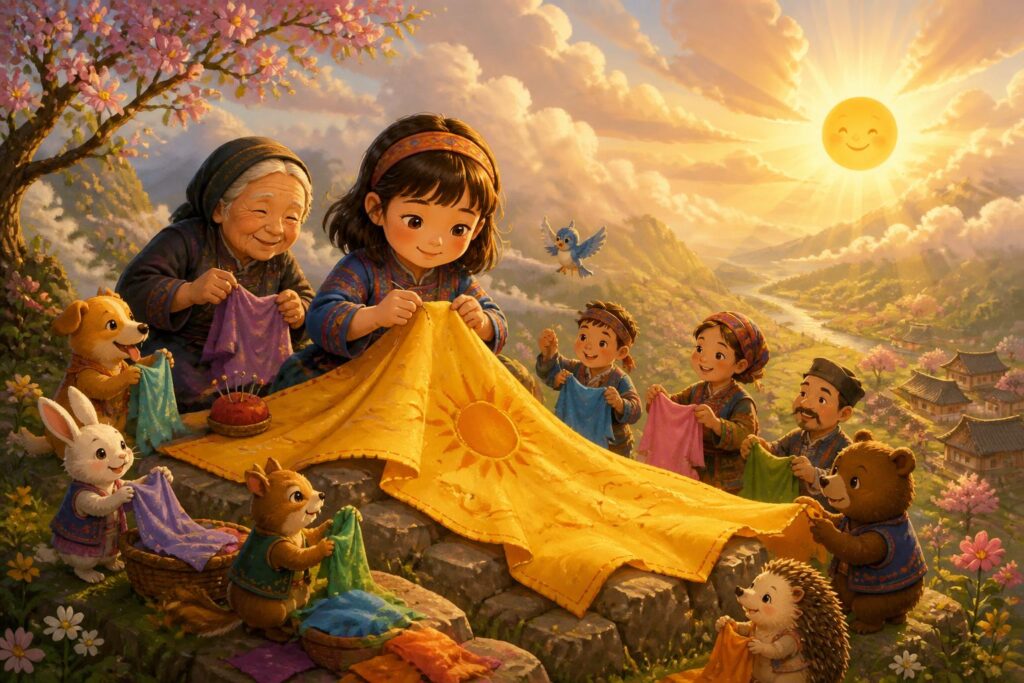
Once upon a time, in a small village nestled between a valley and green mountains, there lived a little girl named May. May lived with her grandmother in a thatched-roof house, with an old plum tree growing in front of it. The girl had nimble hands, keen eyes, and a very special habit: whenever she saw something torn, chipped, or missing a button, she always found a way to repair it.
May could mend the mail carrier’s bag, sew up the old dog’s blanket, and tie an extra strap onto the mushroom gatherer’s basket. She did not do these things for a reward. May simply thought that if something could still be used, it should not be thrown away. Her grandmother often patted her head and said, “Hands that know how to care for things are like a little lamp. They cannot light up the whole world, but they are enough to help the person beside you see the way.”
One year, winter arrived early and lasted unusually long. The wind blowing down from the mountains grew colder day by day. Gray clouds covered the sky, allowing the Sun to appear only briefly in the morning before disappearing again. The cornfields did not have time to ripen, the vegetable beds in the garden drooped, and the birds no longer felt like singing. The children in the village had to wrap themselves in blankets and sit close to the fire, while the adults kept looking up at the sky with worried expressions.
“Perhaps the Sun is tired,” Grandmother said as May placed another log on the fire. “Every day, the Sun has to warm the mountains and forests, the rivers and streams, and so many homes. Maybe the Sun’s coat has torn, and no one has noticed.”
May looked up. She had never thought that the Sun could be cold too. In May’s imagination, the Sun was a giant wearing a shining golden coat. Every morning, it put the coat over its shoulders and traveled across the sky. If the coat really was torn, the Sun must be terribly cold.
The next morning, May put a few corn cakes in her bag, wrapped a woolen scarf around her neck, and went up the mountain. She wanted to ask the Sun whether it needed help. The winding path was covered with dry leaves. May crossed a frozen stream, came upon a group of rabbits huddled beneath a bush, and saw a young pine tree bending under the wind. She broke off dry branches to make a shelter for the rabbits, spread leaves around the base of the pine tree, and then continued on her way.
Halfway up the mountain, May met a sparrow trembling beside a rock.
“Do you know the way to where the Sun is?” May asked.
The sparrow tilted its head. “I have never flown that high. But I have heard the clouds say that behind the mountain peak there is a room made of light. The Sun usually rests there when night falls.”
May thanked the sparrow and shared a piece of cake with it. Then she continued on. When she reached the mountaintop, May saw a door as transparent as ice. Behind it was a spacious room, but it was not shining brightly as she had imagined. The Sun was sitting beside the window, holding its knees with both hands. It was wearing an old golden coat, frayed and torn in so many places that light escaped through them in little rays.
“Hello, Mr. Sun,” May said politely. “Are you hurting anywhere?”
The Sun looked up, its voice deeper and weaker than the sound of sunlight May had heard on summer days.
“I am not hurt, but I am cold. This coat has been with me through many seasons. I want to mend it, but I have run out of my thread of light. If I cannot wear my coat, I will not have enough strength to warm the earth.”
May opened her bag and took out a spool of red thread that her grandmother had given her to sew up her woolen sweater. The spool was so small that it seemed to be enough for only one stitch.
“Could you use this thread?”
The Sun shook its head. “Your thread does not shine. It cannot hold the sunlight in.”
“But if we do not try, we will never know,” May replied.
She sat down beside the Sun and began to sew. The first stitch pierced the edge of the coat, drawing the red thread through. Sure enough, the seam did not light up, but it held the two edges of the fabric close together. The second stitch followed the first. The third joined the second. Before long, a small red line of thread ran along the tear.
The Sun looked at the seam and smiled. “It does not shine, but it is very strong.”
May sewed throughout the afternoon. When the thread ran out, she untied the ribbon from her hair and used it to continue. When the ribbon was not enough, she took the string used to tie her bag of cakes. These small things did not turn into gold or silver, nor did they suddenly give off light. But they helped close the coat little by little.
Just then, a strong gust of wind swept through the room. The door flew open, causing the coat on the Sun’s shoulders to come undone. The thread at one corner was pulled taut and snapped. May was startled, and the Sun lowered its head in disappointment.
“You tried your best, but perhaps it still was not enough,” the Sun said.
May looked down at the valley. From the mountaintop, she could see the little rooftops, the vegetable beds covered in frost, and the old plum tree in front of her house. She remembered her grandmother’s words: a little lamp cannot light up the whole world, but it is enough to help the person beside you see the way.
“If I sew it by myself, it will take a very long time,” May said. “But if everyone sews together, the coat will quickly be mended.”
May ran down the mountain. On the way home, she told the sparrow about the Sun’s coat. The sparrow flew off to call its friends. When the rabbits heard, they asked the squirrels to pass along the news. The squirrels ran through the forest, telling the deer, foxes, and little hedgehogs. By the time May reached the village, nearly every creature knew that the Sun needed help.
The first person to hear May’s story was her grandmother. She did not ask whether it was true. She simply took an old woolen scarf, unwound each soft thread, and rolled them together into a small ball.
“If you believe the Sun needs help, I will sew with you,” she said.
The villagers gradually brought whatever they had. The carpenter brought his strongest hemp cord. The weaver gave the leftover pieces of yellow fabric. The shepherd brought white wool. The children contributed ribbons that had already been used many times. No one had any thread of light, but everyone had a little time and a willing heart.
For three days, the entire village worked together in the largest house. The adults cut fabric, the children wound thread, and the elders showed them how to tie strong knots. Outside, the birds gathered the softest dry grasses. The spiders in the garden spun fine strands of web to connect the pieces of fabric. Each person contributed something, no matter how small, and no one belittled anyone else’s contribution.
When the coat was brought up the mountain, May realized that it had become a strange and wonderful garment. Pieces of fabric in different colors were joined together to form fields, rivers, forests, and rooftops. No two pieces were alike, but together they created a coat that was broad and warm.
The Sun put on the coat. At first, light only glimmered through the seams. Then the pieces of fabric began to flutter gently in the wind. A tender warmth spread from the coat—not dazzling, but soft like a mother’s hand placed on a child’s forehead.
The Sun stood up. A golden ray pierced the clouds. Then a second and a third followed. The ice on the stream gradually melted, the vegetable sprouts lifted their heads, and the sparrow began to sing. Down in the valley, the villagers cheered as sunlight poured over their rooftops.
“I once thought that only a thread of light could mend this coat,” the Sun said to May. “But I was wrong. What keeps the coat strong is not one special thread, but many hands working together.”
From then on, the Sun always wore the coat with its many-colored seams. Whenever it passed over the village, the Sun cast a warm patch of sunlight onto the old plum tree, like a greeting to the little girl who had not been afraid of the long journey.
May grew up and continued to repair old things. She taught the village children how to sew on buttons, mend bags, and care for plants. Whenever someone said that they could do only something very small, May would often smile:
“One stitch does not make a coat, but every coat begins with one stitch.”
And on winter mornings, when sunlight streamed through the windows, everyone could still see a shining golden streak across the sky with sparkling colored seams. It was the Sun’s coat, sewn with patience, faith, and the goodness that people shared with one another.
The Lesson from the Story
May’s story reminds us that even a small good deed has meaning. When each person is willing to contribute whatever they can, things that seem impossibly large can become easier. Help does not have to be a precious gift; sometimes it is simply a thread, a word of encouragement, a little time spent sitting beside one another, or a willing hand ready to begin.
Young children can also make a difference through simple actions within their abilities, such as sharing their belongings, caring for plants, helping family members, and not rushing to throw away things that can still be repaired. What matters most is knowing how to care, how to be patient, and understanding that everyone can contribute to something good that belongs to all.

ARTICLES IN THE SAME CATEGORY
The Little Boy Who Saved Raindrops for the Garden
The Wind Chime That Called Summer Back
The Seedling Who Knew How to Listen and the Forest That Awoke
The Little Bean and the Garden That Knows How to Wait
A Little Raindrop Finds Its Way Back to the Cloud
The Wind Chime and the House of Sounds
ARTICLES IN THE SAME GENRE
The Wind Chime That Awakened the Garden
The Button That Went Looking for Someone Who Keeps Their Word
Tam Cam Part 2: The Vengeful Spirits of the Palace
Tam and Cam: The Palace Intrigue and the Original Ending – Part 1
Tam Cam
Coconut Skull