

 Tiếng Việt
 日本語
日本語 한국어
한국어 中文 (中国)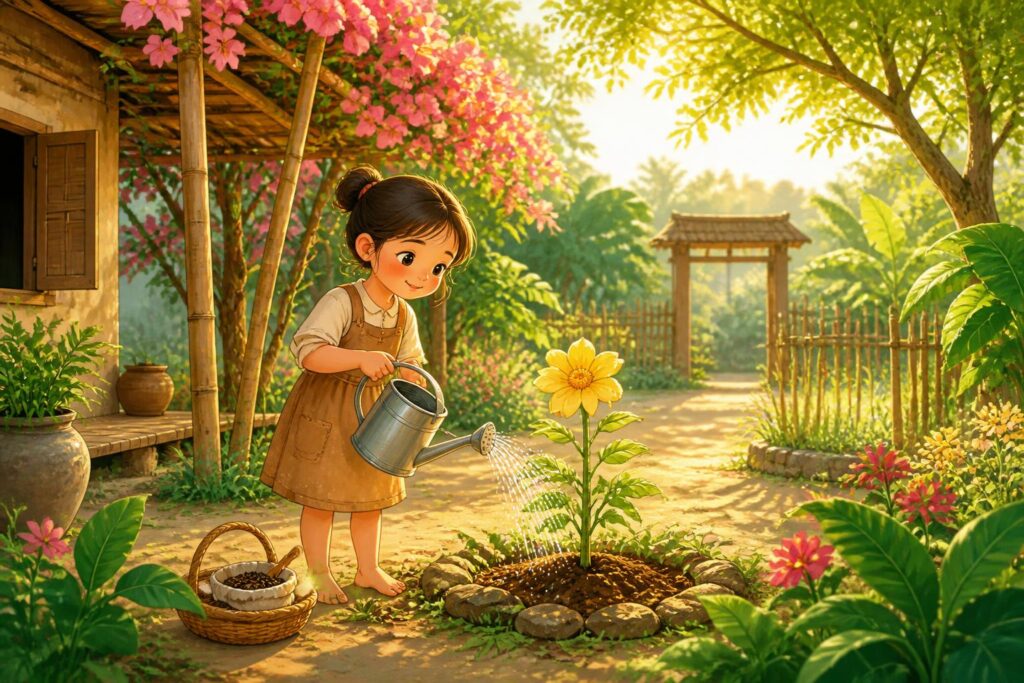
Once upon a time, at the edge of a village nestled along a green hillside, there lived a little girl named An. An lived with her mother in a small house with a bougainvillea trellis in front. She loved everything to grow quickly. Whenever she planted a bean in the ground, she would dig it up every morning to see whether its roots had sprouted. Whenever her mother baked a cake, An would lift the pot lid every few minutes because she wanted to know whether the cake was done. Her mother would often smile and say:
“Some things cannot grow simply because you look at them a lot, An.”
An heard this but did not yet understand. In the little girl’s heart, the loveliest things all had to appear immediately. A butterfly had to fly as soon as it emerged from its cocoon, a flower had to bloom right after it was watered, and a promise had to be fulfilled that very day.
The Seed in the Cloth Pouch
One early spring morning, when An followed her mother up to the forest on the hill to gather medicinal leaves, the girl saw an old woman sitting beside a chestnut tree. The old woman had snow-white hair, small hands, and a brown cloth pouch resting beside her. In front of her was a patch of dry earth, where only a few yellow blades of grass leaned in the wind.
An politely greeted her and asked curiously:
“What are you looking for, Grandma?”
The old woman took a small, round seed from the pouch. It was as bright as a drop of honey.
“I’m looking for a place to plant this seed. It only sprouts in a place where someone knows how to wait.”
An immediately held out both hands.
“Please give it to me! I’ll take very good care of it.”
The old woman looked at the girl for a long while, then handed the seed to An.
“Plant it in front of your house. Water it with only one small ladleful each day. Don’t dig up the soil to look at it, don’t disturb the seed, and don’t get angry if it hasn’t grown yet. When you learn how to wait while still showing love, the seed will know how to wake up on its own.”
An nodded vigorously. The girl believed she could do it. On the way home, An held the seed tightly in the palm of her hand, imagining a flowering tree as tall as the roof of the house, with yellow blossoms on its branches that shone in the night.
The Exciting First Days
When she got home, An chose a patch of soft soil right beneath the bougainvillea trellis. She used a small stick to make a hole deep enough, placed the seed inside, and covered it with soil. An drew a ladleful of water and watered it very carefully. Then the girl squatted beside the garden bed and waited.
One hour passed. Nothing happened.
An moved closer. The ground remained still.
By afternoon, the girl poked the soil with the stick to check. As soon as her mother saw, she gently stopped her.
“Have you forgotten what the old woman told you?”
“But I only want to see whether the seed is healthy.”
“Sometimes, to know whether something is healthy, we have to leave it undisturbed.”
An reluctantly put the stick down. That night, the girl lay in bed thinking about the seed. She imagined it feeling cold beneath the ground, not knowing whether anyone remembered it. Thinking this, An ran out in front of the house, covered the garden bed with a thin cloth, and only then went to sleep peacefully.
The next morning, An woke up very early. She looked at the garden bed and saw a tiny green speck poking up. An was so happy that she nearly shouted for her mother. The girl bent down and was about to touch the sprout, but then she remembered the old woman’s words. An simply sat beside it, smiled, and watered it with one small ladleful of water.
On the third day, the green speck was still only a green speck. On the fourth day, it was a little taller. By the fifth day, a strong wind suddenly rose. The bougainvillea trellis shook, and dry leaves covered the yard. When An ran outside, the sprout had tilted completely to one side.
When Impatience Makes Everything More Difficult
An panicked. She planted a branch beside the young sprout and tied the stem to it with a string that was too tight. An thought she was helping the sprout stand firmly. But by evening, the string wrapped tightly around the stem, making it even harder for the sprout to reach upward.
When her mother saw it, she quickly untied the string. An lowered her head.
“I only wanted to protect it.”
“Wanting to protect it is a good thing,” her mother said, “but if we don’t observe carefully, impatience can also make it hard for someone else to breathe. Caring does not mean doing everything in place of another living thing. Caring means creating a safe place where it can grow on its own.”
An sat beside the sprout for a very long time. For the first time, the girl realized that love was not only about seeing results quickly. Sometimes love meant watering it just enough, shielding it from some of the wind, and then stepping back so the sprout could find the sunlight on its own.
Over the following days, An changed the way she cared for it. She no longer dug up the soil, pulled up the sprout to look at its roots, or watered it too much. Each morning, An simply sat beside the garden bed and told the sprout about the little things that happened during the day. She told it about the calico cat that often slept on the doorstep, the meals her mother cooked, and the children in the village who were learning to fly kites.
The sprout seemed to grow slowly but healthily. Its first two leaves opened, as green and clear as tiny hands welcoming the sunlight.
A Lesson from the Summer Garden
At the beginning of summer, the young tree had grown as tall as An’s knees. Small silver-colored buds appeared on its stem. An happily ran to tell her mother, then planned to pick one bud to give to the old woman on the hill. But her mother asked:
“Do you think the flower bud is ready?”
An looked at it carefully. The flower bud was still tightly closed, with a few thin petals not yet open on the outside. The girl shook her head.
“Perhaps it needs more time.”
“Then let us wait with it.”
An began to understand the meaning of the old woman’s words. Waiting was not sitting still in frustration and counting each day. Waiting meant continuing to do one’s part, continuing to keep faith, and at the same time respecting the unique rhythm by which something precious grows.
While the tree waited to bloom, An applied this lesson to other things. When her little brother knocked over a basket of fruit, An did not immediately scold him but picked up each piece together with him. When her friend Minh was still a slow reader, An did not urge him to read faster but sat and listened until he finished the sentence. When her mother was not yet able to finish sewing a new bag, An did not keep asking about it but found tasks to help her mother.
Everyone in the village noticed that An had changed. She was still cheerful and full of questions as before, but she no longer wanted everything to happen according to her wishes. An listened more, knew how to wait for others to finish speaking, and understood that everyone had their own season in which to grow.
The Flower That Blooms When the Heart Opens
One bright moonlit night, after a long rainstorm, the young tree in front of An’s house suddenly bloomed. It was a large flower with many layers of pale yellow petals. The flower did not radiate a dazzling light as An had once imagined. Instead, it released a gentle fragrance that made anyone passing by want to stop.
The next morning, the old woman from the hill appeared at the gate. She looked at the flower and smiled.
“The seed has awakened because you have learned how to wait.”
An asked:
“Can this flower do anything special?”
The old woman replied:
“The most special thing it does is remind everyone not to forget to care for the things that are still small. A word of encouragement, a friend who is sad, a dream that has not yet taken shape, or you yourself—all of these need time and patience. If you keep forcing them to grow quickly, you may hurt them. If you neglect them, they will wither as well. What is needed is just enough care and a heart that is not in a hurry.”
An looked at the flower. The girl suddenly understood that the gift the old woman had given her was not merely a seed. It was also an opportunity for An to look back at herself. Before, the girl had always thought that waiting was unpleasant. Now, An knew that waiting could be a deeply loving way of caring.
From then on, yellow flowers always bloomed in front of An’s house in their proper seasons. The flowers were not radiant every day; on some days, insects ate the tree’s leaves, and on others, the wind broke a branch. But An did not become sad or give up. She learned how to observe, repair, care for the tree, and patiently wait for it to recover.
Many years later, when An had grown up, she still kept the old cloth pouch the old woman had left behind. Whenever a child in the village asked for a seed, An would give one to them along with a reminder:
“Plant it with gentle hands. Care for it consistently. And remember that precious things do not always bloom as soon as we wish them to.”
In the little garden, new sprouts continued to emerge. Some sprouts grew quickly, some slowly, and some had to endure many rainstorms before they could stand firmly. An did not compare them with one another. She understood that every seed had its own path, just as every person needed a different amount of time to become strong and good.
And so the story of the seed that knew how to wait was passed down from one generation to the next. Adults told it to young children before bedtime, while children retold it to one another beside the flower beds. Everyone who heard it remembered one simple thing: be patient with the things that are growing, be gentle with those who have not yet had time to become whole, and trust that the quiet care given today may bloom into a magnificent flower tomorrow.

ARTICLES IN THE SAME CATEGORY
The Leaf That Knew the Way Home
The Boy Who Gathered Laughter for a Wind Chime
The Little Girl Who Sewed a Coat for the Sun
The Little Boy Who Saved Raindrops for the Garden
The Wind Chime That Called Summer Back
The Seedling Who Knew How to Listen and the Forest That Awoke
ARTICLES IN THE SAME GENRE
Stepmother and Stepchild