

 Tiếng Việt
 日本語
 한국어
 中文 (中国)
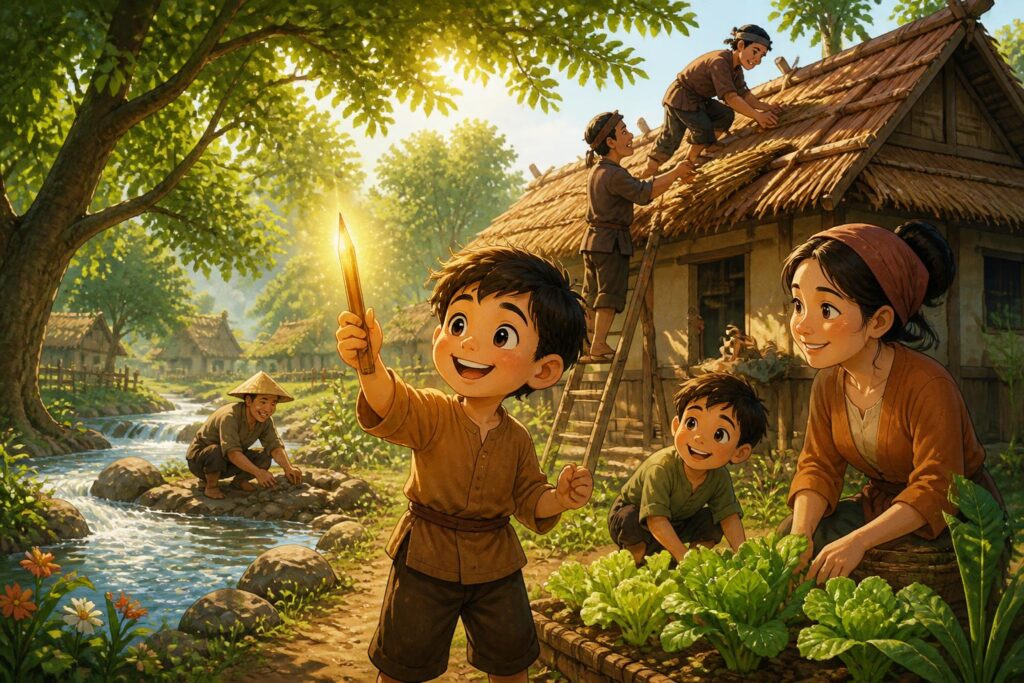
The Pencil by the Stream
Once upon a time, in a small village nestled between rice fields and a lush green forest, there lived a boy named Tiny. He was not actually smaller than the other children his age, but because he was always nimble, loved helping everyone, and often accomplished things greater than his tiny hands seemed capable of, the whole village called him by that name.
Tiny lived with his mother in a thatched-roof house beside a crystal-clear stream. They were poor, and his mother had to rise before dawn to make cakes to sell at the market. Tiny often helped her light the stove, sweep the yard, and carry water before going to school. Though life was difficult, he was always cheerful. What he loved most was drawing. With just a piece of charcoal, a sharp stick, or the tip of a dry branch, Tiny could draw a bird in flight, a boat on the river, and flowers blooming beside a fence.
One afternoon after school, on his way home, Tiny saw an old woman struggling beside the stream. Her bamboo basket had become caught in a thornbush, and the pinecones inside it had scattered across the ground. Tiny set down his schoolbag, carefully untangled each thorny branch, and then helped her gather the pinecones.
The old woman smiled kindly. She wore a worn brown shirt, and her silver hair was neatly tied at the nape of her neck.
“Thank you, my child. Do you like drawing?” she asked.
Tiny was surprised.
“How did you know?”
The old woman pointed to his hand. Tiny’s fingers were still stained black with charcoal.
“Because people who love something usually carry traces of it with them.”
With that, she took a yellowish-brown pencil from her sleeve. The pencil was no longer than an ordinary one, but its body was marked with shimmering lines like sunlight filtering through leaves.
“I’m giving you this pencil. It can draw the things you wish for. But remember, the pencil will only obey someone who uses it with a pure heart. If you draw out of greed or to harm others, your drawings will turn into trouble.”
Tiny held the pencil with both hands. He was about to ask another question when a breeze swept past. The leaves rustled, ripples spread across the stream, and the old woman suddenly vanished behind a veil of fine, mist-like sparkling dust.
The First Gift
When he got home, Tiny told his mother about meeting the old woman. His mother thought it had been nothing more than a beautiful dream, but she still warned him never to use the pencil for anything bad. Tiny nodded, placed the pencil on the wooden shelf, and went to light the stove.
The next morning, his mother woke up and discovered that there was not a drop of oil left in the jar. It had been raining continuously for several days, and she had not been able to go to the market to buy more. Tiny remembered the pencil. He took a piece of paper, drew a small bottle of oil, and softly said:
“I hope Mother has enough oil to make cakes today.”
As soon as he finished speaking, a real bottle of oil appeared on the table. It was not large, but there was enough to last the whole day. Tiny happily ran to call his mother. The two of them looked at each other, astonished and delighted.
From that day on, Tiny used the pencil to help people who truly needed it. When the wind tore several thatch panels from the carpenter’s roof, he drew a bundle of sturdy bamboo so the carpenter could repair it. When a little girl named Lan dropped the woolen scarf her mother had knitted, Tiny drew that exact scarf beside the banyan tree, where Lan had just passed. When earth and rocks partially filled the village well, he drew shovels and bamboo baskets so everyone could work together to clear it.
Tiny did not draw gold, silver, expensive toys, or delicious food meant only for himself. He understood the old woman’s warning: a gift has meaning only when it makes other people’s lives better.
The Rich Boy’s Greed
In the village lived a boy named Bao, the son of the wealthiest cloth merchant in the region. Bao heard his friends talking about the things Tiny had done and became very curious. One day, Bao secretly followed Tiny to the stream. He saw the sparkling pencil in Tiny’s hand and had an idea.
“If I had that pencil, I would draw lots of gold. I would have the biggest castle, the finest horses, and I would never have to listen to anyone again.”
That afternoon, while Tiny was helping his mother dry cakes, Bao secretly took the pencil from the shelf. He ran into the cloth storeroom, shut the door, and drew a chest filled with gold. Sure enough, a very heavy chest appeared in front of him. Bao cheered and drew another chest, then another.
But this time, the gold bars in the chest immediately turned into heavy stones. The storeroom shook. Rolls of fabric toppled down, completely blocking the way out. Bao cried out in fear for help.
Tiny heard the noise and ran over with his mother and several neighbors. He used the pencil to draw a crowbar and some wooden planks. Everyone worked together to get Bao out. The rich boy’s face was smeared with dirt, and he was both frightened and ashamed.
“I’m sorry,” Bao said, lowering his head. “I stole the pencil because I wanted to have a great deal of wealth. I didn’t think I would put everyone in danger.”
Tiny looked at Bao for a moment and then replied:
“The pencil did not make you greedy. It was what you wished for that caused everything to become a mess. If you want, we can use it to help each other repair the storeroom.”
Bao was surprised that Tiny did not scold him. He nodded. The two boys drew brooms, ropes, and wooden racks. The villagers also came to help. By evening, the cloth storeroom had been almost completely cleaned up.
The Challenge of the Drought
That summer, it did not rain for many weeks. The small stream gradually shrank, the village pond dried up, and the vegetable beds began to wilt. The adults discussed digging a new well, but the ground was hard and the work would take a great deal of time.
Tiny picked up the pencil and was about to draw a large stream flowing through the village. But then he remembered the old woman’s words: the pencil could help only with pure wishes; it could not replace all human effort. He thought for a long time, then drew a simple map showing the way to an underground spring beneath the foot of the hill. After that, he called everyone to come and dig.
At first, many people were skeptical. Some said that a boy could not possibly know anything about underground water. But Tiny patiently continued to show everyone the location on the map. Bao also rolled up his sleeves and joined in. Some people dug the earth, others carried rocks, and still others brought drinking water. After two days, the carpenter’s pickaxe struck a layer of damp soil. On the third day, a clear, cool stream of water suddenly burst from the ground.
The whole village cheered. The people led the water to the pond, shared it among the families, and built small channels to irrigate the fields. Tiny was happier than when the pencil had created an object, because this time, the miracle had been accomplished by everyone’s hands.
What Remained After the Pencil
That evening, the old woman appeared by the stream once again. Tiny ran over to return the pencil.
“I think you should keep it. I’ve realized that if people only wait for magic, they will forget their own strength.”
The old woman accepted the pencil, her eyes gentle.
“You have understood the most important thing. The pencil can create useful objects, but only kindness can create change. A person who knows how to share will never truly be poor, because there will always be helping hands around them.”
She lightly touched the tip of the pencil to the ground. The pencil dissolved into tiny specks of light and floated up into the canopy of the trees. From that day on, Tiny no longer had any mysterious gift. He returned to using pieces of charcoal, branches, and scraps of paper. Even so, the villagers still often came to him for help drawing maps, making repair plans, or thinking of ways to help others.
Tiny grew up to become a skilled craftsman whom everyone loved. He did not build a castle of gold, but together with the villagers, he helped create a small school, a wooden bridge across the stream, and a shared garden where the children could play.
As for Bao, he changed after that experience too. He learned to share cloth with families in difficulty and often helped his mother with her work. The two boys became close friends. Whenever someone asked what had made the village better and better, Tiny would simply smile and say:
“It wasn’t the pencil. It was the people who cared about one another.”
The story of the strange pencil was retold through many generations. The children of the village often heard it before bedtime and learned that a beautiful dream was not simply about obtaining what one wanted. A beautiful dream also meant wishing to bring joy, safety, and better opportunities to the people around them.

ARTICLES IN THE SAME CATEGORY
Bông the Bunny and the Raindrop That Kept Its Promise
The Little Firefly and the Guiding Light
Brown Squirrel and the Garden That Found Its Voice
Little Cloud and the Raindrop That Kept Its Promise
Little Mushroom and the Bell That Called the Dawn
Linh and the Garden That Bloomed Only When It Learned to Wait
ARTICLES IN THE SAME GENRE
Bông the Bunny and the Raindrop That Kept Its Promise
The Wind Chime and Brown Squirrel’s Promise
The Boy Who Gathered Laughter for a Wind Chime
The Wind Chime That Awakened the Garden
The Button That Went Looking for Someone Who Keeps Their Word
Tam Cam Part 2: The Vengeful Spirits of the Palace