

 Tiếng Việt
 日本語
 한국어
 中文 (中国)
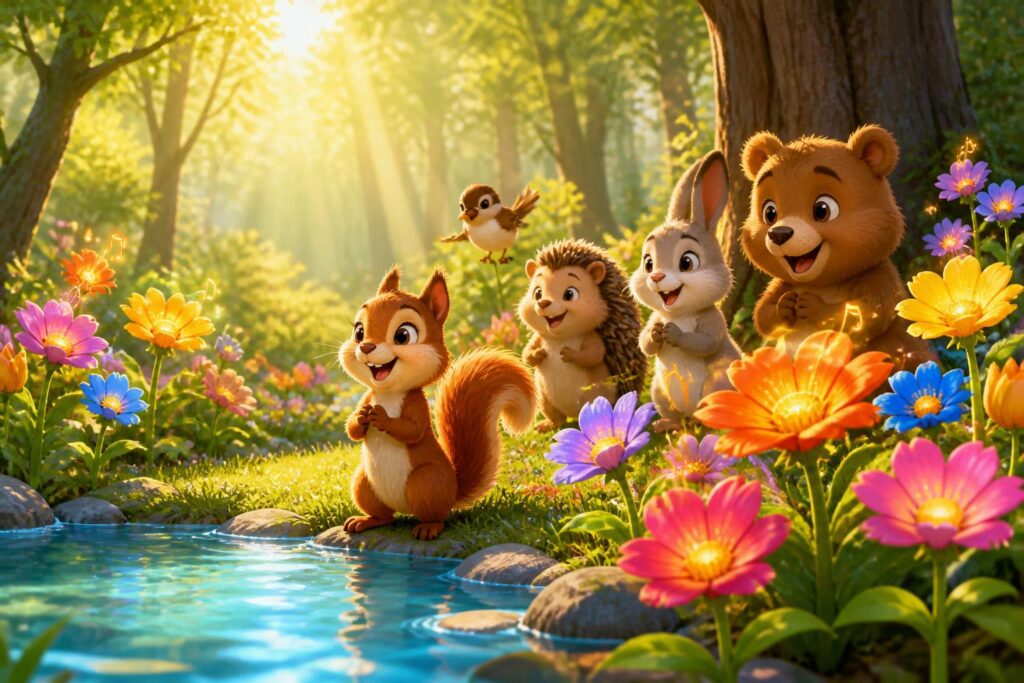
Brown Squirrel Dares Not Sing
At the edge of the forest to the east, there was a small garden that the animals called Wind Garden. It had not only flowerbeds of every color but also something strange: whenever the wind blew through, the flowers produced clear sounds like flute notes. The purple flowers hummed in low tones, the yellow flowers chirped like baby birds, while the white flowers trembled with gentle tinkling sounds.
The animals in the forest often came to Wind Garden in the morning. Little Rabbit liked to lie beside the grass bed and listen to the flowers sing. Sparrow often perched on a low branch to join its voice with the sounds in the garden. Brown Squirrel, meanwhile, only sat quietly on a tree stump, holding a chestnut in both paws and listening attentively to everyone.
Brown Squirrel also loved to sing. She often hummed while gathering nuts, leaping from branch to branch, or returning home after a long day. However, her voice was small and slightly hoarse. Whenever she heard Sparrow singing in a high, soaring voice or listened to Cricket play a lively tune, Brown Squirrel would droop her ears.
“My voice isn’t nice at all,” she told herself. “If I sing in front of everyone, they will surely laugh.”
So Brown Squirrel only sang alone inside her tree hollow. She sang so softly that sometimes even she could not clearly hear her own voice.
Old Owl’s Warning
One late afternoon at the end of the dry season, Old Owl flew to perch on the trunk of a large oak tree in the middle of the forest. He called all the animals together and said:
“Listen, everyone. The stream to the north has almost dried up. The wind in the forest is also growing weaker because the bushes blocking the wind around Wind Garden were knocked down in the storm. Without enough wind and water, the garden will wither. When that happens, the flowers will no longer be able to sing.”
The news made everyone sad. Wind Garden was the happiest place in the forest. If the garden disappeared, how quiet the mornings would become.
Old Owl continued:
“To save the garden, we must reopen the small watercourse from the stream and clear away the branches blocking the path of the wind. This work will take many days, much strength, and the cooperation of everyone.”
Bear Cub took on the task of pulling the large branches. Deer used his antlers to push the logs lying across the path. Rabbit and Hedgehog would dig the soil around the water source. Sparrow flew off to find new seeds to replant the rows of young trees.
Brown Squirrel also wanted to help, but she did not know what she could do. She was not strong enough to pull large branches, nor did she have long legs to dig the soil quickly. She stood behind a fern bush, watching everyone work busily, then quietly returned home.
That night, inside her tree hollow, Brown Squirrel heard the wind blowing through the dry branches. She thought for a long time about the garden and the flowers that were thirsty for water. Suddenly, she remembered something: every morning, before the animals came to Wind Garden, she often ran along all the little paths gathering chestnuts. She knew the roads around the forest very well, including the trails that few ever visited.
“Perhaps I can find another path leading to the water source,” Brown Squirrel said to herself.
The next morning, she decided to try.
The Path Beneath the Thornbushes
Brown Squirrel began walking along the southern hillside, where few animals ventured. She climbed over tangled tree roots, slipped beneath thornbushes, and leaped over stones covered in moss. At times, thorns caught in her tail; at other times, she slipped and fell onto the layer of dry leaves. But each time she thought of turning back, she thought of Wind Garden and the flowers waiting for water.
Near noon, Brown Squirrel discovered a narrow crack in the ground between two rocks. From the crack came a very faint trickling sound. She pressed her ear to the ground and listened carefully. It really was the sound of water. An underground spring was still flowing, but its outlet had been blocked by soil, stones, and tree roots.
Brown Squirrel hurried back to report the news.
“I found water on the southern hillside!” she said, panting. “There is a crack in the rock. The water is still flowing, but it is trapped inside.”
The animals immediately followed her. Bear Cub used his strength to shift the large rocks. Hedgehog dug the soft soil around the crack. Rabbit used his front paws to clear away the dry leaves. Sparrow flew in circles overhead to point out the direction in which the water should be guided toward Wind Garden.
The work continued until afternoon. At last, a large rock broke free. Clear water poured out of the crack, slipped through the grooves in the soil, and flowed down the hillside. Everyone cried out with joy, but their happiness did not last long. The water was flowing too weakly to reach the garden.
“We need to open a wider channel,” Old Owl observed. “But if we dig in this direction, we will have to pass through a stretch of very hard rock.”
Everyone looked at one another anxiously. The rocky stretch lay between the hillside and the garden and was so broad that it would take many days to clear.
A Tiny Sound
While everyone was resting beneath the shade of a tree, Brown Squirrel suddenly heard a strange sound. From the direction of the rocky stretch came a faint vibration, like the sound of a bell very far away. She crawled closer and pressed her ear to the ground. The vibration came from the small gaps between the rocks.
“There are hollow spaces here,” Brown Squirrel said. “If we strike the right places, the rocks may crack.”
Bear Cub tried hitting a rock with his paw, but the sound that echoed back was heavy. Deer tapped another rock with his antlers. Suddenly, a crack in the rocks gave off a clear ringing sound.
“This spot!” Brown Squirrel cried. “Strike in time with this ringing sound!”
The animals began tapping the rocks in the direction Brown Squirrel indicated. Tap, tap, clang. The sounds followed one another across the hillside. At first, they were scattered and disorderly. Then Sparrow noticed a steady rhythm. Sparrow began singing to keep the beat, Cricket played a tune as accompaniment, and Brown Squirrel stood in the middle of the rocky stretch, listening to each echo.
She did not sing loudly, but she hummed a short melody to signal which rocks should be struck next. Her voice was small and slightly hoarse, yet in the quiet hillside, everyone could still hear it clearly.
“Brown Squirrel’s voice is like a thread guiding the way,” Old Owl said. “It is not the loudest, but it is very precise.”
Encouraged, Brown Squirrel bravely sang more. She sang about the stream searching for a way out, about the flowers waiting, and about the forest working together. Her melody was neither as high and soaring as Sparrow’s nor as far-reaching as the sound of Bear Cub striking the rocks. It was warm and steady, helping everyone work without losing coordination.
As the sun slanted westward, a large rock cracked open. The water immediately rushed through the rocky stretch, forming a small stream. Everyone cheered. The water followed the newly dug channel, curved around the tree roots, and gradually moved toward Wind Garden.
The Garden Sings Again
The water reached the garden the next morning. The dry flowerbeds were refreshed. Little Rabbit and Hedgehog continued loosening the soil. Sparrow sowed seeds along the wind path. Deer and Bear Cub rebuilt the row of young trees to catch the currents of wind from the hillside.
A few days later, sparkling drops of water began to appear on the flower petals. When the first breeze blew through, the purple flowers trembled with a warm, low note. The yellow flowers followed with clear sounds. The white flowers softly chimed like silver bells.
Wind Garden was singing again.
The animals held a gathering to celebrate the garden’s revival. Sparrow suggested that everyone sing a song together. Cricket played a tune, Bear Cub kept the beat, and the flowers rang out along with the wind.
At that moment, Brown Squirrel was still sitting at the edge of the garden as usual. She intended to listen quietly and then go home, but Old Owl called her over.
“You found the water source, recognized the echoes in the rocky stretch, and led everyone in the right direction. Today, you should sing with us.”
Brown Squirrel trembled slightly. She looked around and saw that no one was laughing. Sparrow smiled and let her begin. Brown Squirrel took a deep breath and started to sing.
Her voice was still small and slightly hoarse. But this time, she did not try to make her voice like anyone else’s. She sang in her most natural voice, telling of the path beneath the thornbushes, the water in the rocky crack, and the friends who had worked together to save the garden.
When Brown Squirrel finished singing, the whole of Wind Garden filled with gentle sounds. It was not because her voice was the loudest, but because everyone had listened to her.
The Lesson from Wind Garden
From that day on, Brown Squirrel no longer hid inside her tree hollow to sing alone. She still knew that her voice was not like Sparrow’s, Cricket’s, or anyone else’s. But she understood that even a tiny sound could help others find their way. A simple deed could also become important when done at the right time.
The animals in the forest also learned to listen to one another more closely. Bear Cub no longer believed that strength was the only thing needed. Sparrow understood that a beautiful song would be more meaningful when it knew how to blend with other sounds. And the flowers in Wind Garden continued to sing each day, reminding everyone that the forest was most beautiful when no one tried to drown anyone else out.
If one day you feel small or think that you are not as good as someone else, remember Brown Squirrel. You do not need to have the highest singing voice, the fastest steps, or the greatest strength to be helpful. What matters is that you know how to observe, dare to try, and are ready to contribute with the abilities you have.
Because in a garden filled with song, not every sound needs to ring out loudly. Some sounds may be tiny, yet they keep the entire melody from losing its rhythm.

ARTICLES IN THE SAME CATEGORY
Little Cloud and the Raindrop That Kept Its Promise
Little Mushroom and the Bell That Called the Dawn
Linh and the Garden That Bloomed Only When It Learned to Wait
Little Ti and the Bell That Called His Friends
Little May and the Bag That Held Laughter
The Little Bean Searching for Sunshine for the Garden
ARTICLES IN THE SAME GENRE
The Wind Chime and Brown Squirrel’s Promise
The Boy Who Gathered Laughter for a Wind Chime
The Wind Chime That Awakened the Garden
The Button That Went Looking for Someone Who Keeps Their Word
Tam Cam Part 2: The Vengeful Spirits of the Palace
Tam and Cam: The Palace Intrigue and the Original Ending – Part 1