

 Tiếng Việt
 日本語
 한국어
 中文 (中国)
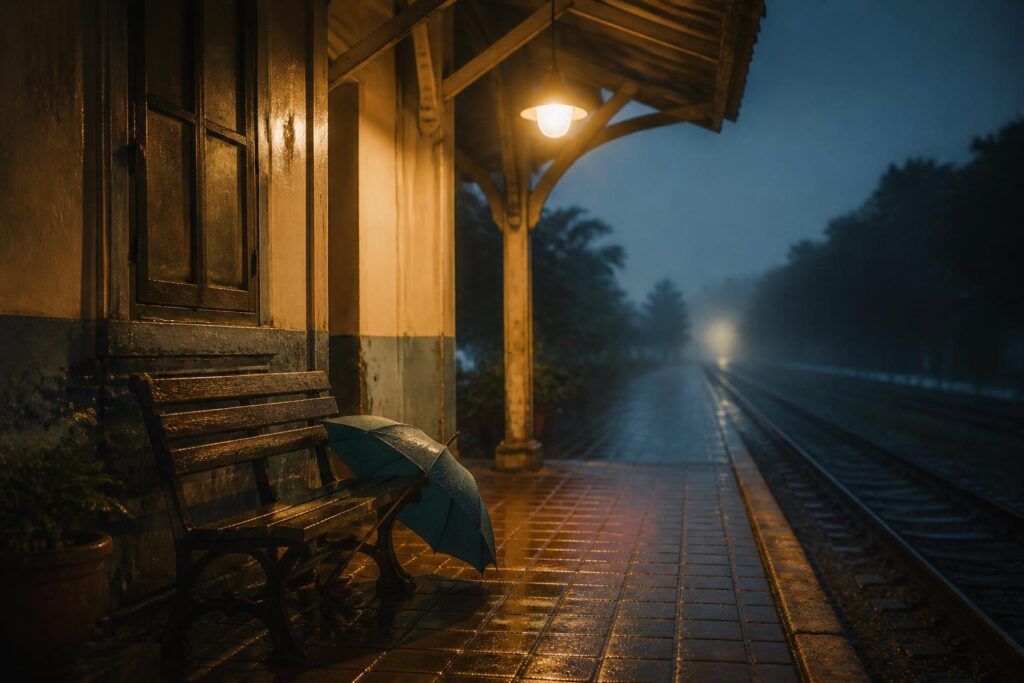
The night Minh returned to his hometown, the train was nearly an hour later than usual. Rain lashed sideways against the windows, carrying with it the smell of damp earth and the cold metallic scent of the rails. When the train stopped, the small platform held only a few figures hurriedly dragging suitcases toward the waiting cars. Minh remained in the carriage for a while longer, looking out through the blurred veil of rain. He had left this place twelve years ago, but the moment he stepped onto the platform, everything seemed to remain tucked away in one corner of his memory.
Beneath the station eaves, a yellow lamp was glowing. It was an old kind with a metal shade faded by time; its light did not reach far, but it was just enough to warm a patch of tiled floor. Minh remembered seeing it countless times when he was a child. Back then, he would often sit on the wooden bench near the lamp post, waiting for his mother to finish her shift. His mother worked at the ticket counter and usually went home later than everyone else because she still had to check the records and tidy the small room at the back.
A Promise in the Rain
Minh realized that the lamp was still standing in exactly the same place. Only the person who lit it had changed. An elderly woman in a brown raincoat was slowly wiping the water from the wooden bench. She did not notice Minh until he walked closer.
“Are you waiting for a train?” she asked.
Minh shook his head. “I just got off the train. I’m going home.”
She looked at him for a moment, then smiled. “It’s good to go home. It’s been a long time since anyone stood here looking at that lamp for so long.”
Minh wanted to ask who she was, but before the question could leave his lips, a train whistle sounded in the distance. The old woman pulled the bench closer to the wall, checked the light bulb, and slung her cloth bag over her shoulder.
“Are you free tomorrow?”
“I think so.”
“If you are, come help me change the bulb. It’s been flickering for the past few days.”
With that, she stepped out from beneath the eaves. Minh watched her small figure gradually disappear into the rain. He did not know why he had nodded. Perhaps it was because of the lamp. Or perhaps, in that dim light, he had just recognized an evening from long ago.
When Minh was fourteen, his mother came down with a high fever but still had to go to work. It was raining that day too, the last train was delayed, and only Minh and his mother remained at the station waiting for the bus home. His mother sat on the bench, her hands icy cold. Minh was worried and angry at the same time. He blamed his mother for not asking for leave, blamed the trains for always running late, and blamed their small home for always lacking one thing or another.
While the two of them waited, an older man walked past and placed an old blue umbrella in Minh’s hands. He told him to use it and return it the next day if they happened to meet again. Minh accepted the umbrella, but because he was so tired and confused, he did not have time to ask the man’s name. By the time the bus arrived, the man was gone.
Before getting on the bus, Minh’s mother took his hand and said, “Remember this, my child: there are people in this world who help others without needing their names to be known. If you can, do the same someday.”
Minh had nodded. But then the years of school, work, and life in the city swept him away. That promise gradually sank beneath hurried phone calls, postponed trips home, and even the irritation he felt whenever his mother reminded him that he should come back to visit more often.
The Keeper of the Light
The next morning, Minh returned to the station. The old woman was standing on a low stool, stretching to remove the lamp shade. Minh quickly steadied the stool and asked to do it himself. They bought a new bulb from a nearby shop, then fumbled with it for nearly half an hour before finally installing it.
When the switch was turned on, the yellow light spread across the tiled floor once again. The old woman looked up, her eyes narrowing with delight.
“Has this lamp been here for a long time?” Minh asked.
“Since my daughter still worked here. She’s been gone for many years now.”
Minh fell silent. The old woman sat down on the bench, resting her hands on her knees. She told him that her daughter had once been a ticket clerk at the station, just like Minh’s mother. After a serious illness, she died at a young age. From then on, every evening, the old woman would bring a cleaning cloth and come here to turn on the lamp. Some days it rained, some days the wind was strong, and some days the whole family urged her to stay home and rest, but she still came.
“Why do I light it?” she said, as though guessing what Minh was thinking. “My daughter once told me that many people got off the train late at night without knowing the area. All they needed was to see the light to know that there were still people at the station. After she died, I thought that as long as the lamp was still lit, her words would still remain here.”
Minh looked at the lamp. He had once thought its light was merely that of an old fixture beneath the eaves. Now he understood that it was one mother’s way of preserving her daughter’s presence. Quietly, without needing anyone to witness it, she had turned a habit into a reminder: in places that seem the most deserted, people can still leave one another something to lean on.
Before leaving the station, Minh asked her about the man who had given him the umbrella years ago. She thought for a moment, then said it might have been Mr. Lam, who had once worked as a porter at the station. He had retired long ago and moved to another commune. She did not know whether he was still alive or how to find him.
Minh had once thought that a debt of kindness had to be repaid to the very person who had given it. But that morning, as he watched the old woman slowly gather her things, he realized that some things could not be repaid in the usual way. An umbrella did not necessarily have to return to the hands of the person who had offered it. Sometimes, it continued to open in another rainstorm, for someone else who needed shelter.
Small Things That Are Not Forgotten
Minh stayed in his hometown for another week instead of returning to the city immediately as he had planned. He repaired the eaves of his mother’s house, took her to the doctor, and then helped the old woman clean the old waiting room. It had been a long time since Minh and his mother had spent a morning working together. At first, his mother was surprised. Then she simply handed him a cloth and told him to wipe the window on the right.
While cleaning out an old filing cabinet, Minh found a small wooden box. Inside were several faded train tickets, a hair clip, and a photograph of the station employees standing in front of the platform. His mother pointed to a man in the back row.
“That’s Mr. Lam. Back then, he often helped passengers carry their luggage. Once, he even took me home after I fell.”
Minh studied the blurred face in the photograph. He could not be sure whether this was the man who had given him the umbrella. But that uncertainty no longer mattered as much as it once had. What mattered was that Mr. Lam had once helped his mother. Perhaps he had also done a small kindness for Minh. And somewhere, the old woman was still lighting the lamp for strangers.
That afternoon, Minh suggested replacing all the old electrical wiring around the station eaves. It was not a major job, but it required more people. Several young men from the neighborhood heard what was happening and came to help. One brought a ladder, another brought tools, and another swept the tiled floor. The old woman stood nearby, repeatedly telling everyone to stop and drink some water.
No one asked who would pay them. No one mentioned whether the work was worthwhile. They simply did it because the lamp had been shining there for so long, and because each of them had, at some point, needed a similar light.
Passing the Light On
On the day Minh was preparing to leave his hometown, it was not raining. He arrived at the station early, carrying a newly purchased blue umbrella. The old woman looked at it and laughed.
“Are you planning to leave it for someone?”
“I don’t know. Someone might need it.”
She accepted the umbrella and placed it in the corner of the waiting room. Minh did not tell her about the promise he had made years ago. Nor did he tell her that over the years he had forgotten almost everything his mother had once taught him. Those words no longer needed to be spoken. They had become concrete actions, resting in the umbrella by the wall, in the new electrical wiring, and in the lamp that was turned on every evening.
Before boarding the train, Minh turned back to look at the platform. The old woman was standing beneath the eaves, checking the switch. The lamp cast its yellow glow over the wooden bench. His mother stood beside her, waving. In that moment, Minh felt that the twelve-year distance was no longer as heavy as he had imagined. He understood that returning home was not merely walking through an old doorway or sitting again in a familiar room. Returning home also meant looking back at the things that had once been given to him, so that he could understand how he wanted to continue giving them to others.
The train began to move. Through the window, the little lamp grew smaller, but it did not go out. Minh thought of the people who had appeared in his life for only a few minutes, a few days, or a single rainy season. Some had left behind a sentence, some an umbrella, and some only a light beneath the station eaves. Such things might seem very small, but sometimes they were enough to guide a person through an entire long journey.
And from that day on, whenever Minh saw someone struggling beneath the rain, he no longer waited for that person to ask for help. He would usually step forward first, open his umbrella, and quietly walk alongside them for part of the way.
Because he knew that kindness was not a gift meant to be stored away. It was a lamp whose meaning came fully alive only when it was lit, so that some stranger could see it and believe that they were not entirely alone.

ARTICLES IN THE SAME CATEGORY
The Sweet Soup Stall Under the Tropical Almond Tree and the Debt of Kindness
A Kind Person Is Not Someone Who Is Always There, but Someone Who Knows When to Stay
An Ordinary Family Meal and the Things That Keep a Family Together
A Proper Apology Can Reopen a Closed Door
The Things No One Applauds Still Make a Decent Life
A Meal with Someone Waiting: The Art of Keeping a Home Close
ARTICLES IN THE SAME GENRE
Little Hedgehog and the Moonlight Garden
The Seedling Who Knew How to Listen and the Forest That Awoke
Brown Squirrel’s Raincoat
The Wind Chime Finds Its Chime Again
Stepmother and Stepchild