

 Tiếng Việt
 日本語
 한국어
 中文 (中国)
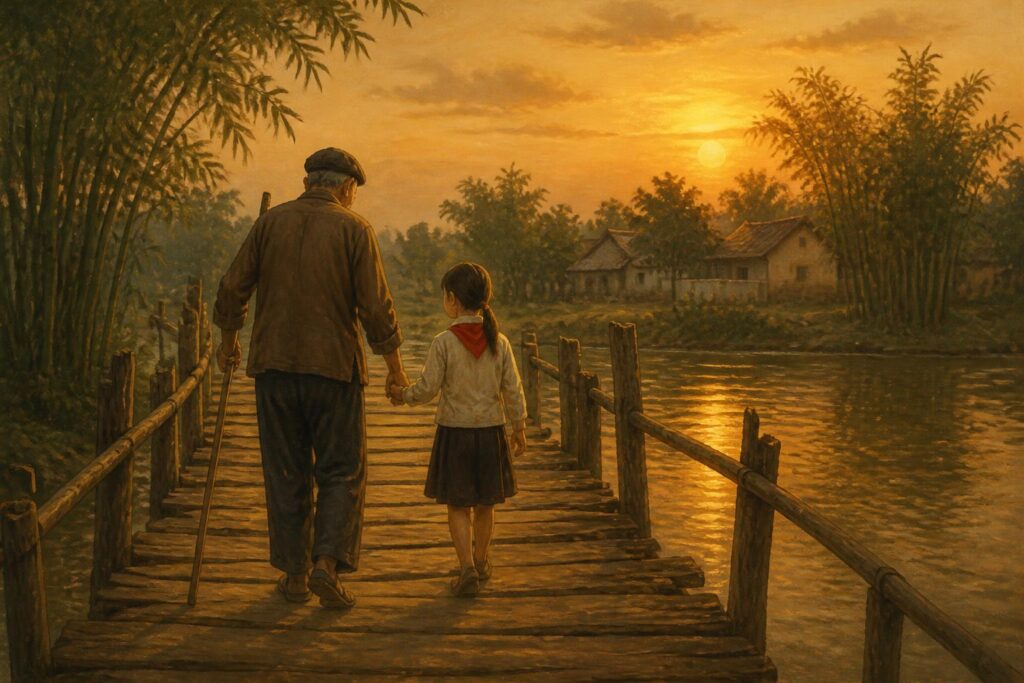
The Bridge at the End of the Village
At the end of Moc Khe Village flowed a river that was not wide, but its waters ran year-round and its bed was filled with submerged rocks. Every rainy season, the current became murky, carrying branches, straw, and sometimes even thatched roofs torn from houses by the wind. To reach the opposite bank, the villagers had to cross an old wooden bridge that had stood there for a very long time.
The bridge had no high railings, and its planks were no longer level. A few planks had been replaced, while others gave off a frightening creak whenever someone stepped on them a little too heavily. Even so, the bridge still connected the two halves of the village’s life. On this side were the residential area, the small market, and the old communal house. On the other side were the rice fields, the mulberry groves, and the road leading to the district.
The bridge watchman was named Lam. He had built a small hut right beside the bridgehead. Inside were a bamboo daybed, an earthen stove, a kettle, and an oil lamp. No one had officially appointed him to the job. Many years earlier, when one span of the bridge collapsed, Lam had volunteered to stay and keep watch, helping the elderly and children cross the river in a small bamboo boat. When the bridge was repaired, he continued to remain there.
During the day, he reminded passersby to walk slowly. At night, he lit a lamp at the bridgehead so that those returning late would not misstep. When it rained, he used a pole to push branches away from the bridge supports. If anyone dropped a load of goods, he bent down to help pick it up. If anyone was afraid of heights, he stood beside them until they reached the other bank.
There was only one thing the villagers always found strange: Lam had never crossed the bridge.
An Old Promise
If he needed to go to the other bank, he usually asked someone else. When he had to send something across, he tied it to a rope and pulled it over. When someone asked why he did not go himself, he merely smiled, poured more tea, and said that there was plenty of work to do at the bridgehead.
The villagers guessed at all kinds of reasons. Some said Lam was afraid of the water. Others said that something unfortunate had happened to him on the other side of the river. The children whispered to one another that beneath the bridge there was always a shadowy figure that pulled at the legs of anyone crossing at midnight. Lam heard them but offered no explanation. He only told the children not to make up stories to frighten one another.
The truth was that twenty years earlier, Lam had lived on the other bank with his wife and young son. One night, during the last days of summer, an unexpected flood struck. The river rose so quickly that no one had time to react. Lam was away from the village working as a hired laborer. When he returned, half of the house had already been swept away. His wife was rescued by neighbors onto the roof of the communal house, but no one could find their six-year-old son.
People searched for three days. They waded along the riverbank, pulled apart clumps of reeds, and shone lanterns into hollows among the rocks. On the fourth day, the rain stopped. The water receded, leaving behind fresh mud and broken branches. The boy still did not return.
Afterward, Lam took his wife to live with relatives in another area. He returned to Moc Khe and took charge of watching the bridge when it was rebuilt. No one knew why he had chosen that work. Only Lam understood that every time he stood at the bridgehead, he still felt as though he were waiting for a child to return from the other side.
The Little Girl with the Red Scarf
One late-autumn afternoon, when the sunlight had softened and the wind had begun to carry the scent of fresh straw, a little girl appeared at the bridgehead. She was about nine years old, small and slight, wearing a brown shirt frayed at the sleeves and a red scarf around her neck. On her back was an old cloth bag containing a few changes of clothes and a wooden box.
The girl stood in front of the bridge for a long time. She looked at the planks, gazed at the water below, and then turned to ask Lam:
“Grandpa, is it far to the other side?”
“Not far. But you must walk slowly, hold on to the rope, and look straight ahead.”
“Won’t you come with me?”
Lam shook his head. “I only stand here.”
The girl was silent for a moment, then stepped onto the bridge. The first plank creaked. She immediately stepped back. Lam took his bamboo staff and moved close to the edge of the bridge, but still stopped on the bank.
“Place your feet where there are nails. Those planks are sturdier.”
The girl did as he said. Each of her steps was slow and trembling. When she reached the middle of the bridge, a gust of wind blew the red scarf to one side. She crouched down, gripping the bridge planks with both hands.
“I can’t go on,” she said, her voice almost breaking into tears.
Lam looked at the water below. For a fleeting moment, he saw again his young son’s wet hair, and the tiny hands that had once clasped his finger. He was about to call for someone from the village, but the opposite bank was completely deserted. If the girl slipped, no one would arrive in time.
At last, Lam stepped onto the bridge.
It was the first time in twenty years that he had set foot on the planks connecting the two banks of the river.
What Was Found Inside the Wooden Box
Lam walked very slowly. The bridge trembled slightly beneath each step, but it did not collapse. He reached the girl, took her ice-cold hand, and said:
“Don’t look down. Look at my shoulder. We’ll take it one step at a time.”
The two of them reached the other bank just as the sun was setting. The girl sat down beside a tree, breathing heavily. Lam gave her a bowl of water he had brought with him, then asked where she was going.
She opened the wooden box. Inside was an old piece of cloth, a few coins, and a neatly folded letter.
“I’m looking for my grandmother,” she said. “My mother told me she lived in a house with a bougainvillea trellis, near the road to the district. My mother died last winter. Before she died, she gave me this box and told me that if there ever came a day when no one was left to care for me, I should bring it to my grandmother.”
Lam looked at the letter but did not touch it. He knew most of the houses on the other side of the river, but he had never heard of an old woman living near a bougainvillea trellis. The two of them followed the dirt road. Near dusk, they met a woman leading a cow back to its pen. When she heard the girl’s story, the woman recognized the address and led them to a low house behind a row of bamboo.
The old woman who lived there was over seventy. When she saw the box, she stood motionless for a long time. Then she raised a hand to cover her mouth, and her eyes reddened. The girl ran over and embraced her. For a while, neither of them could say anything.
That night, Lam slept on the porch. He heard the old woman telling stories and the girl occasionally asking little questions about her mother. The lamp inside cast a streak of yellow light across the earth. Lying on a bamboo daybed borrowed from a neighbor, Lam realized for the first time that the other bank did not hold only the things that caused him pain. It also held people who were waiting to be reunited.
The Bridge Watchman Moves Forward
The next morning, Lam walked the girl to the bridge. This time, she was no longer as afraid as before. When they reached the middle of the bridge, she turned back to look at him:
“Will you cross again someday?”
Lam rested a hand on the rope. Below, the river was clearer after many days of sunshine.
“Perhaps,” he replied. “If there is someone who needs me to take them across.”
“And if no one needs you?”
Lam looked at the opposite bank, where the old woman’s roof was now only a tiny dot among the bamboo groves. He smiled.
“Then I can still cross to visit someone.”
From that day on, the villagers began to see Lam crossing the bridge. At first, he went only on calm mornings. Later, he carried bundles of vegetables, a few pieces of firewood, or a pot of tea. He repaired the rotten plank in the middle of the bridge and set up a small chair where tired people could rest. When someone was frightened, he still stood beside them and gave instructions as before, but he no longer remained forever on one side.
The little girl stayed with her grandmother. Whenever she came through the village, she stopped by the hut beside the bridge and left a guava or a small cake. Once, she asked Lam why he had helped so many people cross the river, yet had allowed himself to stand alone for so many years.
Lam was silent for quite a while before saying:
“Some people think that if they simply remain standing in the old place, they can hold on to the person they lost. But in truth, standing still for too long only makes us stop seeing the people who are right in front of us.”
Crossing the River Is Also a Way of Returning
Many years later, the wooden bridge was replaced with a sturdy concrete one. Lam’s hut was no longer as necessary as before, but he kept the oil lamp and the bamboo staff. Every afternoon, he often sat by the river and watched people passing by. The little girl from long ago had grown up. From time to time, she returned to visit her grandmother, bringing her own young child.
The villagers still called Lam the bridge watchman, even though he no longer needed to keep watch over rotten planks. They called him that because he had spent most of his life helping others cross a distance. But to Lam, the most important bridge did not lie across the river. It lay between memory and the present, between loss and the ability to love once more.
Everyone has an opposite bank they are reluctant to step toward. It may be a conversation they have put off, an apology left unsaid, a house that evokes painful memories, or a choice that requires them to leave their comfort zone. We often think we are patiently waiting, but sometimes we are only using stillness to hide our fear.
Not every bridge leads to an easy ending. Crossing the river does not bring back what has been lost. Yet the first step can open the way to a place where we never imagined we could still be welcomed. And sometimes, what helps a person return to life is not forgetting the pain, but daring to carry that pain across the bridge to meet the people who still need them.

ARTICLES IN THE SAME CATEGORY
The Lamp Beneath the Station Eaves
The Sweet Soup Stall Under the Tropical Almond Tree and the Debt of Kindness
A Kind Person Is Not Someone Who Is Always There, but Someone Who Knows When to Stay
An Ordinary Family Meal and the Things That Keep a Family Together
A Proper Apology Can Reopen a Closed Door
The Things No One Applauds Still Make a Decent Life
ARTICLES IN THE SAME GENRE
Stepmother and Stepchild