

 Tiếng Việt
 日本語
 한국어
 中文 (中国)
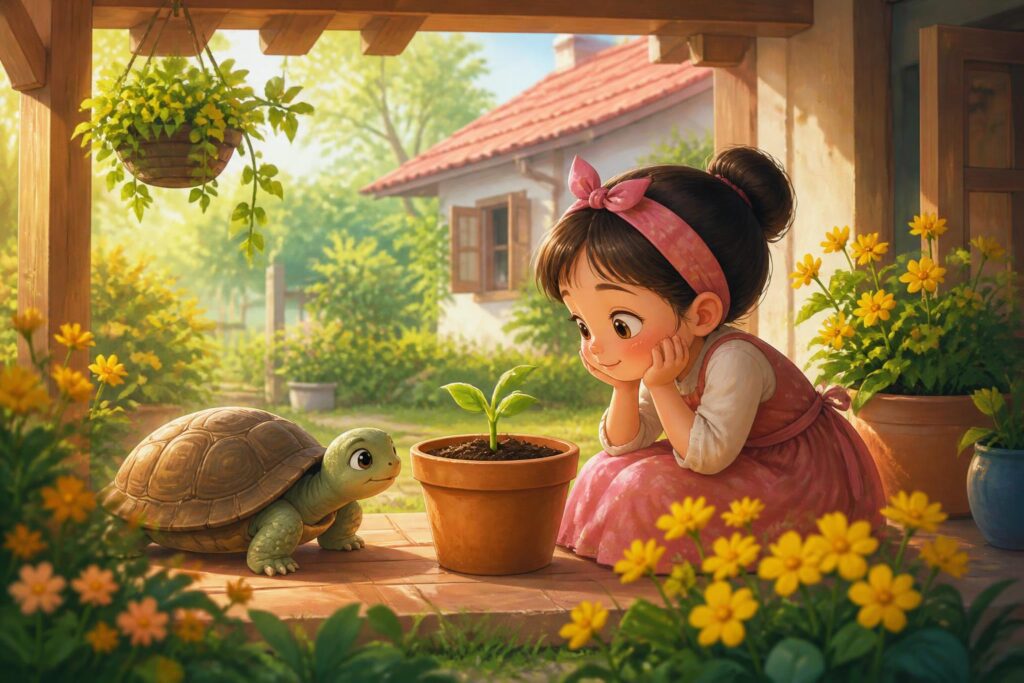
At the far end of a garden behind a red-roofed house, there was a small clay pot that was always kept beneath the porch roof. The pot held no flowers and no fruit tree. In the soil was only a tiny seed that little Na had picked up one morning at the beginning of the rainy season.
Na did not know what kind of plant the seed belonged to. It was round and dark brown, with a thin bright streak on its shell, like a thread. When she picked it up, Na held the seed close to her ear and heard a very faint sound, like someone whispering beneath the deep layers of soil.
“I want to grow.”
Na looked around in surprise. Outside, there was only the sound of a chicken scratching in the dirt, banana leaves brushing against one another, and her mother washing vegetables in the kitchen. Seeing no one talking, Na thought she must have misheard. But the little girl carefully brought the seed home, placed it in the small pot, and covered it with a layer of soft soil.
The Pot Beneath the Porch Roof
Every morning, Na woke up very early to take care of the seed. On the first day, she watered it with a small dipperful of water. On the second day, Na put the pot in a sunny spot. On the third day, she used a stick to draw a circle around the pot so that no one would accidentally step on it.
Yet many days went by, and the soil in the pot remained perfectly flat. Not a single young leaf appeared. Na began to grow impatient.
“Maybe the seed needs more water,” Na said.
She scooped up more water and poured it into the pot. The soil became soaked, and water spilled over the edge, splashing mud onto Na’s sandals. The next day, Na thought the plant needed more sunlight. She carried the pot into the middle of the yard, where the sun beat down fiercely from morning until noon. By afternoon, the soil in the pot had dried and cracked into tiny lines.
Na sat sadly beside the pot. Just then, Tortoise from the neighboring garden slowly crawled over. Tortoise had lived there for so long that no one remembered how old he was. Across his shell were curved patterns resembling a map of a faraway land.
“What are you doing?” Tortoise asked.
“I’m taking care of the seed, but it refuses to grow. I gave it water and brought it into the sunlight, but it still just lies there.”
Tortoise looked at the pot, then at Na. He did not answer right away. He simply stretched out his neck as far as it would go and pressed his ear close to the surface of the soil.
Na asked curiously, “What do you hear?”
“I hear that the soil is thirsty,” Tortoise said. “But thirsty soil does not always need a great deal of water. Sometimes it only needs to be watered just enough and given time to rest.”
Na lowered her head. She remembered the days when she had poured water into the pot in torrents and then left the soil to bake dry in the sun. Na had cared for the seed according to what she thought was best, but she had never asked what the seed truly needed.
The Whisper Beneath the Soil
That evening, Na placed the pot beneath the porch roof. The sun was no longer harsh. A gentle breeze moved through the areca palms, carrying the scent of damp earth and pomelo blossoms. Na sat down beside the pot, placed her hands on her knees, and tried to remain quiet.
For the first time, the little girl did not water the seed, loosen the soil, or shake the pot to see whether it had sprouted. Na simply sat and listened.
At first, she heard crickets chirping in the grass. Then came the sound of her mother closing the kitchen door, water flowing at the well, and a branch softly brushing against the tiled roof. When all the sounds gradually faded, Na heard a very small noise beneath the layer of soil.
“Knock.”
Then there was another.
“Knock.”
Na held her breath. It seemed the seed was stirring.
“Can you hear me?” Na asked very softly.
“Yes,” the seed replied. Its voice was as light as mist. “I hear you every day. You come rushing over, water me too forcefully, carry me into the sunlight, and then worry when I have not grown.”
Na blushed. “I just want you to hurry up and become a beautiful tree.”
“I want to grow too,” the seed said. “But first, I need to lie still in the soil. I need to drink a little water, receive a little sunlight, and open the tiny door in my shell by myself. If you keep lifting me up to check on me or keep changing the soil too much, I will not know when it is time to begin.”
Na remained silent for a long time. She understood that the seed was not lazy. It was simply growing in a way Na could not yet see. Outside, everything seemed to be standing still, but beneath the soil, a quiet journey had already begun.
Days of Patience
From that day on, Na changed the way she cared for the seed. Every morning, she used a small cup to give it just enough water. Na touched the surface of the soil to feel its moisture instead of making guesses. When the weather was sunny, she placed the pot in the gentle light on the porch. When it rained heavily, Na moved the pot closer to the doorway so the soil would not become flooded.
She also stopped digging into the soil to check. Na understood that some things needed to be trusted during the time when their results could not yet be seen.
The first day passed. The second day passed. Then another week passed.
During that time, Na discovered that the garden held many sounds she had never noticed before. In the morning, dewdrops falling from the leaves onto the soil sounded like tiny bells. At noon, ants marched in a line, their legs brushing against one another with a soft rustle. In the afternoon, the starfruit tree in the corner of the garden swayed even when the breeze blew only faintly.
Na began telling the seed about the things she saw. She told it that her mother had cooked a pot of sweet-leaf soup that day, that Mun the cat had fallen asleep in the laundry basket, and that Tortoise had found a very delicious young leaf. The seed listened to everything.
Sometimes, the seed told Na about its own experiences. It spoke of the warm darkness beneath the soil, the first roots searching for a way through the grains of sand, and the feeling of its hard shell gradually cracking open bit by bit.
“Are you scared?” Na asked.
“A little,” the seed answered. “Growing up always means entering a place you have never known before. But I will try. Because above this soil, there is a sky waiting for me.”
Hearing this, Na smiled. She realized that she, too, was often afraid of new things. Na had once been afraid of going to a new class, afraid to be the first to say she was sorry, and afraid to try riding a bicycle without training wheels. Perhaps the seed was like her: it needed a little time, a little care, and someone who would not hurry it along.
The First Green Sprout
One morning after a rainstorm, Na ran out to the porch as she did every day. When she bent over the pot, a tiny spot of green appeared against the brown soil. It was a small curved sprout, so delicate that Na was afraid even a strong breath might make it tremble.
Na did not cry out. She simply covered her mouth with both hands, her eyes wide with joy. Then Na called her mother, Tortoise, and even Mun the cat over to see. Mun did not understand anything; he merely yawned and curled up beside the pot. Tortoise gazed at the sprout for a long time, then nodded thoughtfully.
“You did well,” he said.
Na shook her head. “It wasn’t just me. The seed worked very hard too.”
The seed heard her and gently trembled in the breeze. From the day its first leaf appeared, it grew slowly but steadily. Each day, its stem grew a little taller. After a few weeks, round, soft leaves appeared on the plant. They were bright green beneath the sunlight, like tiny hands waving hello to the sky.
Na continued to care for the plant, but she no longer demanded that it grow according to her wishes. Some days, it produced only one new leaf. Some days, it did not change at all. Na understood that a lack of visible change did not mean that nothing was happening.
A few months later, the plant produced a pale yellow flower. It was not the most dazzling flower in the garden, but it had a gentle fragrance. Every morning, when the sun rose, the flower opened its petals. At night, it closed them like a baby curling up beneath a blanket.
Na sat beside the plant and remembered the day she had found the seed. She understood that the most precious thing was not simply seeing the plant grow. More precious was that, while waiting, Na had learned how to observe, be patient, and listen to a small living thing that was trying its best.
The Lesson Beside the Little Pot
From then on, whenever someone in the house felt sad or impatient, Na would lead them to sit beside the base of the plant. She did not rush to offer advice. Na simply asked everyone to sit still for a while and listen to the garden.
Some people heard the leaves trembling. Some heard birds calling to one another. Some heard water flowing through the ditch. And some, after sitting in silence for a while, realized that they themselves needed to rest.
Na often said, “A seed cannot grow faster just because we keep pulling it up. A person cannot become happier just because we tell them not to be sad. Sometimes, the best thing we can do is stay by their side, care for them just enough, and listen with all our gentleness.”
The yellow-flowered plant continued to grow beneath the porch roof. Each season, it bloomed with new flowers. Na never knew what kind of plant the original seed had belonged to, but she no longer wondered. To Na, its most important name was “the listening plant,” because thanks to it, she understood one thing: even small things have a voice; they simply often need someone truly patient enough to hear it.
And from that day on, whenever a seed fell to the ground in the garden behind the red-roofed house, Na would bend down gently, cover it with a layer of soft soil, and whisper:
“Grow at your own pace. I’ll be here to listen.”

ARTICLES IN THE SAME CATEGORY
The Girl and the Wind Chime
The Little Hedgehog Makes a Coat for the Windy Season
The Little Boy Who Saved a Sunbeam for a Rainy Day
The Boy and the Garden That Knew How to Listen
The Sprout in the Pocket
The Wind Chime That Kept Promises
ARTICLES IN THE SAME GENRE
Bông the Bunny and the Raindrop That Kept Its Promise
The Wind Chime and Brown Squirrel’s Promise
The Boy Who Gathered Laughter for a Wind Chime
The Wind Chime That Awakened the Garden
The Button That Went Looking for Someone Who Keeps Their Word
Tam Cam Part 2: The Vengeful Spirits of the Palace