

 Tiếng Việt
 日本語
 한국어
 中文 (中国)
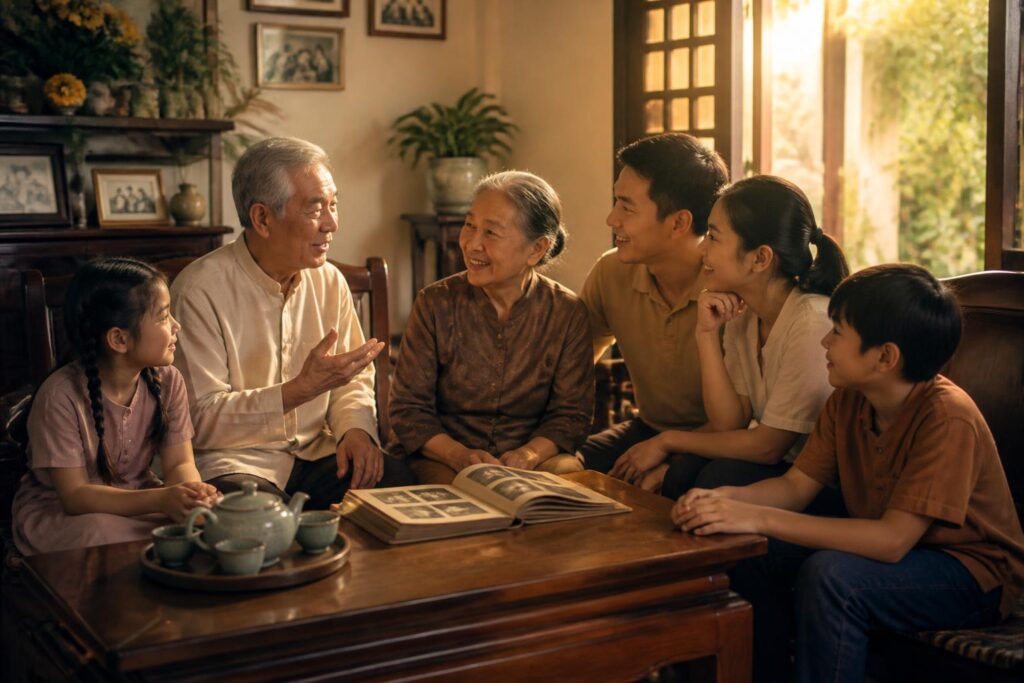
In a tử vi chart, many people tend to focus first on the Mệnh Palace, Tài Bạch Palace, or Quan Lộc Palace because these are areas that are easy to relate to personality, money, and work. However, if one looks only at outward manifestations, the interpretation may lack depth. The Phúc Đức Palace is often viewed as a background layer of the chart, revealing connections between family patterns, inner life, and the ability to rise again after difficult periods.
The concept of “phúc” in tử vi should not be understood simply as a fixed reward that a person passively receives. From a more familiar perspective, it may refer to values passed down through the family, patterns of behavior formed from childhood, support from loved ones, as well as the ability to maintain faith when circumstances change. Therefore, exploring the Phúc Đức Palace is not about concluding that someone is certain to be fortunate or unfortunate, but about reflecting on the spiritual foundation that supports or influences their choices.
How is the Phúc Đức Palace commonly understood?
In the tradition of tử vi, the Phúc Đức Palace is often associated with the blessings of one’s lineage, spiritual life, inner peace, and the degree of harmony a person has with their family environment. In the same circumstances, one person may easily find a source of support that enables them to continue, while another may feel depleted very quickly. This difference does not lie only in material conditions, but also relates to how each person was nurtured in terms of faith, responsibility, gratitude, and the ability to endure.
When analyzing this palace, one should generally not separate it from the chart as a whole. A palace may suggest a tendency, but how that tendency manifests also depends on related palaces, the stars present, and actual living circumstances. Tử vi, when used with awareness, is better suited to serving as a symbolic language for self-observation than as a predetermined verdict on the future.
The Phúc Đức Palace and the influence of family patterns
Family is where a person first learns about right and wrong, love, boundaries, and responsibility. Some families pass down a spirit of connectedness and encourage members to support one another in difficult times. Other families contain prolonged conflicts, silence, or expectations that have never been expressed aloud. These things can affect how a person views themselves and builds relationships with others.
In interpreting the Phúc Đức Palace, lineage should therefore not be understood merely in terms of having more or less wealth, nor should it be reduced to whether a family line is “good” or “bad.” A valuable foundation may sometimes be a tradition of learning, the habit of keeping one’s word, a spirit of mutual support, or the ability to overcome upheaval. Conversely, a family with material means but little communication may still leave its members feeling lonely. What matters is which spiritual legacy is being received and whether the person living in the present can discern and adjust it, and how.
From this perspective, the Phúc Đức Palace can serve as a reminder of intergenerational responsibility. Each person is both a beneficiary and someone who continues to shape the way of life of their own family. An act of kindness, a measured approach to resolving conflict, or the habit of caring for older people can all contribute to creating a safer environment for future generations.
Mental resilience does not come from luck alone
Another useful way to understand the Phúc Đức Palace is as the ability to recover after loss and upheaval. No one can live without experiencing disappointment, career changes, fractured relationships, or periods of feeling directionless. Mental resilience does not mean always being strong, nor does it mean being able to conceal one’s emotions. It is the ability to recognize that one is exhausted, seek appropriate support, and gradually regain balance.
If a chart suggests a deeply troubled inner life, that does not necessarily mean a person will have an unhappy life. It may indicate that they need personal space, require time to process their emotions, or are easily affected by the atmosphere around them. Once they recognize this characteristic, they can proactively build habits of rest, choose healthy relationships, and avoid making important decisions when they are under excessive mental strain.
Similarly, a manifestation considered favorable in the Phúc Đức Palace does not guarantee that a person will always be at peace. Someone with many sources of support may still fall into crisis if they are accustomed to relying on outside help while lacking the ability to take responsibility for themselves. Phúc khí, if understood in practical terms, needs to be nurtured through one’s attitude toward life, the way one uses opportunities, and the ability to share with others.
Do not turn the Phúc Đức Palace into a reason to judge
Rigid interpretations of blessings can sometimes create two extremes. A person believed to have “phúc” may become complacent, assuming that everything will naturally work out. Conversely, someone judged to have a weak foundation may develop unnecessary feelings of inferiority or fear. Both approaches diminish the value of self-observation.
The Phúc Đức Palace should not be used to judge a family’s morality, attribute present difficulties to the mistakes of ancestors, or assert that a person must suffer because of “karma.” Issues such as domestic violence, psychological trauma, illness, or financial hardship need to be addressed with appropriate knowledge and specific support. Tử vi cannot replace psychological counseling, medical care, legal advice, or responsible decisions in life.
A cautious interpretation should begin with open-ended questions. What sources of support have I received from my family? What habits am I repeating that cause my relationships to become tense? When I encounter upheaval, whom do I usually turn to? What helps me become calmer? Questions like these return the chart to its proper role as a source of suggestions while also giving agency to the person living within specific circumstances.
“Phúc” can be cultivated through very ordinary actions
If Phúc Đức is regarded as the foundation of peace and stability, cultivating it does not necessarily require grand actions. First, it means maintaining kindness in our closest relationships. A conversation in which neither person avoids the issue, a timely apology, or listening to a loved one without rushing to judge can all reduce distance within a family.
Second is building a life with a steady rhythm. Relatively regular sleep and rest, working within the limits of one’s health, spending time in nature, reading, practicing stillness, or maintaining a meaningful activity can all help people recognize their inner state. These things do not create miracles, but they give us greater capacity to cope with pressure.
Third is knowing how to give within limits. Kindness does not mean always making sacrifices or solving other people’s problems for them. Sustainable help needs to be accompanied by awareness, respect, and the ability to protect oneself. When a person knows how to give without nurturing resentment, while also knowing when to say no, relationships often have a better chance of becoming healthier.
Finally, one needs to learn how to select and adapt the family legacy. Not every tradition needs to be preserved unchanged, and not every difference from the previous generation is a sign of disrespect toward one’s parents. A person can honor their roots while still changing their way of communicating, their approach to raising children, or their view of success. It is the ability to transform what has been received that allows family patterns to continue developing instead of becoming a burden.
Viewing the Phúc Đức Palace as a reminder of the power to choose
The Phúc Đức Palace can be seen as the quiet part of a tử vi chart. It does not speak only of what already exists, but also prompts reflection on how people create a sense of stability in a world full of change. A harmonious family is a precious source of support, but peace does not come merely from the absence of conflict. Peace also lies in the ability to face the truth, repair mistakes, and not allow old wounds to determine the entire future.
Therefore, when exploring this palace, what matters is not searching for an absolute conclusion. Instead, regard it as an opportunity to identify the resources, limitations, and habits being passed from one generation to the next. If there is a good foundation, appreciate it and continue it through concrete actions. If there are cracks in the family, view them with awareness, seek the necessary support, and begin changing what lies within your control.
In this sense, “phúc” is not merely something that waits to be bestowed. It is also the way we live with our loved ones, the way we overcome adversity, and the way we leave behind a kinder space for those who come after us. The Phúc Đức Palace therefore does not end with a judgment, but opens with a more valuable question: today, what can we do to make our own spiritual life and our family more resilient?

ARTICLES IN THE SAME CATEGORY
The Wealth Palace in a Tử Vi Chart: A Perspective on Money, Habits, and Management Skills
The Quan Loc Palace in a Tử Vi Chart: Understanding Career Through Ability, Choices, and Actions
The Career Palace in a Tử Vi Chart: Understanding Career Paths Through Abilities and Choices
The Spouse Palace in a Tử Vi Chart: Understanding Love Through Maturity and Empathy
The Phúc Đức Palace in a Tử Vi Chart: The Spiritual Foundation and Understanding Happiness
The Wealth Palace in a Tử Vi Chart: Perspectives on Money, Value-Creation Ability, and Financial Habits
ARTICLES IN THE SAME GENRE
The Default Choices Quietly Shaping Our Lives
Familiarity Is Not Always the Truth
Memory Is Not a Video Camera: Understanding It Clearly to Look Back at Ourselves
When Belief Guides the Way We See the World
Knowing When to Ask: A Skill That Opens the Door to Deeper Conversations
Being Busy Doesn’t Mean Making Progress: Rethinking How We Use Our Time