

 Tiếng Việt
 日本語
 한국어
 中文 (中国)
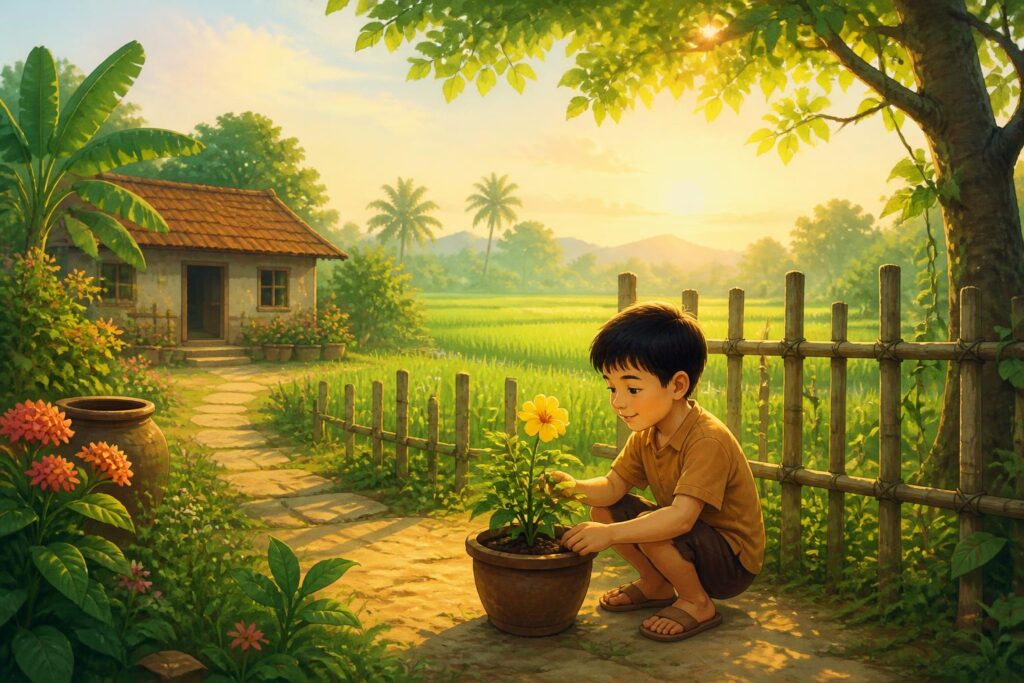
At the edge of a village nestled among green fields, there lived a boy named Tí. Tí was quick, clever, and loved exploring, but he had one flaw that everyone in the village knew about: he always wanted everything to happen very quickly.
He wanted breakfast to be served as soon as he woke up, wanted his kite to rise after just one run, and wanted his mother’s batch of cakes to be baked the moment she put it in the oven. When he planted a small bean in a clay pot, Tí looked down into it every day and sighed because he could not see a single leaf poking through.
His mother would often smile and say, “Everything has its own time, my child. A seed needs to lie still in the soil, drink enough water, and receive sunlight before it can become a tree.”
But Tí did not like waiting. He wanted to see results immediately, just like watching a ball bounce after being thrown onto the ground.
The Wooden Box Beneath the Tree
One afternoon at the beginning of summer, after helping his mother carry vegetables to the market, Tí took a shortcut through the small forest behind the village. The forest was not large, but it had many winding paths. Adults often warned children not to go too deep because they could easily get lost.
Tí knew the forest paths well, so he was not worried. He walked along, kicking dry pinecones, until he heard a very strange sound. It was not the sound of birds, wind, or running water. It sounded like someone tapping very softly on a wooden door.
Knock. Knock. Knock.
Tí stopped and looked around. Beneath an ancient tree covered in green moss stood a small wooden box. The box was so old that its lid had faded, but there was no lock on it. Tí bent down and touched the lid. The sound rang out again.
Knock. Knock.
“Is anyone in there?” Tí asked.
There was no reply. Tí opened the lid. Inside lay a round, light-brown seed on a layer of soft cloth. Beside the seed was a small piece of paper. Written on it were the words: Only one who knows how to listen can help the seed awaken.
Tí picked up the seed. It was warmer than any seed he had ever seen. He pressed it to his ear, but all he could hear was his own heartbeat.
“If you want to wake up, I’ll help you,” Tí said. “But you have to grow very quickly, all right?”
He brought the seed home and planted it in the clay pot by the window. Tí watered it very generously, then sat staring at the soil. After a while, nothing had changed.
Impatient Ways of Caring
The next morning, Tí woke up very early. He ran to the plant pot. The soil was still perfectly still.
Tí added more water. At noon, he watered it again. In the evening, he used his finger to dig into the soil and check whether the seed had sprouted. The seed was still lying motionless, but its outer shell had become slightly soft.
“Perhaps you haven’t heard me,” Tí said. “I’ll call louder.”
He leaned close to the pot and talked continuously about all the things he wanted to do when the tree grew. Tí wanted to climb its branches, pick its sweet fruit, and build a small house in its canopy. He talked until he was hoarse, but the seed remained silent.
On the third day, Tí used a stick to poke gently into the soil and make a small hole so the sprout could emerge more easily. On the fourth day, he placed the pot outside in the harsh sunlight because he thought that the more sunlight the plant received, the faster it would grow. By evening, the soil in the pot had become hard and dry. The seed still had not sprouted.
Tí angrily kicked the leg of the table.
“You’re so slow! Mother’s bean plants have had leaves for ages.”
Just then, his grandmother came in from the garden. She looked at the pot of soil, the watering can filled with water, and the little stick marks on the surface of the soil. She did not scold Tí; she simply pulled up a chair and sat down beside him.
“Have you asked the seed what it needs?” his grandmother asked.
“I’ve watered it, let it bask in the sun, and talked to it every day. I’ve done everything.”
“Have you listened?”
Tí was stunned. He had thought that talking to the seed was enough. His grandmother told him to place the pot between them, and the two of them sat in silence.
At first, Tí found the silence very uncomfortable. Outside, a chicken was scratching at the ground. Farther away, the voices of people calling to one another drifted back from the fields. The wind rustled the banana leaves. An ant crawled across the edge of the pot.
“What do you hear?” his grandmother asked.
“The wind, the chicken, people, and the leaves.”
“What about the seed?”
Tí bent down. This time, he pressed his ear to the pot of soil without saying anything. After a long while, he heard a very small sound, almost no more than a faint vibration beneath his palm.
Knock.
Tí looked up. His grandmother smiled.
“Perhaps it’s saying that the soil is too hard. It may also need less water. To know for certain, you must observe, not simply do whatever you want.”
The Lesson in the Garden
From that day on, Tí began caring for the seed differently. He replaced the dry soil with loose soil from the garden. He placed the pot where it would receive gentle morning sunlight, away from the intense heat of midday. Each day, Tí gave it only enough water, then waited for the soil to absorb it on its own.
He no longer dug up the soil to check. Instead, Tí watched for small signs. When the surface of the soil was dry, he added a little more water. When the leaves of the plant beside it leaned toward the window, he turned the pot so the light would fall more evenly. He also learned not to touch the seed too much.
Waiting was still not easy. Some mornings, Tí woke up wanting to dig up the seed and look at it. Some afternoons, he thought he had been caring for it in vain. But each time, he remembered his grandmother’s words: To know what something needs, you must listen first.
During that time, Tí also began paying attention to the people around him. Before, when his mother told him stories about the market, he would usually listen while running off to play. Now Tí sat quietly beside her and listened as she told him about an old woman who needed someone to carry her vegetables home. When his best friend Bin said he was sad because he had ruined his paper boat, Tí did not hurriedly tell him to make another one. He sat beside Bin and listened to the whole story.
Tí realized that everyone had things that were difficult to put into words. Sometimes his mother was tired but still smiled. Sometimes his grandmother’s back hurt, but she did not complain. Sometimes a friend needed to be listened to before receiving advice.
A week passed. No sprout had emerged, but Tí was no longer angry. He began to feel that the pot of soil was not silent at all. Every day, it gave him a small sign: the soil stayed moist longer, the seed cracked open along a thin line, and beneath the ground, a tiny white root was searching for a way downward.
The Sprout Awakens
On the morning of the eighth day, Tí saw a pale green shoot poking out of the soil. It was so small that, without looking carefully, someone might mistake it for a blade of grass.
Tí was so happy that he almost ran off to call the whole village. But then he stopped. The young shoot was still very weak. Tí gently shielded it from some of the sunlight with a thin piece of cloth, checked the moisture of the soil, and called his grandmother.
His grandmother came over, looked at the sprout, and said:
“You see? It did not wake up because you urged it to. It woke up because the time had come, and because you had learned to care for what it truly needed.”
Tí nodded. He no longer thought the tree was growing to serve his wishes. He understood that a seed was not a toy that could be made to obey someone else’s desires. It was a living thing with its own rhythm, and it needed to be respected.
The shoot grew a little more each day. After a month, it had lush, round green leaves. A few months later, the stem had grown taller than Tí’s knee. One morning, the first flower bud appeared on a branch. The bud was tightly closed, as if it were guarding a small secret.
Tí did not try to pull the petals apart to see inside. He simply gave it enough water and waited patiently. One day, when the first sunlight touched the garden, the flower bud slowly opened. Pale yellow petals formed a circle, and in the center was a red pistil like a drop of honey.
Tí placed his hand against the tree trunk. From within, he felt a very faint vibration.
Knock.
“I hear you now,” Tí whispered. “Thank you for teaching me how to wait.”
What Tí Brought Back to the Village
From then on, Tí asked his mother for a small patch of land beside the fence so he could plant more trees. He did not plant a great many just to have a large garden. He planted each tree where it suited the space, learned how much water it needed, and cared for it patiently.
Tí also told the other children about the wooden box in the forest and the strange seed. Some of his friends did not believe him, while others wanted to find the box immediately and bring it home. Tí simply smiled and told them that what mattered was not finding a special seed, but learning to treat every living thing with attention and gentleness.
Later, the village had a community garden. Each family contributed a tree. The children took turns watering the plants, pulling weeds, and observing the small changes. When a plant did not grow, no one was quick to throw it away. They would find out together whether the soil was too dry or the plant was not getting enough light, then make adjustments little by little.
As for the wooden box beneath the ancient tree, no one ever found it again. Some people said it had been covered completely by moss. Others believed that the box appeared only to those who needed to learn a lesson. Tí did not know which was true, but he still clearly remembered the very soft knocking sound from that afternoon long ago.
The story of the seed reminded Tí that not everything slow is bad. Some things need time to grow, some sorrows need to be heard before they can fade, and some dreams become lasting only when they are cared for with patience. When we know how to pause, observe, and listen, we will realize that life is always sending us small but precious messages.

ARTICLES IN THE SAME CATEGORY
The Wind Chime and the Garden’s Promise
The Little Girl Who Kept the Rainy Season in an Earthen Jar
The Boy Who Planted Light by the Stream
The Button That Knew How to Listen
The Wind Chime That Did Not Want to Ring
The Garden That Knew How to Wait for Rain
ARTICLES IN THE SAME GENRE
The Boy Who Planted Light by the Stream
The Wind Chime That Did Not Want to Ring
The Garden That Knew How to Wait for Rain
The Little Seed and the Garden That Knew How to Wait
Bông the Bunny and the Raindrop That Kept Its Promise
The Wind Chime and Brown Squirrel’s Promise