

 Tiếng Việt
 日本語
 한국어
 中文 (中国)
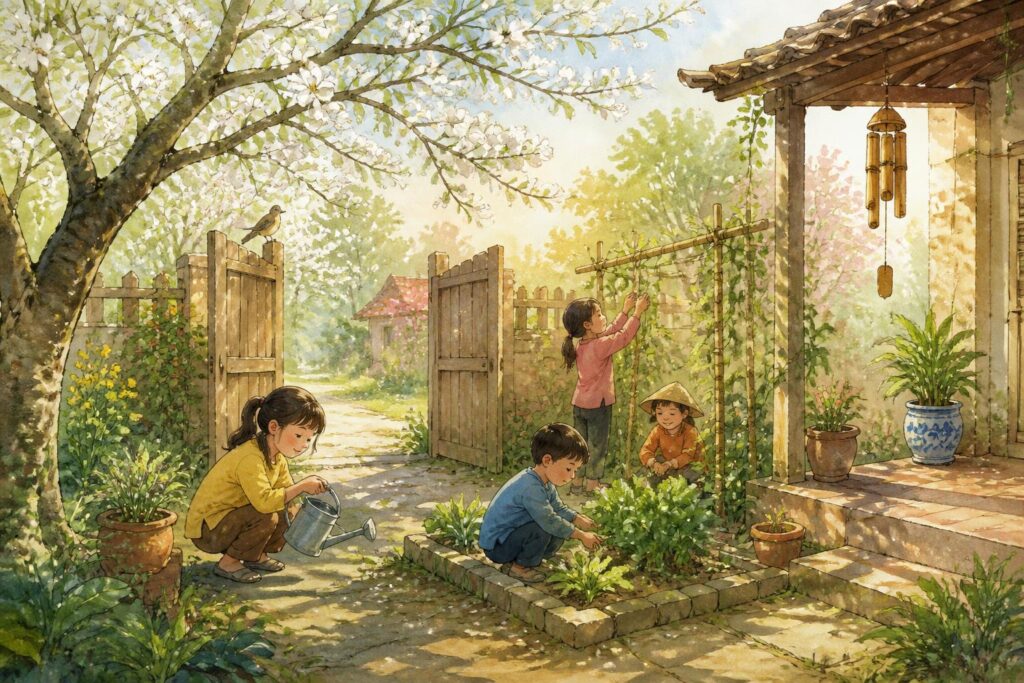
At the end of the stone-paved road in the village of Young Shoots stood a small, forgotten garden. The garden lay behind a house with a blue-tiled roof, its weathered wooden gate kept shut all year round. Long ago, the place had been full of flowers, but over time, weeds grew taller than a person’s knees, the garden beds hardened and dried, and the trellis leaned to one side. Only an old plum tree still stood quietly beside the wall, blooming with a few clusters of white flowers each spring.
Mi often passed the garden on her way to class. She liked watching the plum blossoms fall to the ground, but she had never stepped inside. Her grandmother told her that the garden belonged to a woodworker who had left the village a very long time ago. Before he left, he locked the gate and hung a bamboo wind chime under the porch. Many years passed, yet the wind chime was still there, even though some of the bamboo pieces had cracked and the hanging cord had frayed.
“Why doesn’t anyone take care of the garden, Grandma?” Mi asked.
Her grandmother was picking vegetables. Hearing this, she smiled. “Perhaps because everyone thinks the garden no longer wants to be cared for.”
Mi was surprised. “Can a garden want things too?”
“There are things that cannot be said in words, but can still be noticed if you are willing to observe.”
Those words stayed with Mi all evening. The girl thought about the cracked garden beds, the old plum tree, and the silent wind chime. The next morning, before going to school, Mi stood in front of the wooden gate. Through a gap in the door, she saw a tiny sprout poking up among the grass. The sprout had two young leaves, so green that they almost seemed to glow in the early sunlight.
Mi did not know what kind of plant it was. She only knew that the sprout was trying to grow all by itself.
A Small Deed Beside the Old Gate
That afternoon, Mi asked her grandmother for a small watering can. She opened the garden gate with a key her grandmother had found in an old drawer. The gate let out a long creak, as if it had been waiting a very long time to be opened.
Mi did not do everything at once. She began by pulling out the grass around the sprout. Some blades were soft and came out by the roots with a gentle tug. Others had roots that clung tightly, so Mi had to loosen the soil with a small stick before pulling them out. Her hands quickly became muddy and her knees were covered with dry grass, but Mi did not mind. She also placed a flat stone beside the sprout to mark the spot she needed to remember.
After that, Mi poured a little water around its roots. She did not water it too much because her grandmother had once taught her that plants also needed to be cared for in moderation. Before leaving, Mi looked around the garden and said softly:
“I’ll come back tomorrow.”
No one answered. The wind chime under the porch remained silent. Yet just as Mi stepped through the gate, one bamboo piece lightly touched another, making a clear sound like a whisper.
The next day, Mi returned. She picked up dry branches, straightened the trellis, and gathered fallen leaves into a small pile in the corner of the garden. On the third day, Mi found an old shovel in the shed. On the fourth day, she discovered a row of flower bulbs that had lain dormant for a long time beneath the soil near the plum tree. Mi did not dig them up. She simply cleared the weeds around them and placed a few small branches around the area as a fence.
Each day, Mi could do only a little. On some days, the weather was hot, and she had time only to water the sprout before going home. On other days, it rained as soon as she arrived, and Mi stood under the porch listening to the sound of water falling on the chimes. There were also days when Mi was so tired that she only sat beside the plum tree and told the garden about what had happened at school.
She talked about a difficult math problem, a new friend who had moved to the village, and the calico cat that often slept on the doorstep of her teacher’s house. Mi did not know whether the garden could hear her, but after each story, she felt lighter inside.
The Chime Was Not Only Meant to Make Sound
A week later, Mi’s classmates began noticing her mud-stained shoes. When they learned that she was caring for the old garden, several of them wanted to come along. Tung brought a bamboo broom, Linh brought some flower seeds her mother had given her, and An brought a small wooden scoop.
At first, the children competed to work. Tung wanted to sweep the entire path as quickly as possible, Linh wanted to sow the seeds right beneath the plum tree, while An thought they should repair the trellis first. Everyone thought their own idea was best. Before long, they began arguing.
Mi looked at the wind chime. The wind was blowing through the porch, but the chime only moved one piece at a time and did not produce a clear sound. Suddenly, she remembered her grandmother’s words: there are things that can only be noticed when one is willing to observe.
“How about we try listening to the garden first?” Mi said.
The others stopped.
Mi pointed to the garden bed on the left. “There are lots of little sprouts here. If we sweep too hard, we might break them.” She pointed to the trellis. “And over there, its legs are still sturdy. We only need to tie the vines back up; we don’t need to take it apart yet.”
Her friends bent down and looked more closely. Indeed, beneath the dry leaves were many young shoots poking up. The children divided the small tasks among themselves. Tung swept gently around the path, Linh planted the seeds in a separate bed, and An used soft cord to tie the climbing branches back in place.
When everyone slowed down, the garden seemed to grow larger. Things that had previously been hidden by weeds gradually appeared: a stone step leading to the plum tree, an old wooden bench, and a small water basin at the end of the garden. A leaf was carved into the side of the basin.
At the end of the afternoon, the wind blew through the porch. The wind chime rang out a gentle series of notes. The children looked up and listened. No one said anything, because everyone felt that the sound was like a thank-you.
A Promise Beneath the Plum Tree
From then on, the garden became a place the children often visited after school. They did not call it an assigned task. Each person simply did one manageable thing before going home. Some watered the plants, some gathered leaves, and some checked the gate. When they saw a plant being eaten by insects, they asked adults how to deal with it instead of acting on things they did not know. When they discovered a bird’s nest in a bush, they left the bush as it was and took the other path around it.
Mi also learned that caring did not mean changing everything according to one’s own wishes. Some branches needed to be cut so the plant could grow healthier, but others only needed to be tied back. Some places needed more water, while in others the soil should be left dry. Some seeds would sprout quickly, while others had to remain still beneath the earth for a very long time.
One afternoon, her grandmother came to visit the garden. She stood before the freshly cleaned gate and looked at the still-small plants and the trellis, which was straighter than before.
“You’ve changed the garden,” she said.
Mi shook her head. “Not by myself. My friends helped too. And the plants are growing on their own as well.”
Her grandmother nodded. “That’s right. A good caretaker is not someone who forces everything to grow as quickly as possible. It is someone who knows how to create a safe place where life can grow in its own way.”
That evening, Mi and her friends sat beneath the plum tree. The first flowers of the season had just bloomed, white like tiny points of light against the green leaves. The children decided to make a promise: they would not neglect the garden, but neither would they regard it as anyone’s private property. Anyone passing by could admire the flowers, rest their feet, and contribute a little effort, as long as they did not break branches, step on the garden beds, or take anything they had not planted.
Mi tied a new cord to the wind chime. She did not replace the old bamboo pieces, because they still made sounds of their own. She only made the chime more secure so that it could continue to ring whenever the wind passed through.
The Garden Opens Its Gate
Many months later, the garden had not become a perfect place. There were still days when the grass grew quickly, leaves covered the paths, and some seeds failed to sprout. But the plum tree had grown greener, the flower beds were beginning to show color, and the wooden bench had been cleaned so everyone could sit and rest.
The gate was no longer locked. There was no nameplate hanging on it, nor any boastful message. There was only a small wind chime that rang whenever someone pushed the gate open and stepped inside.
Mi understood that the chime did not call people in to admire a beautiful garden. It reminded them to enter gently. It reminded them that every sprout needed time, that every patch of soil had its own story, and that sometimes a promise was kept only through very small deeds repeated day after day.
One weekend afternoon, a child in the village picked up a yellow leaf and was about to throw it into the flower bed. Mi gently stopped the child and led them to the pile of decaying leaves in the corner of the garden.
“Leaves can return to the soil here,” Mi explained. “But the flower bed needs to be kept clean so the little plants can grow.”
The child nodded and carefully placed the leaf on the pile of decaying leaves. Just then, the wind brushed past the porch. The wind chime rang clearly, joining the sound of leaves trembling in the branches of the plum tree.
Mi smiled. She knew that the garden was still speaking in its own way. And this time, more and more people were willing to stop and listen.
Lesson: Sustainable change often begins with small deeds done patiently. When we learn to listen and care instead of rushing to impose our will, we can help a sprout, a friendship, and even a forgotten place find its vitality again.

ARTICLES IN THE SAME CATEGORY
The Seed That Knows How to Listen
The Little Girl Who Kept the Rainy Season in an Earthen Jar
The Boy Who Planted Light by the Stream
The Button That Knew How to Listen
The Wind Chime That Did Not Want to Ring
The Garden That Knew How to Wait for Rain
ARTICLES IN THE SAME GENRE
The Boy Who Planted Light by the Stream
The Wind Chime That Did Not Want to Ring
The Garden That Knew How to Wait for Rain
The Little Seed and the Garden That Knew How to Wait
Bông the Bunny and the Raindrop That Kept Its Promise
The Wind Chime and Brown Squirrel’s Promise