
Story Collections · 19 November, 2026
The One Who Collected Forgotten Things
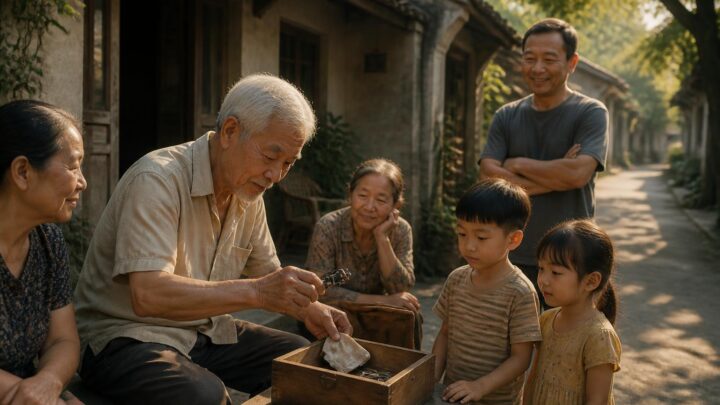
The Wooden Box Beside the Veranda
At the end of a small street stood an old tile-roofed house, with a dark-brown wooden box always placed outside its veranda. The box was not large, just big enough to hold a few odds and ends such as keys, buttons, handkerchiefs, hair clips, or crumpled bus tickets. Beside the box was a wooden sign, on which neat handwriting read: “If you have dropped something, try looking here.”
The man who lived in that house was named Mr. Lam. He was over sixty, thin, with hair more than half gray, and he walked slowly, as though he were always afraid of disturbing something asleep on the ground. Every morning, he swept from one end of the alley to the other. He did not just sweep away leaves. Whenever he saw an object lying alone beside the sidewalk, he would bend down, pick it up, clean it, and place it in the wooden box.
At first, no one understood what he was doing it for. People often lost things, and if necessary, they simply bought replacements. A button was not worth much money. An old handkerchief was hardly a valuable possession. Some people even laughed and said that Mr. Lam had too much free time, which was why he went around collecting things other people no longer needed.
He only smiled and offered no explanation. Whenever someone came to reclaim an item, he carefully asked a few questions to make sure it really belonged to them. When returning it, he never accepted money. He would usually say: “Take it. Some things may be small, but once they are gone, we realize how accustomed we had become to their presence.”
The First Item to Return
The first person to find something in the box was a little girl named An. That day, An had just left school and was crying as she ran down the street, looking into every crack between the paving stones. She had lost a blue hair clip her mother had given her on her first day of school. The clip was not expensive, but it had a small butterfly on it, resembling something her mother had used when she was young.
An searched for a long time but could not find it. When she passed Mr. Lam’s house, she saw the sign and timidly asked:
“Grandpa, did you happen to find a blue hair clip?”
Mr. Lam opened the box and took out a hair clip lying beneath a white handkerchief. He remembered picking it up near the foot of the almond tree that morning. An held the clip to her chest and smiled through her tears.
“Thank you, Grandpa. I thought that if I lost it, I would never find it again.”
Mr. Lam watched the little girl put the clip in her hair. “Sometimes an object does not truly disappear. It has only wandered away from the person who needs it.”
An remembered those words for a very long time. Later, whenever she saw something lying by the roadside, she would stop. If it was trash, she put it in a bin. If it was an object, she brought it to Mr. Lam. Gradually, the other children in the street began doing the same.
The Stories Inside the Box
The wooden box grew fuller day by day. One day, Mr. Lam found a wallet with no money inside, but containing a photograph of an elderly woman. Another day, he picked up a simple silver ring with a date faded on its inner surface. Once, he found a letter that had not yet been sent, blown by the wind into the grass beside a wall.
He did not open the letter. He simply folded it flat, placed it in a paper bag, and set it apart in the lower compartment of the box. He believed that a person’s privacy was like the door to their home: one could not enter it without permission simply because the door happened to be open.
The person who had lost the ring was Mrs. Hao, a woman who lived in the house across the street. She found it nearly a week later, after she had thought she would never see it again. She said it was the ring her husband had given her on their wedding day. Her husband had died many years earlier, but she still wore the ring as a way of holding on to the promise they had made to each other.
“I thought I had lost a piece of jewelry,” she said, “but it turned out what I feared most was losing the feeling that he was still beside me.”
Mr. Lam did not reply. He simply poured her a cup of tea. Outside the veranda, sunlight fell in patches across the tiled floor. The two of them sat in silence for a long time, because sometimes a story needs to be listened to rather than met with more advice.
After that day, Mrs. Hao often came over to help him clean the items in the box. She said his eyesight was poor and she could do it more quickly. Mr. Lam knew that she only wanted a reason to visit, but he did not expose her. Some people need to be helped, while others need to be given the opportunity to help someone else.
What Is Forgotten Is Not Always an Object
One rainy afternoon, Mr. Lam saw a boy sitting beneath the awning of a closed shop. He was about ten years old, soaked through, with both hands wrapped around a worn schoolbag. Mr. Lam asked whether he had lost something. The boy shook his head.
“I haven’t lost anything,” he said. “I just don’t want to go home.”
Mr. Lam did not immediately ask why. He brought the boy a dry towel and a bowl of hot porridge. The boy ate slowly, his eyes fixed on the rain outside. Only after a long while did he say that his parents had just quarreled. His mother had left, while his father had shut himself in a room. He was afraid that if he went home, no one would see him.
After listening, Mr. Lam said: “There are days when adults lose their way too. But the fact that they have lost their way does not mean you no longer have a place to return to.”
He took the boy all the way home. In front of the closed door, he did not reproach the father or offer words of moral instruction. He simply knocked and waited. After a while, the door opened. When the father saw his son, his expression immediately changed. He bent down, embraced the boy, and awkwardly apologized.
The next day, the boy returned to the tile-roofed house. He asked Mr. Lam how he had known what to do. Mr. Lam smiled and replied that he did not know. He had simply thought that if someone was standing out in the rain, the first thing to do was bring them somewhere dry; the other matters could be dealt with gradually afterward.
Mr. Lam’s Own Search
The people on the street gradually grew accustomed to the wooden box. They no longer laughed at Mr. Lam. Everyone had reclaimed something from him at least once, or brought him an object they had found. The street, which had once held only brief greetings, began to have more conversations.
Yet no one knew that Mr. Lam, too, was searching for something he had lost a very long time ago.
His wife had died one winter many years earlier. When she was still alive, the two of them had run a small household-goods shop. After her death, he closed the shop and moved to the house at the end of the street. People thought he liked living alone, but in truth, he did not know how to live in a house without the familiar sound of her voice.
During the first few years, he kept everything unchanged. The cup she often used remained on the shelf. Her coat still hung behind the door. An old pair of slippers was still placed neatly beside the bed. He was afraid that if he changed anything, his memories of her would fade.
But the harder he tried to preserve everything, the quieter the house became. He realized that he did not merely miss a person. He missed being asked what he would eat that day, the sound of her scolding when he forgot to bring a raincoat, and even the evenings when the two of them sat beside each other without needing to talk.
That was when the wooden box appeared. He began collecting forgotten objects because he understood what it felt like to see something familiar lying alone by the roadside. Every object returned to its owner was another time he believed that loss was not always the end.
Until one day, he found a photograph of his wife in an old drawer. The photograph had yellowed, and on the back she had written a line: “If one day I am no longer here, remember to open the door and let everyone in.”
Mr. Lam sat beside the table for a long time. Then he cleaned the front room, arranged a few extra chairs, and opened the door to welcome his neighbors in for tea. He understood that what he had lost could not be restored exactly as it had been, but the love they had shared could continue to exist if he passed it on to others.
The Things We Unintentionally Let Fall
The story of Mr. Lam does not say that every object will be found, or that every separation can be healed. In life, there are losses that cannot be repaired. Some people leave without having time to say goodbye. Some apologies come too late. Some relationships have been drained dry after being neglected too many times.
But amid the things that cannot be changed, people can still choose to treat what remains with kindness. A returned hair clip can make a child happy for an entire day. A ring that is found can help an elderly person hold on to a memory. A bowl of hot porridge can help someone become calm enough to get through a difficult evening.
What is worth reflecting on is that we often recognize the value of care only when it is no longer there. We easily forget a phone call, a word of concern, a shared meal, or the gaze of the person sitting beside us. These things are neither loud nor expensive, yet they quietly create the feeling of belonging.
Therefore, perhaps everyone needs a “wooden box” in their heart. It is a place where we keep small but important things: promises that need to be fulfilled, people who need to be checked on, meals we need to return home for, words of thanks left unsaid, and apologies that should not be delayed any longer. If we do not remind ourselves, we can easily drop them amid our hurried work.
A Door Opening Toward the Street
Many years later, the sign in front of Mr. Lam’s house had grown old. The writing had faded, and the wooden box had been replaced by a new one that the children in the street built themselves. They painted it pale yellow and placed an additional piece of paper beside it: “If you find someone’s belongings, bring them here. If you are sad, you may also sit here for a while.”
Mr. Lam no longer had the strength to sweep the entire street every morning. The task was shared among everyone. An, the little girl who had once lost her hair clip, was now grown and often stopped by to help him record the newly found items. Mrs. Hao still made tea. The boy from years ago occasionally brought his young daughter to visit and told her about the person who had led him out of a rainy afternoon.
People still dropped keys, handkerchiefs, and other small belongings on the street. But once everyone learned to stop and bend down, they also began to notice many other things: a tired neighbor, an elderly person who needed help carrying a bag, a child standing alone outside the school gate, or a relative who had not been asked how they were doing in a long time.
Mr. Lam often said that picking up an object was only a very small act. What mattered more was whether, afterward, we remembered to look around and notice who was being forgotten.
At the end of the street, the door of the tile-roofed house was still open every morning. The wooden box rested beside the veranda, quietly waiting for lost things to return. And perhaps, one day, the person who came looking for a lost object would realize that they had found more than a familiar possession. They had also found a little faith that, amid this vast life, there were still people willing to bend down, pick up, and care for something that seemed to no longer matter to anyone.
Related articles
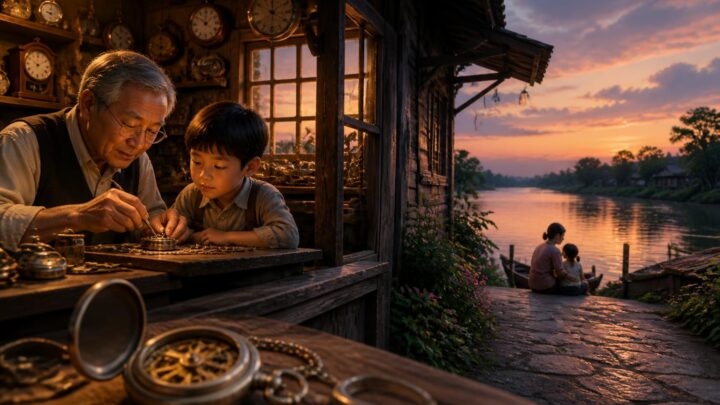
The Clock Shop at the Bottom of the Hill and the Day Time Stopped
At the bottom of the hill leading down to the riverbank stood a small clock shop. The wooden sign in front of the door had faded, but the words carved into it could still be read: Repairing the Things That Missed Their Beat. The townspeople called it Mr. Bay’s shop, though no one knew what
Read more
The Keeper of the Rainy Season and the Umbrella That Never Opened
At the end of the street lined with old golden shower trees, where the low-roofed houses gradually gave way to a stretch of land along the river, there was a man who often appeared just as the sky was about to rain. He was in his early sixties, thin, with mostly gray hair, and always
Read more
The Bougainvillea Wall at the End of the Alley
At the end of a small alley stood a wall covered in bougainvillea. Every sunny season, delicate clusters of flowers burst into bloom against the backdrop of peeling limewash, making the stretch of road that few people had ever noticed suddenly seem brighter. The people in the alley had grown so accustomed to the wall
Read more
The Wooden Bridge and the Guide for Those Who Are Lost
To the north of a small village stood a forest shrouded in mist all year round. The villagers called it the Misty Forest, not because the trees were too dense, but because anyone who entered easily forgot where they were going. Some people went in to gather firewood and returned a few hours later, but
Read more
The Clock That Did Not Tell Time
At the end of a narrow street, where old rooftops leaned to reflect their shadows in a ditch thick with duckweed, there was a small shop called Moc Clock Shop. The wooden sign had faded with age, and the letters on it were almost impossible to read, but everyone in town still knew the place.
Read more
The Clock That Would Not Run and the Forgotten Letter
At the end of a small street stood a watch-repair shop that had been there so long that many people no longer remembered when it had opened. The wooden sign above the porch had faded, two letters in the shop’s name worn away by sun and rain, while the glass door was always covered with
Read more