
Story Collections · 16 November, 2026
The Wooden Bridge and the Guide for Those Who Are Lost
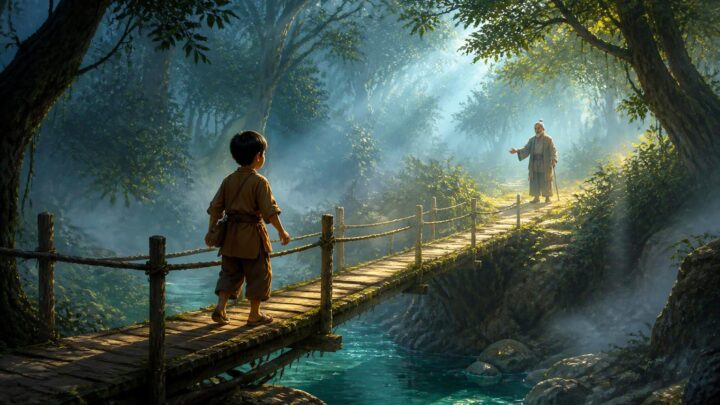
To the north of a small village stood a forest shrouded in mist all year round. The villagers called it the Misty Forest, not because the trees were too dense, but because anyone who entered easily forgot where they were going. Some people went in to gather firewood and returned a few hours later, but could not understand why they were holding a bundle of wildflowers. Others went mushroom picking early in the morning and did not find their way out until evening, with only a few pebbles picked up along the path left in their bags. Such stories made the villagers afraid of the forest, even though no one had ever seen a wild beast or encountered any real danger there.
At the edge of the village lived a boy named Lâm. He lived with his grandmother in a thatched-roof house beside a stream. Lâm had no fields, no livestock, and no valuable possessions except for the small knife his grandmother had given him to whittle bamboo branches. Because his family was poor, Lâm often helped everyone with odd jobs, such as leading goats back to their pen, finding a scarf blown away by the wind, or delivering letters to the house on the other side of the hill. He did every task carefully, but always thought he had no special talent.
His grandmother often said, “A person who knows how to observe the road will not easily get lost. A person who knows how to observe their own heart will be even less likely to lose their way.” Lâm had heard those words since childhood, but he had never fully understood their meaning. He only knew that whenever she finished speaking, she would look toward the Misty Forest as though it were hiding a very ancient story.
The Obscured Path
One late-autumn afternoon, while Lâm was gathering firewood at the edge of the forest, he heard a faint call coming from within the mist. He stood still and listened. The call rang out again, now near and now far, as if the tree trunks were passing it from one place to another.
Lâm knew his grandmother had warned him not to enter the forest when darkness was approaching. Yet the voice sounded so sorrowful. He tied one end of a hemp rope to a large tree, wrapped the other end around his waist, and followed the sound. The deeper he went, the thicker the mist became. Identical tree trunks stood close together, and beneath his feet lay a layer of dry leaves so soft that every step made no sound.
After a while, Lâm saw an old man sitting beside a tree. He wore a dark brown coat, and a wide-brimmed hat concealed nearly half his face. Beside him lay an empty basket and a crooked walking stick.
“Can you lead me out of the forest?” the old man asked.
Lâm looked around. He did not recognize the path he had just taken, but the hemp rope was still taut toward the edge of the forest.
“I don’t know the way out yet,” Lâm said honestly. “But I can follow the rope. Can you walk?”
The old man leaned on his stick and stood up. The two of them walked slowly between the trees. At times the rope became caught in thorn bushes; at others, it was covered by leaves. Lâm had to bend down and search for each section. The old man did not complain. He only occasionally asked Lâm what he was thinking.
“I think that if we walk faster, we’ll get out sooner,” Lâm replied.
“Then why do you keep stopping?”
“Because I’m afraid of going the wrong way.”
The old man chuckled softly. “Being afraid of going the wrong way is nothing to be ashamed of. But if you only stand still because you are afraid, you will never know which path is right.”
When they were nearly at the edge of the forest, Lâm turned to look at the old man. For just a moment, he saw a wooden bridge behind the old man, spanning a ravine. The bridge was very narrow, with railings made of intertwined branches. Pale blue streaks of light, like moonlight caught in place, lay across its surface.
Lâm blinked. The bridge vanished. Before him were only the familiar tree trunks.
“What did you just see?” the old man asked.
Lâm told him. The old man nodded, then took a dry, hand-shaped leaf from his coat pocket.
“Whenever you meet someone who is lost, this leaf will show you the bridge. But remember, the bridge does not take people where they want to go. It only helps them see the choice they had forgotten.”
Having said this, the old man walked out of the forest. Lâm bent down to pick up his bundle of firewood, and when he looked up, the old man was gone. On the ground, there was only a line of footprints leading to the stream, where they dissolved into the evening mist.
Those Who Sought a Different Way
A few days later, a salt merchant came to the village from a distant region. He led two mules carrying heavy sacks of salt on their backs. Wanting to shorten the journey, he entered the Misty Forest by the eastern path. By evening, people heard him calling for help, but no one dared go in to look for him.
Lâm remembered the dry leaf. He tied the hemp rope to a tree, took an oil lamp, and stepped into the forest. After walking for some distance, he saw the salt merchant sitting beside a slope. One of the mules had slipped, and the sack of salt had fallen into a dry ravine.
“I must find the northern path,” the salt merchant said. “If I go around, I’ll lose an entire day.”
Lâm looked at the leaf in his hand. The veins on it glowed faintly, pointing toward a dark space between two cliffs. As they drew near, the wooden bridge appeared. It did not lead north as the salt merchant wished, but crossed to a small path running along the water.
“This route goes farther around,” the salt merchant said with a frown.
“But it may lead you and the mule out of the forest,” Lâm said.
The salt merchant did not want to listen. He tried climbing the cliff to go straight ahead, but loose stones slipped beneath his feet and forced him to turn back. In the end, he had no choice but to cross the bridge. The path on the other side led them to a broad meadow where they could spend the night. The next morning, they found the way out to the south, safely and without losing another mule.
Before leaving the village, the salt merchant gave Lâm and his grandmother a small bag of salt. Lâm did not keep it for himself, but shared it among the poorest households. He kept only a pinch for his grandmother to season the porridge that evening.
The story of the bridge quickly spread throughout the village. People began coming to Lâm whenever someone became lost in the forest. Some wanted to find their way home, some wanted to find a lost object, and some simply wanted to know why they kept walking without ever reaching the place they needed to reach. Lâm could not always help them. The leaf only began to glow when the person before him truly needed another choice, not when they merely wanted the easiest path.
The Bridge Was Not for Those Who Thought Only of Themselves
One winter, the village chief’s son disappeared. He was hot-tempered and often argued with everyone. Before leaving home, he had stolen his mother’s silver bracelet and run into the forest. The village chief promised a reward to whoever found his son, so many people immediately set out together.
Lâm also entered the Misty Forest with the leaf in his hand. He found the young man’s footprints beside the stream, then saw that they led to a muddy patch of ground. There, the young man’s shoe was stuck in the mud. Farther on came a faint groan.
Lâm ran over and saw the village chief’s son trapped among tree roots. He was still clutching the silver bracelet in his hand.
“Get me out,” the young man said. “Otherwise, I won’t return this bracelet.”
Lâm tried to pull him free, but could not. He looked at the leaf. For the first time, it did not glow. Lâm sat down beside the trapped young man and asked:
“Do you want to go back?”
“Yes.”
“Do you want to apologize to your mother?”
The young man was silent for a long time. Then he opened his hand and placed the bracelet on the ground.
At that very moment, the dry leaf lit up. The bridge appeared on the other side of the muddy patch, where sturdy tree trunks offered something to hold on to. Lâm tied the hemp rope around his companion and gradually pulled him free from the roots. The path indicated by the bridge was not short, but it avoided the mud and led them close to the edge of the forest.
When he returned, the young man handed the bracelet to his mother himself. He told her everything without blaming anyone. The village chief intended to punish him severely, but his mother simply embraced him. She said that a person who knew how to admit a mistake still had a chance to change, while a person who only sought to hide their mistakes would remain trapped forever in the forest of their own making.
Lâm Finds His Own Path
Many years passed, and Lâm continued helping people cross the Misty Forest. He gradually realized that the bridge did not appear in the same way for everyone. For the impatient, it appeared after a long detour. For the greedy, it lay in a place where they had to leave an object behind. For the fearful, the bridge often appeared only after they had crossed the first gap.
Then one day, Lâm’s grandmother fell seriously ill. The villagers advised him to take her to the town to find a physician, but the road there passed through the Misty Forest. Lâm had led many people through the forest, yet this time he was still afraid. He did not want to lose his way while taking the person he loved most to seek help.
Lâm took the dry leaf, carried his grandmother on his back, and entered the forest at daybreak. The mist was thicker than usual. He walked on and on, but did not see the bridge. The leaf lay motionless in his palm.
“Perhaps the bridge doesn’t want to help us,” his grandmother said weakly.
“That’s not it,” Lâm replied. “Perhaps I’m trying to find the exact path I imagined instead of looking at the path that is actually before me.”
He stopped and listened to the sound of running water. Before, Lâm had always followed the forest’s familiar signs, but this time he realized that the stream was flowing in a different direction. He followed the sound of the water, crossed a rocky slope, and saw the wooden bridge emerge from the mist.
The bridge did not lead to the main road. It took the two of them to a small house beside the stream, where a woman who gathered medicinal herbs lived. The woman helped Lâm care for his grandmother, then showed him a shortcut down to the town. As a result, his grandmother was taken there in time and gradually recovered.
After that journey, Lâm finally understood what his grandmother had once said. Knowing how to observe the road helped a person avoid getting lost in the forest, but knowing how to observe their own heart helped them avoid getting lost among their choices. He did not become rich or famous. He simply continued living in the thatched-roof house, working with his hands and helping those who needed a way out.
Later, when Lâm had grown old, the dry leaf also decayed into dust. Yet the bridge continued to appear in the Misty Forest. The villagers passed down the belief that the bridge belonged neither to Lâm nor to anyone else. It appeared only when a person was honest enough to admit they were lost, brave enough to keep moving forward, and generous enough not to think only of saving themselves.
So, if one day you find yourself standing in an unfamiliar forest, unsure which direction to take, do not rush to follow the easiest path. Listen to the sounds around you, look again at what you are trying to hold on to, and ask yourself whether someone may need you to reach out a helping hand. The bridge you are searching for may not lie ahead. It may begin in the very moment you are willing to stop, look clearly into your own heart, and choose to take the first step.
Related articles

The Keeper of the Rainy Season and the Umbrella That Never Opened
At the end of the street lined with old golden shower trees, where the low-roofed houses gradually gave way to a stretch of land along the river, there was a man who often appeared just as the sky was about to rain. He was in his early sixties, thin, with mostly gray hair, and always
Read more
The Bougainvillea Wall at the End of the Alley
At the end of a small alley stood a wall covered in bougainvillea. Every sunny season, delicate clusters of flowers burst into bloom against the backdrop of peeling limewash, making the stretch of road that few people had ever noticed suddenly seem brighter. The people in the alley had grown so accustomed to the wall
Read more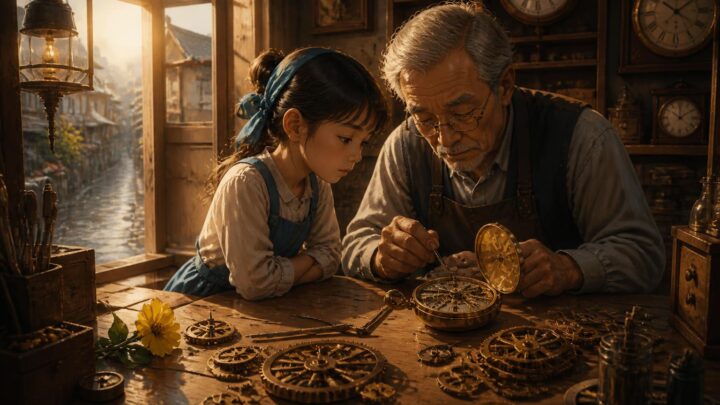
The Clock That Did Not Tell Time
At the end of a narrow street, where old rooftops leaned to reflect their shadows in a ditch thick with duckweed, there was a small shop called Moc Clock Shop. The wooden sign had faded with age, and the letters on it were almost impossible to read, but everyone in town still knew the place.
Read more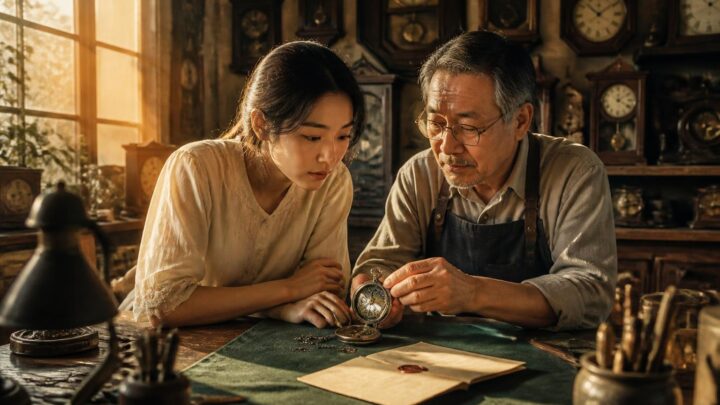
The Clock That Would Not Run and the Forgotten Letter
At the end of a small street stood a watch-repair shop that had been there so long that many people no longer remembered when it had opened. The wooden sign above the porch had faded, two letters in the shop’s name worn away by sun and rain, while the glass door was always covered with
Read more
The Garden Behind the Old Wall
When An returned, the small alley was still as narrow as she remembered. Low awnings followed one another along both sides of the street, providing just enough shade from the afternoon sun. The smell of freshly cooked rice drifted from some kitchen, mingling with the scent of damp earth after the rain, and she felt
Read more
The Scent of Rain on an Old Coat
That afternoon, An reached the entrance to the alley just as the rain began to fall. The drops were small, sparse, and cold, clinging to the car window in long streaks that blurred the road ahead. The low hibiscus hedge was still there, as was the star-fruit tree leaning toward the neighbor’s house and the
Read more