
Story Collections · 14 November, 2026
The Scent of Rain on an Old Coat
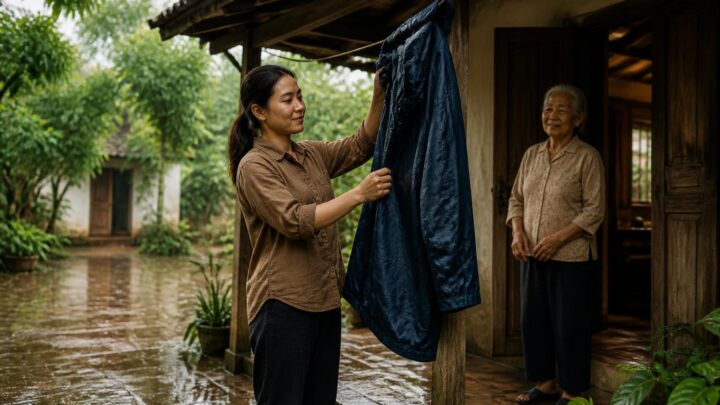
That afternoon, An reached the entrance to the alley just as the rain began to fall. The drops were small, sparse, and cold, clinging to the car window in long streaks that blurred the road ahead. The low hibiscus hedge was still there, as was the star-fruit tree leaning toward the neighbor’s house and the step covered with a thin layer of moss. Only An had changed. She had left this place nearly ten years ago—long enough for the village road to be paved, for the grocery store at the entrance to become a café, and for more than half of her mother’s hair to turn gray.
An turned off the engine but remained still in the car for a while. She did not know whether she was delaying the moment of entering the house or simply wanted to hold on to the strange feeling of someone who had just returned. In the trunk were several boxes of things she had brought down from the city: nutritional supplements, a few new outfits, an air purifier, and gifts hastily chosen during her lunch break. Everything was necessary—or at least that was what An had told herself.
Hearing the car, Mother pushed herself up from the wooden chair outside the porch. She looked thinner than An remembered. The old brown shirt hung loosely at the shoulders, its hem frayed. Mother looked at her daughter and smiled as though An had only just returned from the market, not been away from home for such a long time.
“It’s raining. Come inside and change your clothes, child.”
An got out of the car and hugged her mother quickly. She meant to say that she had missed her, but the words caught in her throat. Instead, she asked:
“Have you eaten yet, Mom?”
Mother smiled and gently patted her back. “I was waiting for you to come home.”
The House and the Things Left Unspoken
The house still held the familiar scents of old wood, cooking smoke, and pomelo leaves drying on a bamboo tray. An set her bag on the table and took out each item to explain it. Mother listened attentively, nodding and asking how much everything had cost. When An showed her the air purifier, she looked at it for a while and then said that the living room already got plenty of air—was it really necessary to buy such a thing?
An felt slightly annoyed. She had spent the entire evening reading product reviews and choosing a model suitable for an older person, yet Mother had asked one simple question and brushed it aside. An felt that her disappointment was unreasonable, but it was still there.
“Just use it, Mom. I bought it for you.”
“Yes, I know. But you should save your money and take care of yourself first. There must be a lot of expenses in the city.”
That made An fall silent. Mother was always like that. Whenever An sent money, Mother said she did not need it yet. Whenever An bought gifts, Mother said the things in the countryside still worked perfectly well. Whenever An called, Mother only asked whether she had eaten and then quickly told her about Mrs. Sáu’s cat, the guava tree behind the house, or whether it had rained that day.
An had once thought that Mother did not understand her life. She did not know about meetings that lasted until evening, bills that had to be paid, or the times An stood in the middle of her cramped rented room and asked herself what she was working so hard for. But perhaps Mother understood more than An had imagined. She simply did not ask about the things An was not ready to tell her.
For dinner, Mother made sour fish soup and boiled vegetables with caramelized fish sauce. An complained that the food was too salty as she ate, then served herself more fish. Mother noticed but said nothing, only quietly pushed the plate of vegetables toward her.
“Have you been sleeping well lately?” Mother asked.
“Yes. Work has just been a little busy.”
“Even if you’re busy, you still have to rest. They can hire someone else, but I only have one child.”
An looked up. Mother was still lowering her head as she picked the bones from the fish, her voice calm, as though she were merely reminding An to bring a raincoat. It was a very gentle sentence, but within it was all the longing An had tried not to face.
The Coat Hanging Behind the Door
Night fell, and the rain grew heavier. The electricity in the neighborhood flickered and then went out completely. Mother took a candle and placed it on the table, its yellow light wavering across the walls that had faded with age. An went to look for a towel to dry her hair and saw the old raincoat hanging behind the kitchen door.
It was dark blue, the kind of raincoat made from thick plastic fabric that her father used to wear. The collar had faded, and one sleeve bore a clumsy repair. Her father had died many years earlier, after a brief illness. At the time, An had been in her final year of university, busy preparing for exams and a job interview in the city. She had come home later than everyone else and had not been able to hear her father say his final words.
An had carried that regret for many years, though she rarely admitted it. She often comforted herself by saying that she could not have known beforehand. No one could have known. And yet, whenever she saw the raincoat, she remembered the last morning her father had taken her to the bus station. It had not been raining, but he had still put on the blue coat and stood beneath the porch, repeatedly reminding her to call home when she arrived.
“You still keep this coat?” An asked.
Mother was stacking bowls in the kitchen. She followed her daughter’s gaze and replied:
“Yes. What harm is there in leaving it there?”
“It’s old. You could throw it away and buy a new one.”
Mother wiped her hands on the hem of her shirt. “Some things are old but still usable. Besides, when I see it, I feel as if your father is still lingering around the house.”
An said nothing. She wanted to say that her father had been gone for a long time, that keeping a coat would not bring the dead back. But she knew she had no right to say that. Some things are not kept because they still have practical value, but because they help someone make it through empty days.
That night, An lay on the old bed in the room where she had once studied. Through the window, the rain falling on the corrugated metal roof sounded like someone knocking steadily at the door. She remembered the years when she had longed to leave this place. Back then, the small house, the deserted road, and the repetitive meals made her feel that her life was being held captive. She wanted to go far away, earn lots of money, and live in an apartment with glass windows overlooking the city.
She had achieved part of that dream. But the farther she went, the more she realized that some things could not be replaced by a larger apartment or expensive trips. She could buy her mother a new machine, but she could not buy back the morning when her father still stood beneath the porch. She could send money regularly, but she could not send her presence in her place.
A Short Trip to the Market
The next morning, the sky was clear. Mother invited An to go to the market to buy some fish. The road gleamed after the rain, puddles reflecting the clear sky. Mother walked slowly, carrying a plastic basket and occasionally stopping to greet someone she knew. An walked beside her, at first impatient because Mother was taking so long, but then suddenly realizing that she was savoring each small encounter.
At the vegetable stall, Mother bought a bunch of mustard greens and bargained with the vendor. At the fish counter, she asked the young helper about his upcoming exams. Passing the pastry stall, Mother bought two hot sesame doughnuts and handed one to An, just as she had always done when An was little.
“You eat it, Mom,” An said.
“I don’t like sweet things.”
An knew that Mother was lying. When An was young, whenever there was a pastry, Mother always broke off the better portion for her. An had grown up with such gentle lies, to the point that she thought everything she had had come to her naturally.
On the way home, An asked Mother why she did not move to the city and live with her. An’s apartment was not large, but there was still room for another bed. Mother was silent for a while before saying:
“I’m used to living here. Besides, you work all day. If I moved there, I’d only be by myself most of the time.”
“I’ll arrange my schedule.”
“You should take good care of your own life first. I don’t want you to feel burdened because of me.”
For the first time, An heard the loneliness in her mother’s voice. It was neither reproach nor a demand. It was the loneliness of someone who had grown used to taking care of everything herself, used to waiting without daring to call, used to saying “I’m fine” so that her child would not worry.
An stopped in the middle of the still-wet road. She took her mother’s hand. It was small and dry, with prominent veins.
“Don’t always say you’re fine, Mom,” An said. “If something’s wrong, call me.”
Mother smiled. “And will you answer when I call?”
The simple question made An’s face grow hot. There had been times when Mother called while An was in a meeting; she had let the phone vibrate and then forgotten to call back. There had been messages from Mother containing only a few words, which An read but thought she could answer that evening. Then one evening followed another, and the things that needed to be said kept being pushed to the next day.
“I will answer,” An said. “If I can’t answer at that moment, I’ll call back.”
Mother did not reply. She only gave her daughter’s hand a gentle squeeze. But that squeeze made An understand that a promise did not lie in the emotion of one morning, but in the small things she would do after returning to the city.
One Way of Coming Home
An stayed home for three more days. She repaired the kitchen door, replaced the porch lightbulb, called a repairman to inspect the roof, and took Mother for her scheduled medical examination. None of these tasks was significant, nor could they resolve all their worries. Mother still insisted on cooking, still complained that An bought things that were too expensive, and still walked her all the way to the gate even under the hot sun.
Before leaving, An took down the old raincoat, washed it clean, and hung it to dry beneath the porch. Mother stood beside her and watched without asking why.
“I’ll have this coat repaired,” An said. “Whenever you miss Dad, take it out and look at it. But don’t let it get damp and moldy.”
Mother nodded. “Yes. You know how to take care of things better than I do now.”
An laughed. It had been a long time since the two of them had laughed together over something so small.
The car left the alley as the afternoon once again drew clouds across the sky. In the rearview mirror, An saw her mother still standing by the gate, one hand resting on the post and the other waving slowly. An did not turn her face away as she had on previous occasions. She watched until her mother’s figure disappeared behind the trees.
On the seat beside her was the bag of sesame doughnuts Mother had packed for her, along with a cloth handkerchief that smelled of sunlight and rain. An opened the window slightly. The wind flowed in, carrying the scent of damp earth, leaves, and a familiar smell she had thought she had forgotten.
Perhaps coming home did not mean returning to live entirely in the past. Nor did it mean abandoning the path she had chosen to remain forever beneath one roof. Coming home meant knowing how to look back at the people who had quietly stood behind her, knowing how to ask whether they were tired before talking about her own weariness, and knowing how to make time for a meal even when her work schedule was always packed.
An could not turn back time. She could not meet her father again on that final morning, nor could she give her mother back the long years that had passed in waiting. But she could begin with a call answered at the right time, a trip home, and a question asked without haste.
That afternoon, when she arrived back in the city, An set an alarm for the following Friday evening. She texted her mother to say that she would come home, then placed her phone beside her computer. A little while later, Mother sent back a small rice-pot emoji and her familiar reminder: “Don’t work too hard. Remember to eat dinner.”
An looked at the screen and smiled. Outside the window, the city lights came on. In the room far from home, for the first time in many years, she did not feel that she was running away from anywhere.
Related articles
The Clock That Did Not Tell Time
At the end of a narrow street, where old rooftops leaned to reflect their shadows in a ditch thick with duckweed, there was a small shop called Moc Clock Shop. The wooden sign had faded with age, and the letters on it were almost impossible to read, but everyone in town still knew the place.
Read more
The Clock That Would Not Run and the Forgotten Letter
At the end of a small street stood a watch-repair shop that had been there so long that many people no longer remembered when it had opened. The wooden sign above the porch had faded, two letters in the shop’s name worn away by sun and rain, while the glass door was always covered with
Read more
The Garden Behind the Old Wall
When An returned, the small alley was still as narrow as she remembered. Low awnings followed one another along both sides of the street, providing just enough shade from the afternoon sun. The smell of freshly cooked rice drifted from some kitchen, mingling with the scent of damp earth after the rain, and she felt
Read more
The Empty Chair Beside the Porch
The Chair No One Had the Heart to Put Away At the end of a small alley stood a tile-roofed house whose tiles had faded with age. In front of the house, beneath an old starfruit tree, there was always a low wooden chair. The chair was not beautiful, nor was there anything particularly special
Read more
The Compass of the Lost Traveler
At the edge of a town nestled among the hills, there was a small shop that specialized in making and repairing compasses. The shop had no large sign; it only hung a tarnished bronze bell beneath the front porch. Whenever someone stepped inside, the bell rang out clearly, as though the room had just remembered
Read more
The House with Three Windows and the Clockmaker
At the end of the slope leading down to the river wharf, there was a clock repair shop so small that passersby often overlooked it. The wooden sign hanging above the door had faded with time; only the two words “Peace of Mind” could still be made out clearly. The shop’s owner was Mr. Lam,
Read more