
Story Collections · 13 November, 2026
The Compass of the Lost Traveler

At the edge of a town nestled among the hills, there was a small shop that specialized in making and repairing compasses. The shop had no large sign; it only hung a tarnished bronze bell beneath the front porch. Whenever someone stepped inside, the bell rang out clearly, as though the room had just remembered something.
The shopkeeper was an old man named Lâm. He had bright eyes and slender but steady hands. He often sat beside a low wooden table, wiping each glass face, straightening each needle, and inspecting gears so tiny that outsiders could barely see them. People in the town still said that Mr. Lâm could repair any compass except the compass of someone who did not know where they wanted to go.
One afternoon, when low clouds stretched across the hillside, a boy named Minh entered the shop. He carried an old compass in the palm of his hand. Its casing was scratched, the glass face had a small crack, and the needle inside kept trembling and spinning in circles, refusing to settle.
“Could you repair it for me?” Minh asked.
Mr. Lâm took the compass, placed it on the table, and asked, “Where are you planning to use it?”
Minh lowered his head. “I don’t know yet. That’s why I need to have it repaired.”
Mr. Lâm did not laugh. He opened the back, removed each part, cleaned away the dust, and replaced a thin wire that had shifted out of place. After a while, he set the compass back in front of Minh. The needle trembled slightly, then pointed north.
“Now it works,” he said.
Minh picked it up, but he did not look happy. “If I go north, will I reach somewhere better?”
“A compass does not know which place is better. It only shows you where north is.”
“Then what if I go the wrong way?”
“You will know which direction you are going.”
The Fear of Choosing the Wrong Path
Minh told him that he was about to leave the town for a distant city. There, he could learn a trade, find work, and begin a new life. But everyone gave him different advice. One person told him to choose a profession with a stable income. Another said that he had to go far away in order to grow up. Someone advised him to stay because his family needed him. Still another told him that youth came only once and that he should not miss any opportunity.
Minh listened to everything and remembered everything, yet he became more and more confused. He wanted a certain sign, a road without any turns, a decision he would never have to regret. He thought the compass left behind by his father would help him. But the needle kept spinning, exactly like his mind whenever he had to make a choice.
Mr. Lâm placed a teapot on the table. “Do you know why this old compass was thrown off?”
Minh shook his head.
“There is a very small piece of iron inside it. Perhaps someone left the compass near an iron object for too long. At that point, it began to be pulled in another direction. Even a small object is enough to keep a compass needle from pointing accurately.”
Minh looked down at the compass. “So are there things inside people that make them lose their direction too?”
“Of course. Fear of being laughed at, fear of disappointing one’s parents, fear of falling behind one’s friends, fear of starting later than everyone else. Those fears are not loud, but they can pull your decisions in a direction you do not truly want.”
Minh remained silent for a long time. Outside, the wind moved through the row of trees, making the bronze bell by the door ring in scattered notes.
A Road Without Signposts
The next morning, Mr. Lâm took Minh up the hill behind the town. There was a fork in the road at the top. One path descended into the valley, another ran toward the forest, and the third led to an open stretch of land covered in weeds. There were no signposts and no fresh footprints.
“Choose one road,” Mr. Lâm said.
Minh looked at the three paths. “Won’t you tell me which one is the right road?”
“If I knew, I would only know which road was right for me. You cannot borrow someone else’s life to live in your place.”
The longer Minh looked, the more reasons he found not to take any of the roads. The path down to the valley was too steep. The road into the forest was full of thick undergrowth. The path across the meadow was empty, and he had no idea where it would lead. He stood there until the sun climbed high.
At last, Minh chose the path into the forest.
After walking some distance, he came upon an old wooden bridge. It had not collapsed, but several of its planks had rotted. Frightened, Minh turned back, thinking that he had chosen incorrectly from the very beginning. Just then, Mr. Lâm came up behind him.
“You see? I should have chosen another road,” Minh said.
“Because this road has an old bridge?”
“Because it is difficult.”
“A difficult road is not necessarily the wrong road. Just as an easy road does not guarantee that it will take you where you need to go.”
Mr. Lâm did not cross the bridge for Minh. He only showed him how to test the planks, how to place his feet on the sturdier spots, and how to use a branch for support. It took Minh quite a while to reach the other side. When he looked back at the bridge, he realized that he was no longer trembling as he had before.
A Compass Shows the Direction, Not the Destination
On the way back, Mr. Lâm told Minh that many people wished for a tool that could make decisions for them. They wanted absolute advice, a sign that could not be misunderstood, or someone wise enough to bear all the consequences on their behalf. But no compass could do that.
A compass shows the direction. A map reveals the terrain. Experience helps people recognize dangerous stretches of road. Those who have gone before can tell others about what they experienced. However, the final step still belongs to the person standing at the crossroads.
That does not mean that everyone must face every choice alone. Asking other people for their opinions is necessary, especially when we do not yet have enough information. Listening to family, friends, and experienced people can help us see what we have overlooked. But listening does not mean handing over all decision-making power to someone else.
There is a fine line between accepting advice and avoiding responsibility. When we simply do what others tell us, we may feel temporarily relieved because we do not have to choose for ourselves. But if the result is not what we hoped for, that relief often turns into resentment. By contrast, when we weigh things for ourselves and accept our own decision, we may still feel sorrow or make mistakes, but we will learn something that truly belongs to us.
Minh asked, “What if I discover later that I chose wrongly?”
Mr. Lâm replied, “Then you stop, reconsider your direction, and choose the next step. Taking a wrong turn does not mean that your entire life is lost.”
The Small Signs Along the Way
Before leaving the town, Minh visited the shop one last time. He placed the compass on the wooden table and said that he had decided to go to the city to study machine repair. He was not sure it was the perfect choice, but whenever he thought about learning how machines worked, he felt curious rather than simply afraid.
Mr. Lâm did not ask whether that profession was certain to lead to success. He only checked the compass once more and handed it back to Minh.
“Remember,” he said, “your direction may change as you come to understand yourself better. Someone who wants to go east today may realize a few years later that they need to turn south. What matters is not keeping the same choice in order to prove that you were never wrong. What matters is knowing why you are continuing to move forward.”
Minh put the compass in his pocket. Before leaving, he turned back and asked, “Have you ever been lost?”
Mr. Lâm looked out the window. “Many times. Once, I went much too far simply because I was reluctant to admit that I no longer wanted to reach that place. Another time, I stayed still for too long because I thought that if I did not move, I could not make a mistake. Only later did I understand that a person who is lost is less frightening than a person who refuses to look back at himself.”
Minh left the shop just as the sky began to brighten. The road ahead was still long, the unfamiliar city might be filled with difficulties, and the compass in his pocket could not guarantee him an easy future. But for the first time in many months, Minh no longer demanded that the future give him a promise.
He walked on, occasionally opening the compass to check his direction. Each time the needle settled toward the north, he remembered that he did not need to know the entire road. He only needed to be honest about his next step.
In life, there are times when we too resemble a compass needle pulled off course by too many voices. The expectations of our loved ones, society’s gaze, old failures, and fear of the future can make it difficult for us to hear our own desires clearly. At such times, what we need to do is not always seek out another piece of advice. Sometimes, we need to step back, move those influences farther away, and observe what still allows our hearts to remain calm.
No one can give us a complete map. Every choice contains some uncertainty, and every road has stretches no one has ever walked before. Nevertheless, a person who knows to ask what they are moving toward will be less easily swept along by the crowd. And even when they take a wrong turn, they still have the chance to return with clarity rather than despair.
A compass does not take the traveler’s place and start walking. It only reminds us that amid a changing world, people can still find their direction by being honest about what they value, having the courage to take responsibility, and patiently adjusting when necessary.
Related articles

The Empty Chair Beside the Porch
The Chair No One Had the Heart to Put Away At the end of a small alley stood a tile-roofed house whose tiles had faded with age. In front of the house, beneath an old starfruit tree, there was always a low wooden chair. The chair was not beautiful, nor was there anything particularly special
Read more
The House with Three Windows and the Clockmaker
At the end of the slope leading down to the river wharf, there was a clock repair shop so small that passersby often overlooked it. The wooden sign hanging above the door had faded with time; only the two words “Peace of Mind” could still be made out clearly. The shop’s owner was Mr. Lam,
Read more
The Tea House That Does Not Sell What Has Been Lost
At the bottom of the slope leading down to the river wharf, there was a small tea house. It had no sign, displayed no goods all the way to the walkway, and had no calls inviting customers in. People in the area called it bà Mộc’s tea house, though no one knew when she had
Read more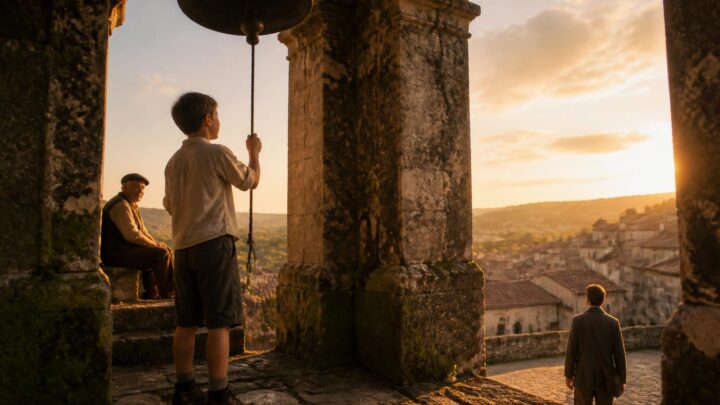
The Bell Ringer and the Things Left Unsaid
At the end of the stone slope in the town of An Mộc stood a small church, its tiled roof faded with age and its bell tower covered in moss. The people in the area no longer remembered exactly when the church had been built. They only knew that for many years, whenever the sun
Read more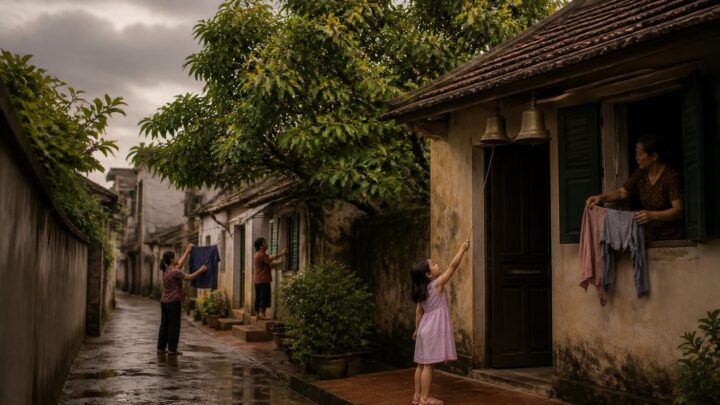
The Keeper of the Last Bell at the End of the Alley
The Bell on Cloudy Afternoons At the end of the alley stood a low, tiled-roof house, with two pots of orange jasmine and an old starfruit tree in front. Every afternoon, when the sunlight began to withdraw from the mottled walls, Mr. Lam would step onto the veranda, pull the cord hanging beneath the roof,
Read more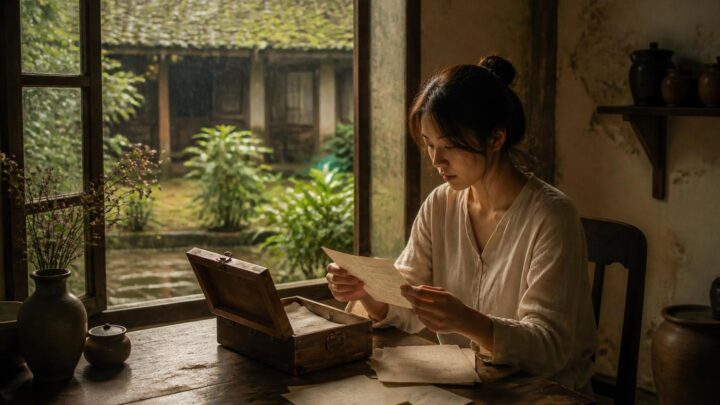
The Box That Held the Scent of Rain
The day An returned to the village, the rain had just stopped. The dirt road leading into the small hamlet still glistened with water, and the two rows of grass along the roadside drooped as if they had just gone through a long conversation with the wind. The vehicle carrying her stopped in front of
Read more