
Story Collections · 11 November, 2026
The Bell Ringer and the Things Left Unsaid
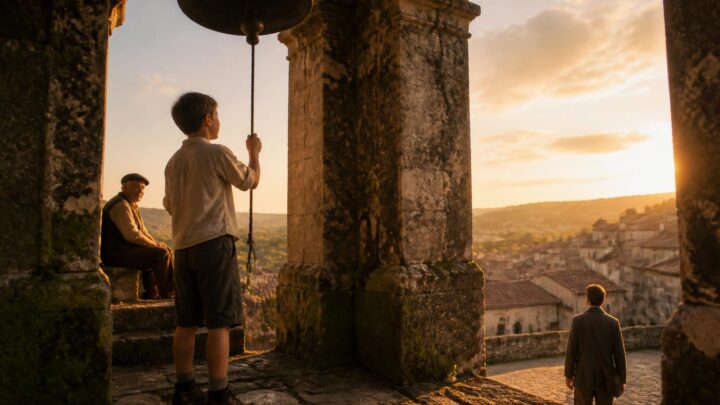
At the end of the stone slope in the town of An Mộc stood a small church, its tiled roof faded with age and its bell tower covered in moss. The people in the area no longer remembered exactly when the church had been built. They only knew that for many years, whenever the sun touched the western mountains, the bell rang three times, slowly and deeply. The cart drivers at the market heard the bells and knew it was time to return. The children playing beside the stream heard them and hurried to gather their sandals. As for the elderly people who often sat before their doorways, they would silently gaze toward the bell tower as though listening to a familiar reminder.
The bell ringer was named Mr. Lâm. He lived in a small room behind the church, where there was a wooden bed, a charcoal stove, and a cabinet filled with old notebooks. He had done the job for nearly forty years, since his hair was still black and his legs were still strong enough to climb all the spiral steps leading up to the tower. Every day, he swept the courtyard, dusted the bell rope, checked the worn joints, and then waited for the afternoon hour.
No one paid him in the usual way. During the rice season, people in town brought him a sack of rice. When the orchards bore fruit, they left baskets of oranges, bunches of bananas, or a few bundles of greens in front of his door. Some repaired his roof for him; others left a little firewood. Mr. Lâm accepted everything with a gentle smile, but rarely spoke of gratitude. He believed that the bell belonged to everyone, while he was merely the person who kept it from being forgotten.
The Boy Who Often Stood at the Foot of the Tower
Among those who often listened to the bells was a boy named Tín. Tín was eleven years old and lived with his mother in a corrugated-metal house at the top of the slope. His father had left town long ago to find work elsewhere. At first, he still sent letters. Then the letters came less and less frequently, until they disappeared altogether. Tín’s mother did not speak ill of her husband, nor did she promise that he would return. She only told her son that some people left not because they did not love anyone, but because they did not know how to stay.
Tín did not understand what she meant. He only knew that whenever he heard the bells, a feeling he could not name stirred inside him. He often walked to the church after school, stood beneath the almond tree in front of the courtyard, and watched Mr. Lâm pull the rope. The bells sent sparrows flying from the tiled roof and made the sunlit dust tremble in the air. After the third ring, Mr. Lâm would usually sit down on the stone steps, drink a cup of tea, and look along the road leading out of town.
One afternoon, Tín worked up the courage to ask:
“You ring the bell to call everyone home, don’t you?”
“That is part of it.”
“And the other part?”
Mr. Lâm looked at the boy for a long while before replying, “To remind those who are far away that there is still a place where they are remembered.”
Tín lowered his head and picked up an almond leaf. The answer made him think of his father, but he did not say so. Mr. Lâm did not ask anything more.
The Wooden Box in the Room Behind the Church
On a rainy day at the beginning of the season, a strong gust of wind blew open the door of the storage room behind the church. Tín was helping Mr. Lâm gather bundles of wet firewood when he saw a wooden box beneath a shelf. The box was small and tied shut with a faded fabric cord. Scratches overlapped across its lid, as though it had been opened and closed many times.
“What’s in there?” Tín asked.
“Things people have not yet had the chance to say.”
Tín thought he was joking. But when Mr. Lâm untied the cord, the boy saw dozens of neatly folded pieces of paper inside. Some were yellowed with age; others were still fresh. There were no recipients’ names on them, only brief lines: “I’m sorry I left when you needed me most, Mother.” “I miss my old friend, but I don’t know where to begin.” “If I had been willing to listen just a little longer, perhaps things would have been different.”
Tín looked up. “Who wrote these?”
“People in town. Some brought them here themselves; others asked me to keep them for them.”
“Why don’t they say these things directly?”
Mr. Lâm closed the lid of the box. “Because some words become harder to say the longer they are left unsaid. But being difficult to say does not mean they do not need to be said.”
He told Tín that many years earlier, when he had first taken the job, he had placed a box beside the foot of the tower. Anyone who had something to say but not enough courage could write it down and put it inside. He did not read the papers. He simply kept them, as one keeps a promise. At the end of each year, he burned the old papers in the fireplace, so that the people who had written them could begin again without carrying too much weight with them.
“But if they are burned, what meaning do the words still have?” Tín asked.
“Meaning does not depend on whether someone else hears them. Sometimes, all it takes is being honest with yourself for a knot to begin loosening.”
The Day the Bells Fell Silent
At the end of that rainy season, Mr. Lâm’s leg began to hurt. He still tried to climb the tower as usual, but on the thirtieth step, his knee suddenly gave way. Tín, walking behind him, quickly caught him. The two of them sat resting for a long time beside a small window overlooking the rooftops of the town.
“Don’t ring the bell tomorrow,” Tín said.
“If there is no bell, everyone will forget when it is time to go home.”
“It’s only for one day.”
Mr. Lâm did not answer. But the next morning, he did not climb the tower. By afternoon, there was no sound of bells in town. The vendors still closed their shops, the children were still called home, and dinner was still served. Nothing major happened. And yet many people felt that afternoon was unusually empty.
The old woman who sold sweet tea sat in front of her stall, looking up at the bell tower, and said that she was used to hearing the bells before thinking of her late husband. A carpenter said that the bells reminded him to go home and eat with his daughter, even though the two of them were angry with each other. Tín’s mother, who rarely mentioned his father, also stood by the window longer than usual.
That evening, several people from town came one after another to visit Mr. Lâm. One brought medicine, another brought porridge, and someone repaired the slippery steps. No one said that they had come because the bells had fallen silent. They simply sat around the wooden table and talked about the small events of the day. But Mr. Lâm understood. Some things are recognized only when they are no longer there.
Late that night, Tín saw his mother step outside. She held a piece of paper in her hand, hesitated for a long time, and then handed it to him.
“Do you want to write to your father?” she asked.
Tín looked at the blank paper. He wanted to write that he had grown taller, that he knew how to fix his bicycle when the chain came off, and that there were days when his mother was tired but still made cakes for him. He also wanted to ask why his father did not come home. But in the end, Tín wrote only one sentence: “Do you remember the bells of An Mộc?”
His mother read it, and her eyes reddened. She did not say that the sentence was too short. She folded the paper, placed it in the wooden box, and sat beside her son beneath the veranda. The two of them said nothing more, but this time their silence was no longer cold.
Those Who Return Do Not Always Take the Old Road
A few weeks later, Mr. Lâm’s leg improved, but he no longer climbed the tower alone. The people in town took turns helping him ring the bell. Tín was the first to arrive. He learned how to check the rope, how to keep the rhythm of the pulls, and how to listen for unusual sounds within the ringing. Mr. Lâm did not pass on any special secret to him. He only instructed him that if he wanted the bell’s sound to carry far, the person pulling it had to know when to stop.
“Pull too hard, and the sound will be dull. Pull too quickly, and the sound will be short. Everything needs a moment of silence in order to resonate.”
Tín never forgot those words.
One early-winter morning, someone brought Mr. Lâm a letter from the city. The envelope did not clearly identify the sender; it only bore Tín’s name. His hands trembled as he held it. Inside were a few lines from his father. He wrote that he had thought many times about returning, but was ashamed because he did not know where to begin. He did not ask Tín to forgive him immediately, nor did he make any grand promises. He only asked whether, one day, he might stand beneath the bell tower and listen with his son to the three afternoon rings.
Tín read the letter twice. He did not run into the street, nor did he cry. He placed the letter beside the old piece of paper in the wooden box. Then he asked his mother whether she wanted to reply. His mother remained silent for a long time before saying that they could write, but this time they would not write things meant to hold someone back. They would write the things that needed to be made clear, so that if they met again, no one would have to guess what was in anyone else’s heart.
On the day Tín’s father returned, the town held no reception. He walked up the slope on a cloudy afternoon, carrying an old cloth bag, and stood before the church gate. Tín saw him from a distance. Father and son did not embrace right away. They simply stood facing each other, awkwardly, like people who had known each other but had to learn again how to be close.
Mr. Lâm handed the bell rope to Tín. “You pull it today.”
Tín took hold of the rope. His father stood in the courtyard, with his mother beside him. The first ring sounded, slow and deep. The second spread across the rooftops, reaching the wooded slopes at the end of the hill. When the third ring came, Tín let go at the right moment, allowing the sound to linger in the falling afternoon.
Words Spoken at the Right Time
Many years later, the people of An Mộc still spoke of Mr. Lâm as the man who had kept the town’s bell ringing. But Tín remembered him differently. He remembered the wooden box, the scraps of paper without recipients’ names, and the lesson about silence. He understood that people often waited for the perfect opportunity to apologize, give thanks, or express their longing. Yet the perfect opportunity rarely appeared. Sometimes, all that was needed was an ordinary afternoon and someone willing to sit down and listen.
The wooden box remained at the foot of the bell tower. The people of the town continued to place inside it the things they had not yet had the chance to say, but each year there were fewer pieces of paper. It was not because they were no longer sad or regretful. Perhaps they had learned to speak to one another sooner, before silence became a wall.
And the bells still rang every afternoon. They did not call everyone back to one fixed place. They reminded people that no matter how far they had gone, they could still find their way back through a sincere word. And sometimes, returning does not begin with footsteps, but with the moment we dare to speak what we have held in our hearts for too long.
Related articles
The Keeper of the Last Bell at the End of the Alley
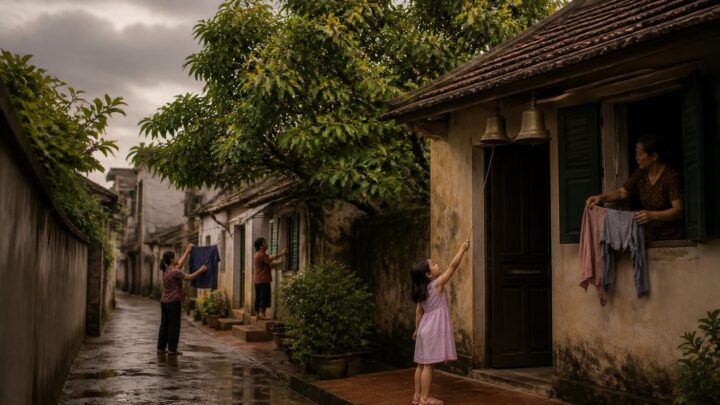
The Bell on Cloudy Afternoons At the end of the alley stood a low, tiled-roof house, with two pots of orange jasmine and an old starfruit tree in front. Every afternoon, when the sunlight began to withdraw from the mottled walls, Mr. Lam would step onto the veranda, pull the cord hanging beneath the roof,
Read more
The Box That Held the Scent of Rain
The day An returned to the village, the rain had just stopped. The dirt road leading into the small hamlet still glistened with water, and the two rows of grass along the roadside drooped as if they had just gone through a long conversation with the wind. The vehicle carrying her stopped in front of
Read more
The Chair Beneath the Veranda and the One Who Came Back
There are houses that do not keep people with doors, nor hold anyone back with reproaches. They simply stand there in silence, weathering sun and rain alongside a small yard, an old doorstep, and an object that seems meaningless. When people grow weary amid the vastness of life, it is precisely those ordinary things that
Read more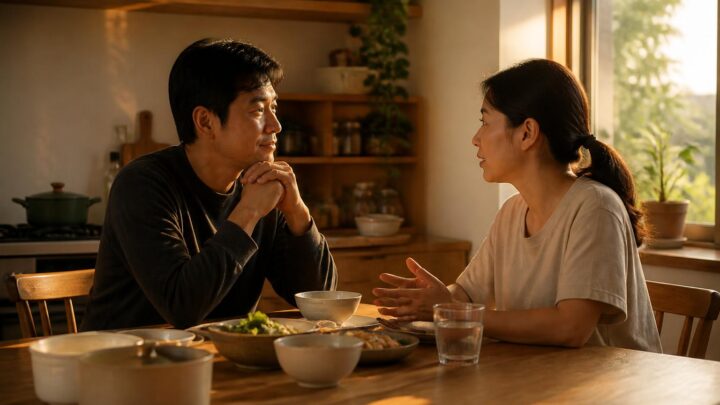
A Belated Apology Can Still Open the Door to Tomorrow
In many relationships, what drives people apart is not necessarily some major event. Sometimes it is simply a harsh word spoken in the heat of the moment, a broken promise treated lightly, a prolonged silence, or the habit of always assuming that the other person will understand without an explanation. Such things may pass unnoticed
Read more
The Keeper of the Last Bell in the Village
At the end of the dirt road leading out to the fields, there was a small village nestled beside a river that flowed slowly all year round. The villagers called the place Van Khe Village, not because it had any particularly special stream, but because whenever evening fell, the bell from the ancient communal house
Read more
The Scent of Rain on an Old Tiled Roof: When Memories Teach Us How to Return
There are afternoons when a sudden rain is all it takes to carry us back to a place deep in our memories. Not by foot, but through the scent of wet earth, the sound of water falling on a tiled roof, and the warmth that once lingered beside the doorstep. These things often appear when
Read more