
Children's Stories · 11 November, 2026
Little Tí and the Garden That Kept Laughter
The Garden Behind the Wooden House
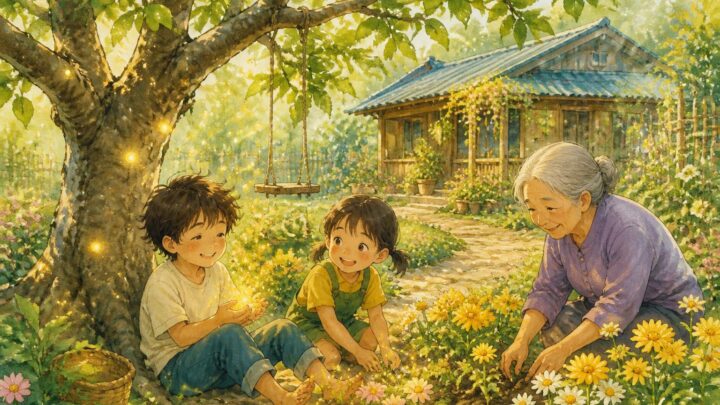
At the end of a small road stood a wooden house with a blue roof. In that house, a little boy named Tí lived with his grandmother. Tí had bright eyes, hair that was always as messy as a nest of baby birds, and a very strange habit: whenever he was happy, he would laugh so loudly that even the birds on the fence would tilt their heads and listen.
Behind Tí’s house was a garden that was not very large but stayed green all year round. There was his grandmother’s vegetable patch, an old guava tree, a gourd trellis curved like a little bridge, and a moss-covered stone bench. His grandmother always said that the garden was a gift left by his grandfather. He had planted every tree with his own hands, tended every patch of soil, and named the garden the Sunlight Garden.
However, ever since his grandfather passed away, the garden had gradually grown quiet. His grandmother no longer had enough strength to care for it as she once had. The flower beds grew sparser, weeds covered the paths, and no one sat on the swing beneath the guava tree anymore. Tí loved his grandmother dearly, but he did not yet know what to do to bring the garden back to life.
One afternoon, after the rain had just stopped, Tí went behind the house to gather dry branches. As he passed the stone bench, he heard a faint sound.
“Ha… ha… ha…”
Tí looked up. There was no one in the garden. He looked beneath the rosebush, behind the guava tree, and then bent down to see whether an animal was hiding there.
“Who’s there?” Tí asked.
The sound came again, clearer this time, pure as the sound of a drop of water falling into a porcelain bowl.
“I am no one. I am a forgotten laugh.”
Lost Laughter
Tí’s eyes grew round. He had never heard a laugh that could speak. From beneath the stone bench, a tiny spot of light floated out. It was as small as a pea, pale yellow, and shimmering like the last sunlight of the day.
“Can laughter be forgotten too?” Tí asked.
“Of course,” replied the spot of light. “When someone is happy but has no one to be happy with, their laughter sometimes flies away to look for another place. If it finds a kind garden, it will stay and make warm things sprout.”
Tí held out his hand. The spot of light landed on his palm, light and warm.
“Then why is this garden so quiet?”
“Because no one here has truly laughed for a long time. Not laughter meant to mock, and not laughter pretending to be happy. The garden needs laughter that comes from a kind heart.”
The spot of light explained that many lost laughs still remained in the garden. There was the laughter of a baby who had once played beneath the guava tree, the laughter of Tí’s grandfather when he saw the first gourds of the season, the laughter of his grandmother when she was young, and the laughter of the neighbors who had once come to help build the wooden house.
But they had fallen asleep in the earth because no one was left to call them awake.
Tí thought for a while and then said, “I’ll find a way to wake them.”
“You alone won’t be enough,” said the spot of light. “Laughter only grows when it is shared.”
The next morning, Tí began his work. He did not try to do anything grand. First, he took his grandmother’s bamboo basket, gathered dry leaves, and collected broken branches. He loosened the soil around the remaining flower clumps, straightened the leaning fence, and carried water to the guava tree.
While he was working, Tí heard a rustling sound outside the gate. It was Lan, the neighbor girl who often wore a butterfly-shaped hair clip. Lan watched the garden for a while and then asked:
“What are you doing?”
“I’m waking up the laughter.”
Lan looked at Tí, unsure whether to believe him or burst out laughing. But when she saw Tí struggling to pull a branch heavier than he was, she ran in to help. The two of them pulled together, and the branch rolled aside. Tí lost his balance and fell flat into the wet grass. His face was covered in mud, with only his two eyes shining brightly.
Lan burst out laughing. Tí looked at himself and laughed too. The children’s laughter rang out through the deserted garden. From beneath the soil near the flower bed, a tiny spot of light floated up and joined the first one.
“See?” cried the spot of light. “The garden has heard it!”
When Joy Is Passed from Hand to Hand
From that day on, Lan often came over to help Tí care for the garden. The two of them put the stones back around the path, pulled weeds, and searched for seeds left in his grandfather’s wooden box. Tí wanted to sow all the seeds at once, but Lan said they should divide them into separate beds so that each plant would have enough room to grow.
“Joy is the same,” Lan said. “If we hold on tightly to all of it for ourselves, it won’t have room to grow.”
Tí thought Lan was absolutely right. He decided to invite more people. He invited Lan’s younger brother, a boy who often sat alone on the porch arranging pebbles into the shape of a boat. He invited the carpenter at the end of the road, who could repair the swing. He also invited the old woman who sold cakes at the market, because she had once told him that she loved chrysanthemums.
Everyone contributed a little. The carpenter replaced the swing’s old rope. The cake seller gave them some yellow chrysanthemum seeds. Lan’s younger brother arranged pebbles into a winding path around the guava tree. Tí’s grandmother cooked a pot of mung bean sweet soup and brought it out to share with everyone.
The garden did not immediately become a perfect place. Some patches of earth were still uneven, a few clumps of grass had not yet been pulled, and the swing creaked whenever someone sat on it. But there were now conversations, footsteps, the sound of running water, and more laughter than before.
Each laugh made a spot of light appear. They rose from the earth, from the branches, and from the cracks in the stones beneath the moss-covered bench. Some spots were round like corn kernels; others were long like golden threads. They did not make the garden dazzling, but simply made everything feel warmer.
At the end of the week, Tí thought of a game. He placed a basket beside the guava tree and told everyone to put in it one thing that had made them happy that day. No one was allowed to say that someone else’s thing was too small or unimportant.
Lan put in a heart-shaped leaf she had found beneath the fence. Lan’s younger brother put in a white pebble because it made him think of a boat sailing across the sea. The carpenter put in a curved piece of wood because he had made it with his own hands. Tí’s grandmother placed a newly blossomed chrysanthemum in the basket.
Tí looked at the basket and said, “Everyone’s joy is really different.”
His grandmother smiled. “But when they are placed together, they make a very beautiful garden.”
The Secret of the Old Guava Tree
That night, after everyone had gone home, Tí sat beneath the guava tree. The wind blowing through the leaves made a rustling sound. The first spot of light circled around him and then stopped on a low branch.
“You did it,” it said.
“I only cleaned the garden,” Tí replied.
“No. You called everyone back. A garden does not live on soil, water, and sunlight alone. It also lives through people who know how to care for one another.”
Suddenly, the guava tree’s trunk trembled slightly. A green guava fell right in front of Tí. He picked it up and saw a thin streak of light on its skin. When Tí brought the guava closer, he heard his grandfather’s familiar laughter.
“Grandpa?” Tí called softly.
The laughter did not answer. It simply echoed gently, like a memory resting quietly in the wind. Tí understood that his grandfather had not truly disappeared from the garden. He was still there—in the guava tree, in the stone bench, in the way his grandmother tenderly cared for every sprout, and in the good things everyone did together.
Tí ran into the house to tell his grandmother. She sat silently for a long time, holding the guava in both hands. Then she smiled. It was a smile Tí had not seen in a long while, gentle but slightly trembling.
At once, a stream of golden light flew out through the window. It joined the spots of light in the garden. The guava tree shook its leaves, the chrysanthemums gently bowed, and the swing gave a cheerful creak.
The Garden Does Not Keep Laughter for Itself
From the summer of that year onward, the Sunlight Garden became a place people often visited. Children came to play beneath the guava tree. Adults sat on the stone bench and talked. Those who had seeds brought seeds, those who had time helped water the plants, and those who knew how to tell stories told them to the children.
Tí continued to keep the basket beside the tree. Every day, people placed a small happy thing in it. Sometimes it was a red tomato, a feather, a scribbled drawing, or simply a word of thanks.
Tí gradually understood that life was not always cheerful. Some days Lan received a poor grade, some days his grandmother felt tired, and some days heavy rain broke a branch. At such times, no one forced anyone else to laugh. They simply sat together, listened, and found a way to repair what was broken.
And strangely enough, after times like those, the laughter in the garden became deeper. It was not laughter from people who had never felt sad, but the laughter of people who knew they did not have to face sadness alone.
One late-autumn afternoon, Tí asked the first spot of light:
“Does the garden keep all the laughter?”
The spot of light swayed on the guava branch.
“No. Laughter is not born to be kept. It comes here to be passed on.”
With that, the spot of light flew high into the air. It rose over the wooden roof, flew across the fence, and followed the wind to somewhere that needed a little warmth. The other spots of light also gradually left the garden, leaving behind yellow chrysanthemums, newly sprouted plants, and the lively conversations of everyone there.
Tí watched them go, without feeling sad. He knew that other laughter would come tomorrow. As long as there were still people here who knew how to share, the garden would never become quiet again.
And from then on, whenever he heard someone laugh with genuine gentleness, Tí remembered the Sunlight Garden. He understood that no matter how small a joy might be, it could brighten an entire day if we knew how to give it to the person beside us.
Related articles
The Little Girl and the Seed That Kept Its Promise
At the far end of Cloudy White Village stood a small house with brown tiled roofs. In front of it was a yard filled with sunshine all year round. In that house, a little girl named An lived with her grandmother. An had bright eyes, black hair usually tied neatly behind her back, and such
Read more
The Boy Who Sewed a Coat for the Sun
At the edge of a small village with brown-tiled roofs, where the dirt road curved around vegetable beds and bamboo hedges, there lived a boy named Tí. Tí was not the strongest boy in the village, nor could he run fast or climb trees as well as the other children. But he had a heart
Read more
The Boy and the Wind Chime Learn to Listen
At the end of the village road stood a small house with a brown-tiled roof and a bougainvillea vine covering the fence. In front of the house, Minh’s grandmother hung an old wind chime. The chime was made from slender bamboo tubes, a small brass leaf, and a faded blue cord. In the past, whenever
Read more
The Little Girl Who Kept Raindrops in a Cloth Bag
The Late Arrival of the Rain At the end of a red dirt road stood a small village nestled among rolling hills. Surrounding the village were cornfields, vegetable plots, and lush green bamboo thickets. The villagers lived simple lives; each person had their own work, going to the fields in the morning and returning to
Read more
The Little Girl and the Seedling Asleep Beneath the Roof
At the end of a red dirt road stood a low, tiled-roof house, with an old starfruit tree growing in front of it. In that house lived little Na with her grandmother. Na had bright eyes, hair that was always tied to one side, and a very special habit: she often picked up things other
Read more
The Boy Who Gathered the Wind and the Garden That Knew How to Listen
The Boy on the Hillside At the edge of a small village with brown-tiled roofs, towering areca palms, and a winding dirt road that ran all the way to the foot of the hill, there lived a boy named An. An was not the strongest boy in the village, nor could he run as fast
Read more