
Story For Children · 8 November, 2026
The Little Girl Who Kept Raindrops in a Cloth Bag
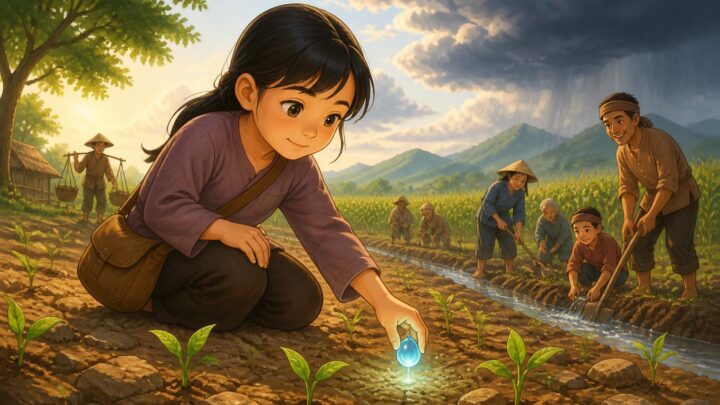
The Late Arrival of the Rain
At the end of a red dirt road stood a small village nestled among rolling hills. Surrounding the village were cornfields, vegetable plots, and lush green bamboo thickets. The villagers lived simple lives; each person had their own work, going to the fields in the morning and returning to the fireside in the evening. There was only one thing that worried everyone: that year, the rainy season came late.
Clouds passed across the sky but refused to stop. They drifted lazily over the rooftops and treetops before disappearing behind the mountain peaks. The fields gradually dried out, the vegetable beds drooped, and the pond at the village entrance was reduced to a single small, crystal-clear puddle. The adults took turns carrying water to the plants. The children could no longer run and play beneath the cool rains as they did every year.
An was a nine-year-old girl who lived with her mother and grandmother in an old tiled-roof house. An had bright eyes, and her hair was usually tied neatly with a strip of blue cloth. She liked collecting small things that other people easily overlooked: a heart-shaped leaf, a pebble as shiny as a candy, or a button that had fallen beside the porch. Her mother had sewn An a brown cloth bag to hold those treasures.
One afternoon, as An was walking along the edge of a field, she saw a drop of water resting on a blade of grass. The drop was perfectly round and transparent, reflecting the entire pale, sunlit sky. An bent down and was about to touch it when another drop fell onto the back of her hand. Then one more drop fell onto the edge of the leaf.
It was not yet rain. They were only a few drops of water that had strayed from a small cloud. Even so, An was so happy that she ran all along the edge of the field calling out to everyone. The villagers looked up at the sky, but the cloud had already drifted away. High above, only a patch of faded blue remained.
The Bag with the Shining Seeds
That night, An placed the cloth bag beside the window. She thought that perhaps it would truly rain in the morning. After everyone had gone to sleep, a very soft sound awakened An. It was like the sound of a drop of water touching a leaf, but it seemed to come from right beside her.
An sat up and looked toward the bag. A gentle light, like moonlight, glowed from its opening. She opened the bag and was surprised to see that the pebbles and dry leaf were no longer inside. Instead, there were three tiny, sparkling seeds, each one as clear as if it had been made of water. They were not wet, nor did they roll away; they simply lay still, radiating a pale blue light.
As soon as An touched the first seed, she heard a voice as thin as wind slipping through a curtain:
“These are raindrop seeds that have not yet fallen. They remain only where there is someone who knows how to cherish precious things.”
An looked around the room but saw no one. Softly, she asked:
“Can the raindrop seeds help our village?”
The voice replied:
“They can. But a raindrop seed does not grow inside a bag. It grows when it is given to the place that needs it most.”
An carefully closed the bag and placed it beneath her pillow. She thought of the thirsty cornfields, her mother’s vegetable beds, and the pond at the village entrance. She wanted to take the raindrop seeds out and use them immediately, but she was afraid that if she gave them to the wrong place, they would disappear without helping anyone.
The next morning, An told her mother what had happened. Her mother listened for a long time and then said:
“There are wonders we do not need to fully understand before we know how to appreciate them. Observe very carefully before you decide.”
Three Places Waiting for Rain
An began carrying the bag with her. She went through every corner of the village and realized that each place had its own kind of thirst.
At the village entrance, the empty pond lay beneath an old banyan tree. Some people suggested using the first raindrop seed for the pond, since it was where every household still collected water. They said that if the pond were full, the whole village would have less hardship. An thought that made sense.
In the middle of the village, Old Man’s Mận’s wife tended a small medicinal herb bed behind her house. She said the plants needed water to survive the dry season; otherwise, many elderly people in the village would lack the familiar remedies they relied on when illness came with changes in the weather. An thought that was important too.
At the far end of the village was the plot belonging to a boy named Tí. Tí lived with his father, who had an injured leg and could not carry water very far. The father and son had planted young bean plants in their plot. Every day, Tí used a small ladle to water each plant at its roots, but the earth still cracked from the dryness. He did not complain; he simply quietly shared his small supply of water with the weakest plants.
An watched Tí water the plants and asked:
“Why don’t you water the bigger plants first? They have more leaves.”
Tí wiped the sweat from his forehead and replied:
“The big plants have deeper roots. The little ones are the ones most likely to go thirsty. If they survive, they will grow big someday too.”
His answer reminded An of the voice’s words that night. The raindrop seeds needed to be given to the place that needed them most, not the place that appeared the grandest.
The First Raindrop Seed
That afternoon, An returned home and took the first raindrop seed out of the bag. She placed it in an earthen bowl and carried it to Tí’s garden. As soon as the seed touched the ground, it melted into a small stream of water that soaked the soil around the young bean plants. The dry earth grew dark and moist again. The drooping leaves slowly lifted their heads.
Tí’s eyes widened. He called his father out to see, and the two of them thanked An again and again. But the wonder did not stop there. The next morning, the young bean plants had stretched a little taller. A small water channel had appeared in the soil, running from the garden down to the bottom of the slope. There was not much water in the channel, but it was enough for the neighboring beds of plants to benefit as well.
An understood that a small raindrop could travel farther than she had imagined. If she kept it in the bag, it was merely a beautiful light. When given away at the right moment, it became life.
The Second Raindrop Seed and the Lesson of Sharing
The second raindrop seed made An even more uncertain. She thought of the pond at the village entrance, where many families needed water. But she also remembered Old Mận’s medicinal herb bed. An told her mother about it, and her mother said:
“Dividing a gift into many portions does not always make the gift weaker. Sometimes, knowing how to share it properly helps it reach more places.”
An carried the raindrop seed to the old well behind Old Mận’s house. The well had not been used for a long time because the water vein beneath it was too weak. She dropped the seed into the well. The raindrop seed did not dissolve immediately; instead, it gave off a clear, ringing note. After a while, a very soft trickling sound rose from the bottom of the well.
The water began to rise, slowly but steadily. Old Mận drew up one ladleful, keeping only enough to water her medicinal herbs, then placed the remaining ladlefuls along the path so everyone could use them together. Before long, the villagers began arriving one after another with small jars to collect water. Everyone reminded one another to take only what was needed, not to push, and not to let any water go to waste.
Thanks to the water in the well, Old Mận’s medicinal herb bed came back to life, and the villagers gained another precious source of water. An realized that the second raindrop seed had not filled the pond, but it had helped everyone learn how to protect what little they had.
The Last Raindrop Seed
Only one raindrop seed remained in the bag. Just then, thicker clouds appeared in the sky. The wind blew across the cornfields, carrying the smell of hot earth and dry grass. The villagers rejoiced, but then the clouds stood still again without releasing a single drop.
Everyone looked up at the sky. Some wanted to use the last raindrop seed for the pond. Others hoped it would save the cornfields. An hugged the bag to her chest, feeling its weight even though it held only one tiny seed.
She walked to the middle of the fields. There stood a high, barren patch of land where no plants could survive. People usually went around it because they thought the land was useless. But An saw a few tiny grass shoots struggling to push through the cracks. Beside them was a hollow in the earth marked by the footprints of many small animals. Perhaps they still came there to escape the sun, even though the place had never had the shade of a tree.
Suddenly, An understood what she needed to do. She did not drop the raindrop seed into the pond or in the middle of the cornfields. She placed it on the high patch of land and called everyone over.
The raindrop seed melted, forming a small circle of water. The water slipped through the cracks in the earth and ran toward the lower places. The villagers used hoes to open shallow channels, guiding the water toward the fields. The children used branches to shade the grass shoots. The adults gathered dry leaves and spread them around the roots of the remaining trees.
At that very moment, a drop of water fell onto An’s cheek. Then a second drop fell onto her mother’s shoulder. At last, the clouds opened their doors. Rain fell, sparsely at first, then more heavily. The whole village rang with joyful cheers. The adults did not run indoors for shelter; they stood in the yard, letting the rain soak their hair and shoulders.
The rain continued until nightfall. The next morning, the pond at the village entrance held an additional layer of clear water. The cornfields could not turn green again immediately, but the soil had softened. The once-ignored high patch of land had begun to sprout new grass. Everyone agreed to build a small fence around it to protect the young plants and keep the soil from being washed away during heavy rain.
What Remained in the Bag
From that day on, An’s cloth bag held no raindrop seeds. Inside were only the heart-shaped leaf, the shiny pebble, and an old button. But An was not sad. She knew the raindrop seeds had not truly disappeared. They had become seedlings, water in the well, channels in the field, and the villagers’ habit of sharing.
Whenever someone found a precious drop of water, everyone remembered An’s story. They no longer left faucets running, took more than they needed, or failed to find ways to help small plants survive the hot days. Tí cared for his garden, Old Mận looked after the well, and An often planted more trees around the high patch of land with her friends.
Many years later, the place became a green meadow. During the rainy season, water flowed along the small channels to nourish the fields. During the dry season, the village trees still provided shade for people to rest beneath. No one knew whether the magical raindrop seeds had truly existed or were merely a gift from a little girl’s imagination. But everyone understood what the story had taught them: the most precious things become meaningful when they are given with care and at the right time.
And if one day you happen to see a sparkling drop of water on a leaf, try bending down to look closely. Perhaps within that tiny drop is reflected a gentle reminder that all life needs to be cherished, while joy often grows from the things we are willing to share.
Related articles
The Little Girl and the Seedling Asleep Beneath the Roof
At the end of a red dirt road stood a low, tiled-roof house, with an old starfruit tree growing in front of it. In that house lived little Na with her grandmother. Na had bright eyes, hair that was always tied to one side, and a very special habit: she often picked up things other
Read more
The Boy Who Gathered the Wind and the Garden That Knew How to Listen
The Boy on the Hillside At the edge of a small village with brown-tiled roofs, towering areca palms, and a winding dirt road that ran all the way to the foot of the hill, there lived a boy named An. An was not the strongest boy in the village, nor could he run as fast
Read more
The Wind Chime That Called Kindness by Name
On the other side of the green hill, where the bur grass often clung to the hems of passersby’s trousers, there was a small village called Rustling Wind. The village was not wealthy, but every house had a flower garden and a wooden bench in front of the porch. In the mornings, the adults went
Read more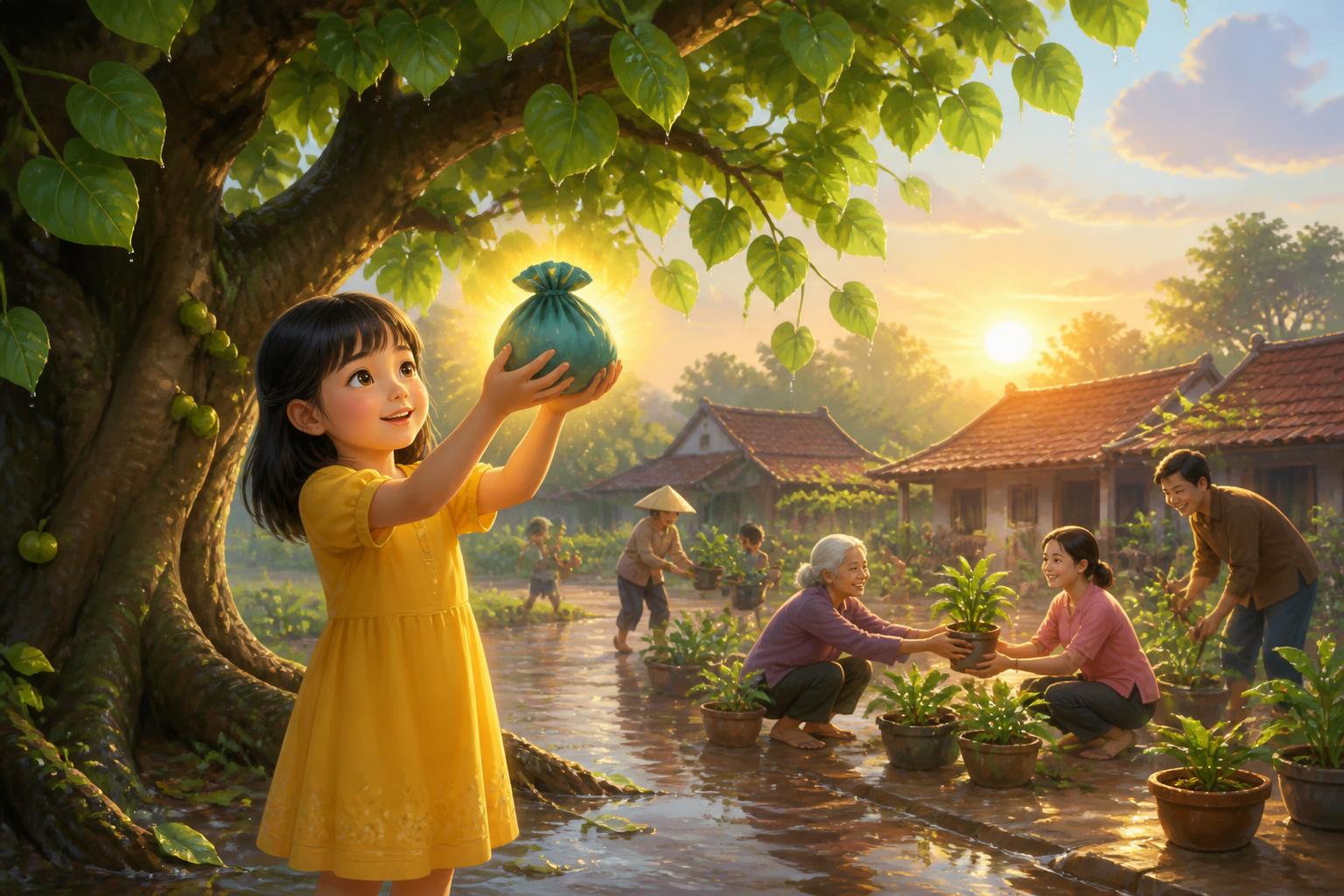
Little Mây’s Bag of Sun Seeds
At the end of the dirt road leading into Gió Nội Village stood a small tiled-roof house, with a yard full of yellow chrysanthemums. In that house, little Mây lived with her mother and grandmother. Mây had hair as soft as the clouds in the sky, clear, bright eyes, and a very unusual habit: every
Read more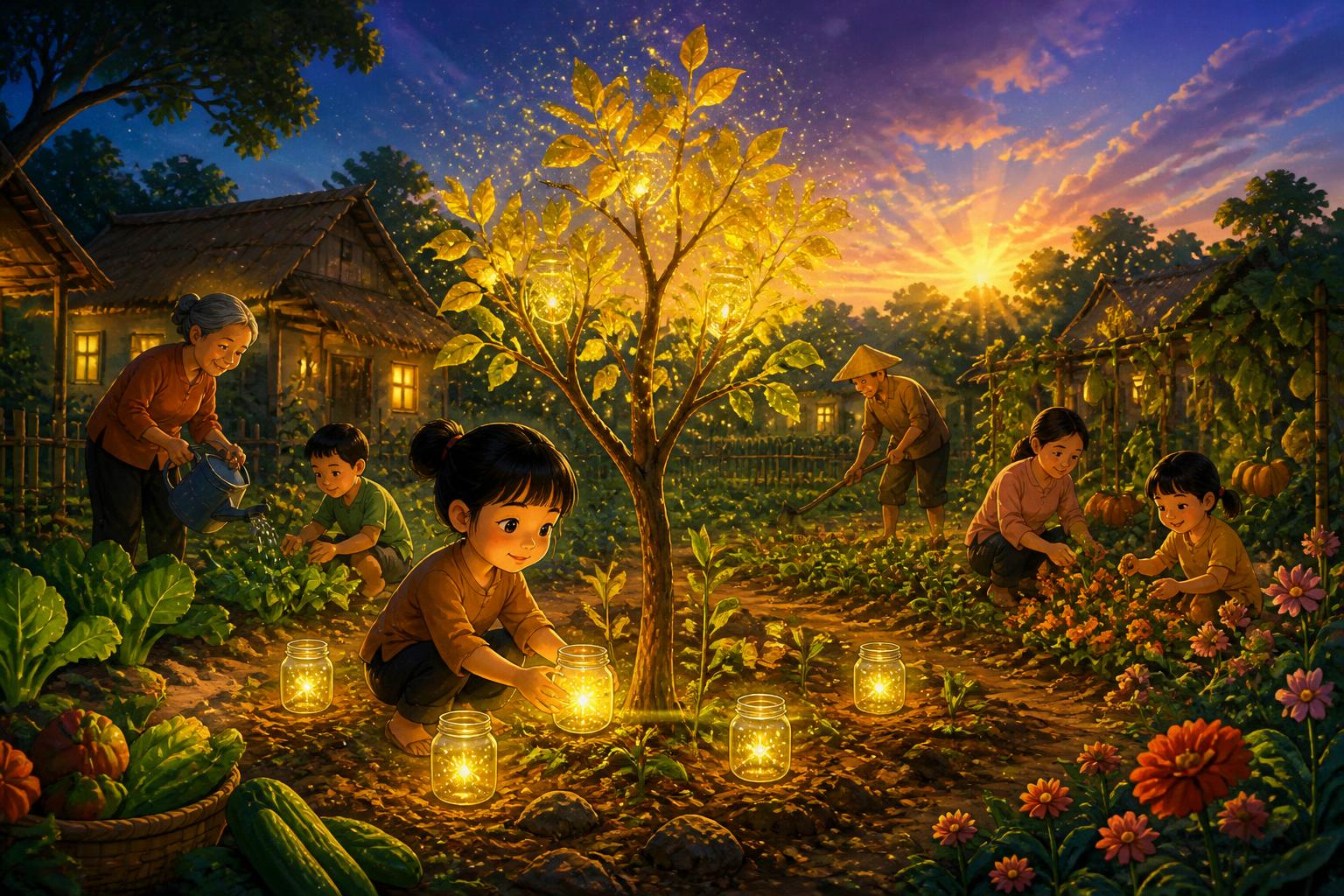
The Seedling That Held the Sunlight
A Morning Without Sunlight At the edge of a small village stood a house with a blue-tiled roof, where little An lived with her grandmother. Behind the house was a garden that was not very large but was always full of sounds. In the morning, sparrows chirped as they hopped from branch to branch. At
Read more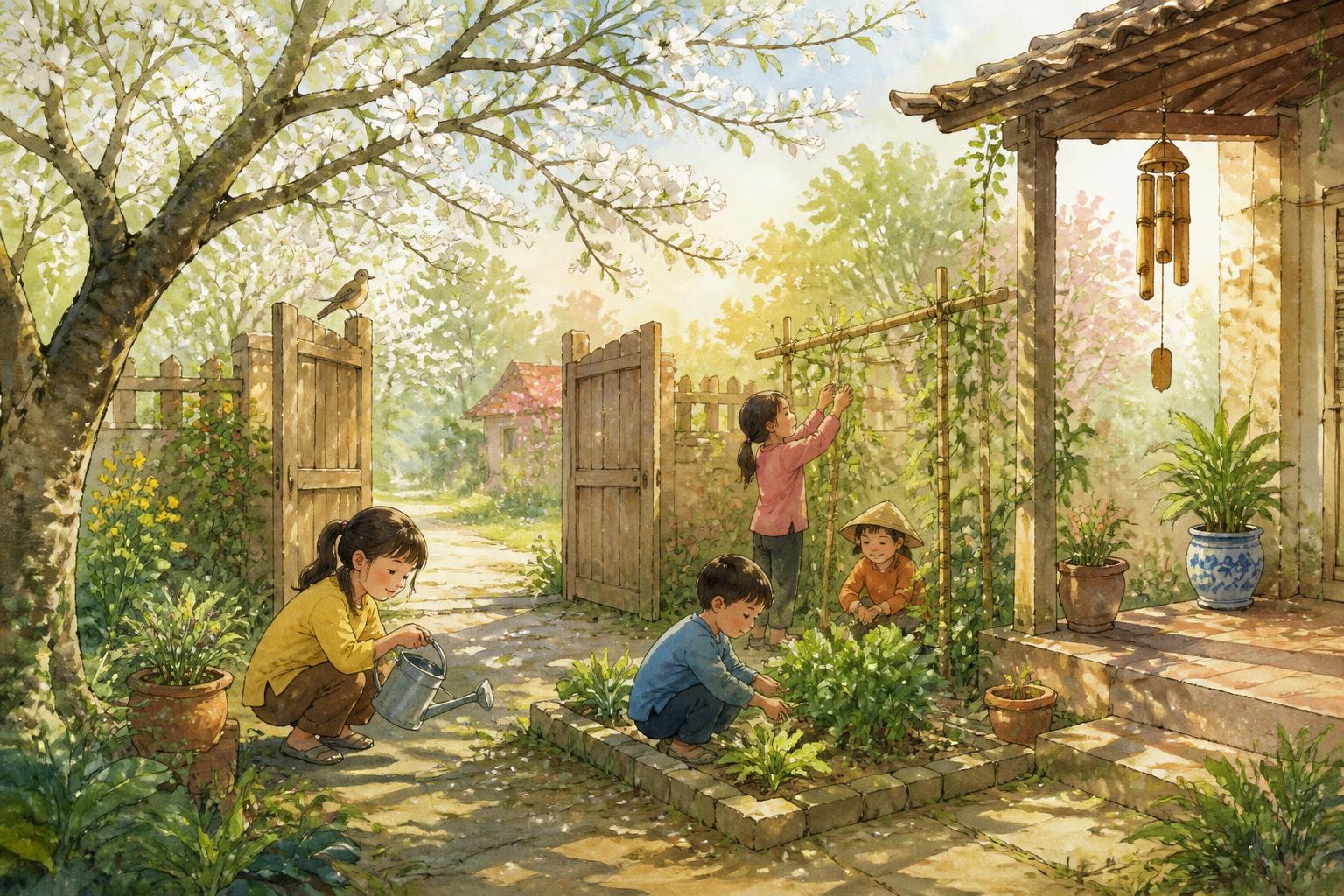
The Wind Chime and the Garden’s Promise
At the end of the stone-paved road in the village of Young Shoots stood a small, forgotten garden. The garden lay behind a house with a blue-tiled roof, its weathered wooden gate kept shut all year round. Long ago, the place had been full of flowers, but over time, weeds grew taller than a person’s
Read more