

 Tiếng Việt
 日本語
 한국어
 中文 (中国)
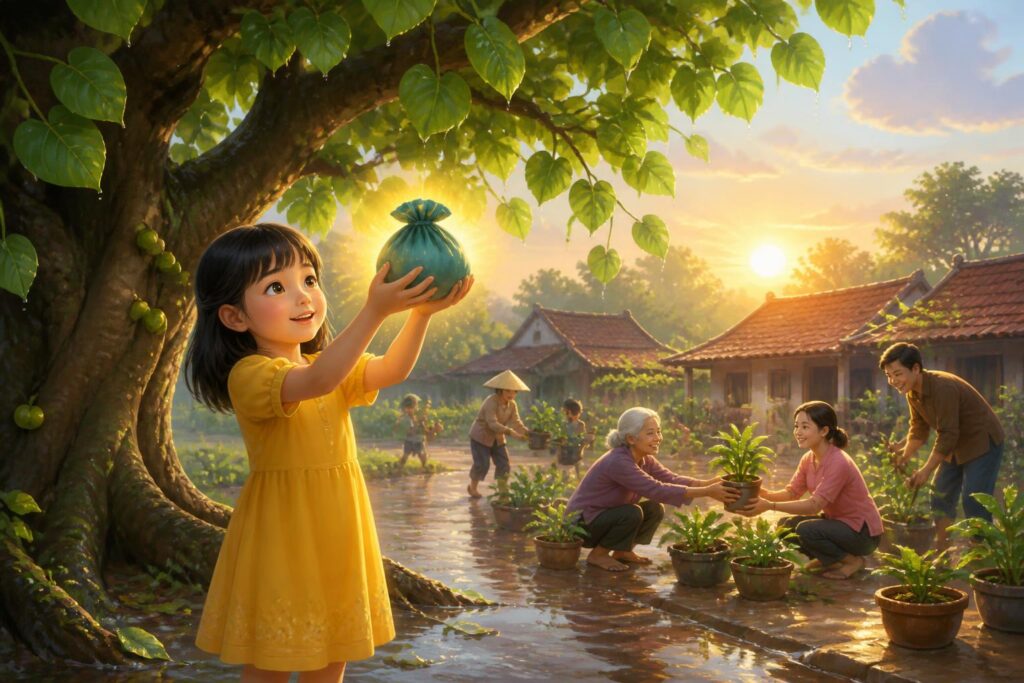
At the end of the dirt road leading into Gió Nội Village stood a small tiled-roof house, with a yard full of yellow chrysanthemums. In that house, little Mây lived with her mother and grandmother. Mây had hair as soft as the clouds in the sky, clear, bright eyes, and a very unusual habit: every morning, she went out into the yard, tilted her face toward the sunlight, and counted how many rays had fallen onto the flower petals that day.
Her mother often laughed and asked, “What are you counting the sunlight for?” Mây would answer, “I want to know whether the world is warm enough today.” When Grandma heard this, she would stroke Mây’s head and tell her that warmth did not exist only in the sunlight. It was also in one person sharing a bowl of rice with another, in a word of concern offered to someone who was sad, and in a hand reaching out at just the right moment.
Mây did not yet fully understand Grandma’s words, but she always tried to help everyone in the village. She picked up the areca nuts that had fallen in front of Old Lành’s house, carried the vegetables her mother had sent to the blacksmith, or stood by the irrigation ditch calling lost ducks back to their pen. These tasks were so small that no one would have thought they needed to be mentioned, but Mây did them with all her cheerfulness.
The Bag Beneath the Tree
One afternoon after a rainstorm, a faint rainbow appeared in the sky. Mây took a bamboo basket to the edge of the forest to look for mushrooms with her mother. As they passed an old fig tree, she saw something caught between its roots. It was a small, pale-blue cloth bag, about the size of her hand, tied with a golden thread.
Mây bent down and picked up the bag. Inside were seven round, gleaming seeds, each one glowing softly like a drop of sunlight that had settled there. When she touched them, the bag suddenly grew warm, and the seeds inside trembled gently.
Her mother asked in surprise, “Where did you find that?” Mây told her everything. Her mother gazed at the bag for a long while, then instructed her, “When we find something whose owner is unknown, we should ask around before keeping it. Tomorrow morning, take it to the village chief’s house. Perhaps someone is looking for it.”
That evening, Mây placed the bag on the table. Light from the tiny seeds cast shimmering golden spots onto the walls of the house. She reached out, intending to take one of the seeds out to examine it, but remembered her mother’s words and stopped. Mây told herself that she would ask everyone the next morning, even though she was very curious.
The next morning, she took the bag to the village chief’s house. The village chief shook his head. He asked every family, but no one recognized it. Old Lành said it might belong to a traveler who had passed through the village. The blacksmith guessed that the bag might have fallen from the mountain. Everyone discussed it for a long time, but they still could not find its owner.
Just then, a gust of wind swept across the yard. The bag in Mây’s hands suddenly shone more brightly. One round seed rolled out on its own and stopped beside her foot. When Mây picked it up, she heard what seemed like a very faint whisper: “Give me to the place where warmth is lacking.”
The First Sun Seed
Mây told everyone what she had heard. Some people laughed, while others said it was only the sound of wind passing through the treetops. But Mây still trusted what she had felt. She thought of her grandmother. The weather had turned cold over the past few days, and Grandma’s room was on the side away from the sun, so the blankets and bedding were always damp. Mây asked her mother if she could take the first sun seed home and place it beside the window.
At noon, she placed the sun seed in a small earthen bowl in Grandma’s room. Before long, the room became warm and dry. Grandma reached out and touched the blanket, smiling. She did not call it magic. She only said, “You saw what I needed before I even had a chance to say it.”
That afternoon, the light in the sun seed softened, then returned to rest inside the bag. Mây understood that each seed could be used only once, but the warmth it brought would remain if people knew how to care for one another.
The second sun seed was given to the blacksmith’s shed. The wind had torn away part of its roof, and rainwater dripped onto the earthen floor. The blacksmith was usually strong, but he had hurt his back that day and had not been able to repair it. Mây and several friends gathered bamboo, collected palm leaves, and covered the roof. After everyone had finished, Mây placed the sun seed beside the stove. The shed lit up, brightly enough for the blacksmith to see his tools clearly and continue working.
The blacksmith was deeply moved and decided to give Mây a small iron bracelet. Mây shook her head. “I don’t need a gift. If you want to thank me, please help repair Old Lành’s gate tomorrow.” The blacksmith nodded at once. And so, the light from the sun seed did not merely warm one shed; it connected one good deed to another.
A Sun Seed for Those Who Were Sad
The third, fourth, and fifth seeds were used by Mây for people in the village. One was placed beside the bed of the baker’s baby when the child had a fever and could not sleep peacefully. One was taken to the communal kitchen after a day of heavy rain, so the neighbors could cook porridge for families that had not yet managed to return home. The remaining seed was given to Tí, a boy who herded goats and had been sitting alone by the hillside ever since his white goat had gone missing.
Mây did not simply deliver the sun seeds and leave. For the baker’s baby, Mây sat and told a story about a little bird searching for spring. At the communal kitchen, she washed vegetables, started the fire, and handed out bowls to everyone. As for Tí, Mây and her friends searched for goat tracks along the northern slope. That evening, they heard a bleat in a patch of beautyberry bushes and managed to bring the white goat home.
Tí hugged the goat, so happy that he forgot to thank her. Mây did not need him to say anything. She realized that the sun seeds only helped people see one another more clearly; true joy was created by people’s footsteps, words, and hands.
Only two seeds remained in the bag. Mây began to worry. She was afraid that if she continued using them, one day someone in the village might need one and the bag would be empty. So she placed the last two seeds in a wooden box, put it beneath her pillow, and told herself that she had to keep them very carefully.
The Moonless Night
A few days later, a dark cloud swept in from the mountains. The wind shrieked through the bamboo grove, and rain poured onto the rooftops. All of Gió Nội Village sank into darkness as the oil lamps went out one after another. The adults had to bolt the doors, while the children huddled beside their parents and listened to the thunder rumble.
That night, Mây suddenly heard frantic knocking at the door. It was Na, the daughter of the letter carrier. Na was crying as she said that her father had not returned. He had taken letters to the village across the stream that afternoon, but the water had risen too quickly. Na’s mother was afraid that he had become trapped near the wooden bridge.
Mây ran to the village chief’s house. Everyone discussed how to search for the letter carrier, but it was too dark and the rain was too heavy. Without light, no one could see the path down to the stream clearly. Mây remembered the last two sun seeds. She opened the wooden box and placed one seed inside a large earthen lamp. Golden light immediately spread out, illuminating the village yard and the flooded road.
But the road to the bridge was still very far. Mây took the final seed and placed it in another lamp. Its light was not dazzling, but it was steady and warm. The villagers carried the lamps, tied ropes around their bodies, and set out together in a line. The strongest went ahead to test the path, those who could swim carried ropes, while Mây and Na stayed by the bank waiting for news.
Nearly at midnight, they brought the letter carrier back. He had slipped and had to cling to a tree trunk in the middle of the rushing water, but he had still held the bag of letters tightly against his chest. Na ran to embrace her father. Mây watched the two lamps slowly fade and felt relieved.
When dawn was near, the two sun seeds went out completely. The blue bag contained only its soft, empty fabric. Mây felt a little sad. She had thought she would keep one seed to admire on beautiful days. Seeing this, Grandma took her hand and said, “Some things lose their old shape, but become light in the memories of many people.”
The Gift Beneath the Fig Tree
The next morning, the rain stopped. The villagers worked together to clear away broken branches, reopen the drainage ditches, and repair the damaged roofs. The blacksmith repaired Old Lành’s gate as he had promised. The baker brought porridge to the homes of those affected by the flooding. Tí led the goats around a safer slope. Without anyone telling them to, people began giving one another small acts of kindness.
Mây took the empty bag back to the old fig tree. She placed it beside the tree’s roots and thanked the gift for helping her understand more about kindness. Just as she stood up, a fig leaf fell down. Beneath the leaf were seven small brown seeds. They did not glow, but they were exactly the same shape as the sun seeds from before.
Mây brought them home and asked her grandmother about them. Grandma said they might be seeds from some kind of plant. Her mother helped her sow the seeds in seven earthen pots. Every morning, Mây watered them, while the people in the village took turns bringing compost and good soil. After some time, small sprouts emerged. Their leaves were clear green, and their undersides gleamed with a soft golden color whenever the sunlight touched them.
No one knew what those plants would grow into. Perhaps they were simply ordinary trees. But the entire village cared for them patiently. Because through the story of the blue bag, everyone had come to understand that the most precious light was not something that could only be kept inside a bag. It appeared when people paid attention to one another’s difficulties and worked together to do what needed to be done.
From then on, Mây still went out into the yard every morning to count the sunlight. The only difference was that she no longer counted how many rays fell onto the flower petals. She counted the good deeds she saw throughout the day: someone opening a door to help another person, a child giving up a seat, a family sharing a meal, or a word of concern spoken at just the right moment.
And every time, Mây discovered that the world was warmer than she had imagined. As long as each person was willing to give away a little of the light in their heart, no matter how dark the road became, it would one day find the dawn.

ARTICLES IN THE SAME CATEGORY
The Seedling That Held the Sunlight
The Wind Chime and the Garden’s Promise
The Seed That Knows How to Listen
The Little Girl Who Kept the Rainy Season in an Earthen Jar
The Boy Who Planted Light by the Stream
The Button That Knew How to Listen
ARTICLES IN THE SAME GENRE
The Seedling That Held the Sunlight
The Boy Who Planted Light by the Stream
The Wind Chime That Did Not Want to Ring
The Garden That Knew How to Wait for Rain
The Little Seed and the Garden That Knew How to Wait
Bông the Bunny and the Raindrop That Kept Its Promise