

 Tiếng Việt
 日本語
 한국어
 中文 (中国)
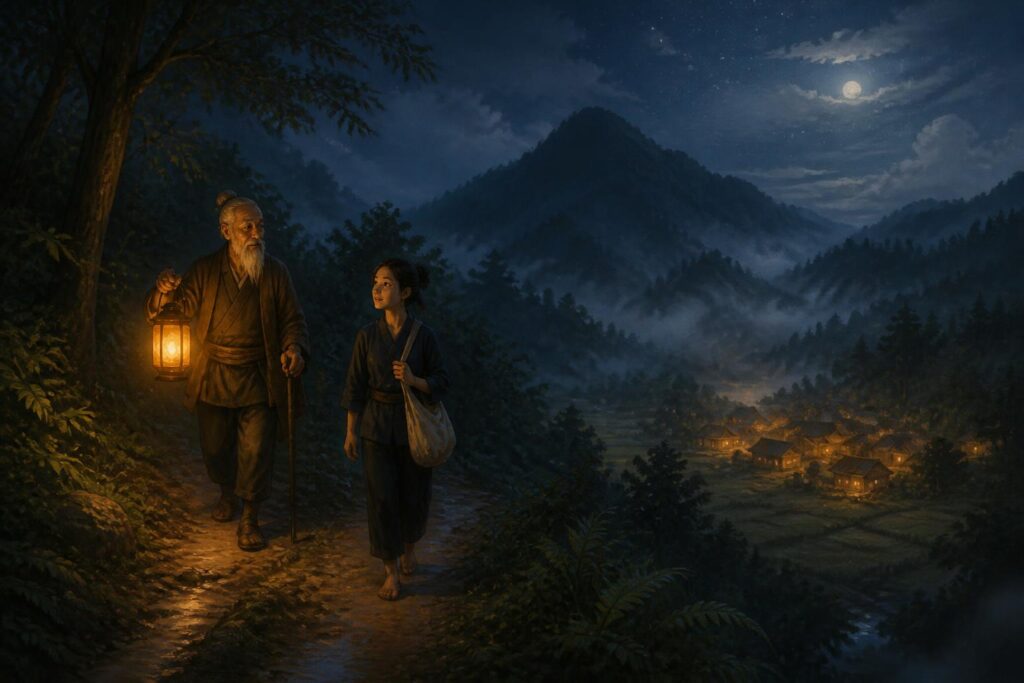
The Lamp at the Edge of the Forest
At the end of a narrow valley, a dirt road ran along the mountainside. It did not lead to a large city, nor did it connect to any busy markets. It merely passed a few houses with old tiled roofs, a low stone bridge, and a forest covered in mist all year round. Because so few people traveled along it, the locals often called it the forgotten road.
And yet, right beside the road’s first bend, a lamp was always lit whenever darkness fell. The lamp hung from a tall wooden post. Its light was not bright, but it was enough to reveal the jagged stones and puddles left behind by the rain. The person who cared for the lamp was an old man named Lam. He had lived in the little hut beside the lamp post for so long that no one could remember when he had first arrived there.
Every afternoon, before the sun disappeared behind the mountain peaks, Mr. Lam cleaned the glass, filled the lamp with oil, and inspected the post. He repeated this task through the sunny seasons, the rainy seasons, and the bitterly cold, windy nights. Someone once asked why he kept the lamp lit when hardly anyone passed by. He simply smiled and replied, “I do not light the lamp for those who already know the way. I light it for those who are afraid they will not find the way.”
The villagers nodded when they heard this, but few truly understood. They thought Mr. Lam was old and simply liked maintaining old habits. In the eyes of many people, the lamp was no different from a decoration beside an empty road.
The Girl Who Left the House on the Hill
One late afternoon at the end of the rainy season, a girl named An left the house on the hill. She carried a cloth bag, a small water bottle, and a crumpled map. An had lived with her mother in that house since childhood, but after an argument, she decided to seek the city on the other side of the mountain range. She believed that there would be better work there, people who understood her better, and a life no longer tightly bound by old matters.
An’s mother did not stop her. She only stood by the door, placed a brown woolen scarf in her daughter’s hands, and said, “If you get tired, come back and rest. Going very far is not the only way to become an adult.”
An heard her but did not reply. She thought her mother was simply afraid she would fail. She folded the scarf into her bag and walked down the slope. Before darkness fell, An had crossed the stone bridge and reached the bend where Mr. Lam’s lamp stood.
The old man looked at the map in her hand and asked, “Where are you going?”
“To the city on the other side of the mountain.”
“This road does not lead there.”
An unfolded the map and pointed to a blue line running through the forest. “The map says there is a shortcut. If I walk all night, I’ll reach the foot of the mountain on the other side tomorrow morning.”
Mr. Lam shook his head. “That map is old. A flash flood washed the path away many years ago.”
An grew irritated. “If you know the roads, why don’t you tell me another way?”
“Because I do not know whether you need to get to the city or simply want to leave your home.”
The question left An silent. She did not want to hear any more, so she turned and walked into the forest. Mr. Lam watched her go but did not call her back. He simply raised the lamp’s wick a little so that its light would reach farther.
The Road That Was Not on the Map
The forest at night was entirely different from the forest An had seen during the day. Tall, twisted tree trunks stood in the mist, their branches and leaves brushing against one another with a sound like people whispering. The trail appeared and disappeared beneath the wet leaves. An tried to walk quickly because she was afraid that if she stopped, she would remember her mother’s words and turn back.
After nearly an hour, she came to a fork in the road. The map showed only a single straight path, but there were three trails in front of her. The path on the left was covered in moss, the middle one bore animal tracks, and the path on the right was so narrow that only one person could walk along it. An chose the path on the right, thinking it was the one known by the fewest people.
The farther she went, the steeper the ground became. After a while, An heard running water and realized she was standing before a deep stream ravine. The wooden bridge across it had broken in half. She stepped back, but behind her there was only darkness. The wind rushing through the forest made the treetops shake violently. For the first time since leaving home, An felt afraid.
She sat down on a rock and hugged her cloth bag. Inside it was the woolen scarf her mother had given her. An took it out and wrapped it around her shoulders. The scent of sunlight and cooking smoke still lingered in the wool. She closed her eyes, trying not to think about the house on the hill, but the harder she tried to forget, the clearer her mother’s image became.
Suddenly, a wavering streak of yellow light appeared in the distance among the trees. The light was not strong, flickering like a giant firefly, but it made An stand up. She followed it, stepping through wet bushes and over slippery stones. After a while, she realized it was the light of the lantern Mr. Lam was carrying.
“Did you come looking for me?” An asked.
“No. I came to inspect the road.”
“This road is not on the map.”
“And yet it is still here.”
Mr. Lam set the lantern down, looked at the stream, and explained that long ago, this trail had connected two villages. After the flood, the bridge broke, plants grew over the path, and people stopped using it. However, if they followed the water upstream for about half a mile, they would find a wide bed of stones where they could cross the stream. From there, another path led out to the mountainside.
An asked, “Why don’t you mark the trail?”
“I once put up a sign. But the rain washed it away. I once drew it on a map. But paper eventually tears too. Some roads cannot be preserved with ink or wood. They are preserved only by someone remembering them and showing them to the next person.”
What An Really Wanted to Find
The two of them followed the stream. Mr. Lam walked slowly but steadily, testing the surface of each stone before setting his foot down. An walked behind him, several times intending to ask why he had not simply let her find her own way, but each time she decided not to. In the small lantern light, she could see that his hands were covered in calluses and deep cracks from the cold wind.
When they reached the bed of stones, Mr. Lam told An to stand still and wait for him to cross first. He placed the lantern on a low branch to illuminate the way. When he was halfway across, a stone beneath his foot slipped. He lost his balance and fell to his knees in the shallow water. An immediately stepped forward and pulled him up. The lantern fell into the water, and its flame went out with a sudden hiss.
For a moment, the entire forest was plunged into darkness. An heard her own heartbeat, the water striking the stones, and Mr. Lam breathing heavily. Suddenly, she understood that light did not always come from a lamp. Sometimes it began with one person refusing to abandon another when they were in trouble.
An took a match from her bag, shielded it from the wind with her hand, and relit the lamp’s wick. The flame was weak at first, then gradually steadied. She handed the lamp to Mr. Lam and helped him continue.
After crossing the bed of stones, they reached a patch of high ground. From there, they could see the faint distant lights of the village at the foot of the mountain. Mr. Lam said that if An continued along the road to the east, she would reach an old bus stop. From there, she could travel toward the city.
An looked at the distant lights, then back at the forest behind her. She had thought she was leaving home to find a new life, but throughout the journey, all she had really been doing was running from the feeling that she was not understood. She had never told her mother that she was afraid she was not good enough, afraid that she would spend her whole life going around in circles on the hill, afraid that her dreams would be dismissed as unrealistic. She only knew how to be angry, because anger was easier to express than fear.
“Do you think I should keep going or turn back?” An asked.
Mr. Lam did not answer immediately. He looked at the lamp in her hands and said, “I can only light the stretch of road in front of us. The decision about which way to go is still yours. But if you leave, go because you have chosen a place you want to reach, not merely because you want to leave behind a place that has caused you pain.”
The Light Passed On
An did not go to the city that night. She returned to the house on the hill with Mr. Lam. When her mother opened the door, she did not ask how far her daughter had gone. She only looked at the woolen scarf around An’s shoulders, then silently added more firewood to the stove.
An sat beside the fire and told her everything. She spoke about the hidden trail, the broken bridge, the bed of stones in the stream, and the lamp that had nearly gone out. Finally, she said that she still wanted to go to the city to learn a trade, but she no longer wanted to leave in anger. She wanted to prepare more carefully, to know where she was going and what she needed to do, instead of simply walking away to prove that she could live without anyone.
An’s mother listened to everything and then replied, “If you still want to go, I will help you prepare.”
A few months later, An left the house on the hill for the second time. This time, she carried a new map, a sturdy pair of shoes, and the small lamp Mr. Lam had given her. Before leaving, she went to the old lamp post and cleaned the glass with him. She realized that the lamp was not only for people lost in the forest. It was also for those caught between the desire to leave and the fear of making a beginning.
Many years passed, and Mr. Lam gradually grew weaker. One morning, he handed the key to the hut and the lamp-care tools to An, who had returned to visit the village after spending a long time studying and working in the city.
“Will you stay here?” he asked.
“Not exactly. There are still many places I want to go. But whenever I return, I will light the lamp.”
Mr. Lam smiled. “That is enough.”
From then on, the lamp at the edge of the forest continued to shine every night. Sometimes An was the one who lit it; sometimes a passerby helped her clean the glass; and sometimes the village children brought oil to contribute. The road remained quiet, and maps still often left out the small paths, but no one called it the forgotten road anymore.
The Lesson of a Small Lamp
An’s story reminds us that the desire to leave is not always a sign of ingratitude, just as staying is not always a sign of weakness. What matters is the reason behind the choice. When we move only to escape our pain, that pain often follows us wherever we go. When we become calm enough to understand what we want, the journey truly becomes a beginning.
Mr. Lam’s lamp also offers another way of looking at helping others. He did not decide for An, drag her back, or promise that the road ahead would be easy. He simply gave her a little light, pointed out the danger, and let her choose her next step. That is a form of support that respects another person’s freedom.
In life, everyone may encounter a “road that is not on the map.” It could be a career choice they had never considered, a difficult conversation, a new beginning after failure, or a moment when they must admit that what they are pursuing is no longer right for them. At such times, we do not necessarily need someone to draw the entire route for us. Sometimes, all we need is enough light to see the next step.
And once we have made it through our own stretch of darkness, we can become a lamp for someone else. We do not need grand words or to prove that we know all the answers. We only need to be there, listen, share what we know, and let the other person find their own direction. A small light still matters, because in the darkness, what people need first is not to see the whole world, but to know they have not been left behind.

ARTICLES IN THE SAME CATEGORY
The Man Who Mended Forgotten Umbrellas
The Empty Chair in the Evening Rice Shop
The Empty Seat Beneath the Station Eaves
The Postman on the Nameless Slope
The Lamp That Never Goes Out at the End of the Slope
The Ferry Landing Behind the Bamboo Grove and the Keeper of Promises
ARTICLES IN THE SAME GENRE
Behind a Hasty Judgment: Learning to See Others with Understanding
Tam Cam Part 2: The Vengeful Spirits of the Palace
Tam and Cam: The Palace Intrigue and the Original Ending – Part 1
The world is never short of those who judge others by their material possessions; however, the most concerning poverty of all is the lack of wisdom and self-cultivation.
Stay Away from Foolishness: Seven Forms of Self-Deception and the Path to Awakening
Letting Go of Attachment to Overcome Anxiety: When What Exhausts Us Is Not Life Itself, but the Way We Hold On to It