
Children's Stories · 9 November, 2026
The Boy Who Sewed a Coat for the Sun
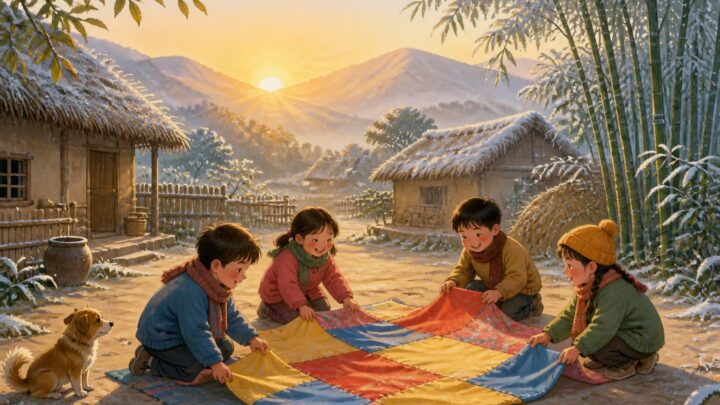
At the edge of a small village with brown-tiled roofs, where the dirt road curved around vegetable beds and bamboo hedges, there lived a boy named Tí. Tí was not the strongest boy in the village, nor could he run fast or climb trees as well as the other children. But he had a heart that always noticed the smallest things. Tí knew that the yellow dog liked to lie beside the stove in the afternoon, that the plum tree behind the house needed only one more ladle of water to turn green again, and that the elderly neighbor quietly pulled her wool scarf higher whenever the winter wind blew.
That winter arrived early. In the mornings, mist covered the rooftops, the fences, and even the cabbage leaves still beaded with water. Adults put on extra layers, children wrapped scarves around their necks, and the sparrows huddled in sheltered bushes. Tí often stood by the window looking east, where the Sun still rose slowly behind the mountain range.
“Mother, why does the Sun have to shiver too?” Tí asked.
His mother was mending an old wool sweater for him. Hearing this, she smiled.
“The Sun is high up in the sky, so it probably isn’t cold, dear. The Sun’s light warms our whole village, too.”
But Tí still was not completely reassured. He noticed that during winter, the Sun often appeared later, its light was paler, and it was not warm enough to dry the drops of dew until noon. In the afternoon, the Sun hurried behind the mountains again, leaving the entire field in a cold purple light.
That night, Tí took out the small wooden box where he kept his precious things. Inside were a blue marble, three feathers, a shiny button, and a piece of red string. He placed everything on the table and thought for a long time. If the elderly neighbor had a wool scarf, and little Lâm’s baby sibling had thick socks, then what did the Sun have to protect itself from the cold?
“I’ll sew the Sun a coat,” Tí decided.
A Special Coat
The next morning, Tí told his mother about his plan. She was so surprised that she nearly dropped her spool of thread.
“Sew a coat for the Sun? But the Sun is enormous, dear.”
“Then I’ll sew a really wide coat.”
“A coat needs fabric. Where will you get the fabric?”
Tí looked at his old coat. Its sleeves were worn, but it was still warm enough. He then thought of the faded yellow curtain in the storeroom, the tablecloth his mother rarely used, and the scraps of fabric his grandmother had left behind.
His mother could not bring herself to refuse her son’s earnest eyes. She took out a large cloth bag, and together they went around the village asking for old pieces of fabric. The carpenter’s house gave them a piece of soft brown cloth. The shopkeeper’s house gave them several strips of yellow fabric. The elderly neighbor removed a wooden button from an old coat and told Tí to use it as the Sun’s coat button.
“I have nothing new left,” she said, “but old things, when joined together with kindness, can still become beautiful.”
Tí remembered those words.
For three days, he and his mother sat beside the fire. Tí had never sewn such a large coat before, so his stitches were sometimes straight and sometimes crooked. He sewed some pieces on backward, while others came loose as soon as he had attached them. Each time, Tí did not lose his temper. He pulled the stitches out and started over.
The coat gradually took shape with patches of different colors: the yellow of sunlight, the red of the fire, the blue of the sky, and the brown of earth. Tí called it the Warm Dawn Coat.
On the fourth day, he took the coat outside to dry. It was so wide that it covered the entire gourd trellis. The wind blew through it, making the pieces of fabric flutter like a field of flowers in motion.
Just then, a powerful northern wind suddenly swept in. It lifted the coat off the trellis, carried it past the fence, and caught it on the top of the banyan tree at the entrance to the village. Tí ran after it, but the farther he ran, the higher the wind pulled the coat.
“Don’t be afraid! I’m bringing the coat to the Sun!” Tí called as he ran.
The village children heard him and ran out to help. One pulled the rope, another climbed onto the stone steps, and another stood beneath the tree giving directions. But the banyan tree was too tall, and its branches were slippery with mist. At last, the coat slipped from the treetop, flew across the field, and fell into the stream.
The Stream Would Not Give Back the Coat
Tí sat by the stream, sadly watching the coat caught among the reeds. The water was cold and fast, and no one dared to wade in. If the coat were swept away, all his hard work would be lost.
Suddenly, a voice rang out from beneath the water:
“Why do you want to give the coat to the Sun?”
Tí looked around. On a wet stone, a silver fish was lifting its head.
“Because I think the Sun gets cold in winter, too. If the Sun were warmer, my village would have more sunlight.”
The fish swished its tail.
“The Sun doesn’t need your coat. But I understand the kindness in your heart. Are you willing to do something more difficult?”
“What is it?”
“Find the people who are cold before you think about warming the Sun.”
Before Tí could ask anything else, the fish dove beneath the surface. The stream suddenly spun into a small circle. The coat caught in the reeds was gradually pushed toward the bank. Tí pulled it out, wrung it dry, and hugged it tightly to his chest.
On the way home, Tí saw the elderly neighbor struggling in front of her door. The wind had blown a roof tile loose, allowing the cold air to sweep inside. Tí did not take the coat home right away. He called his friends, and together they gathered bamboo branches, tied the eaves back in place, and temporarily secured the displaced tile. Tí used the leftover brown fabric to cover the window.
That afternoon, the elderly woman sat beside the fire, and her hands no longer trembled as they had that morning.
“The Sun’s coat has already helped me,” she said.
Hearing this, Tí felt warmer inside than he did even when standing in the sunlight.
Light Sewn from Good Deeds
The next day, Tí brought the coat to the communal courtyard. He wanted to repair it securely and then find a way to take it to the highest hill. But as soon as he spread the coat out, he saw many people in the village who needed help.
A family with a newborn baby was short of firewood. A farmer at the far end of the village had broken the handle of his hoe. The shopkeeper’s chickens had had their coop knocked over by the wind. Tí suddenly remembered what the fish had said: find the people who are cold before thinking about warming the Sun.
So the coat was taken apart piece by piece. The yellow fabric became a windbreak for the chicken coop. The red fabric was placed around the baby’s cradle. The blue fabric was used to wrap a new hoe handle. The remaining pieces were sewn into several small scarves for the village children.
Tí’s friends helped, too. One brought firewood, another repaired fences, and another delivered food to a sick family. Tí’s mother opened an old chest and took out clothes that no longer fit, washed them, and gave them to those who needed them. The elderly neighbor gave her last wooden button to a little girl who had lost a button from her coat.
Within just a few days, the whole village had changed. The eaves were covered, the windows had extra wind barriers, and every household’s stove glowed with fire. The adults no longer sat around complaining about the cold. Instead, they began asking whether the people next door needed any help.
That morning, the Sun appeared behind the mountain range. Sunlight fell across the rooftops, spread over the road, and sparkled on the stream. Tí looked up. He imagined that the Sun was smiling.
“Mother,” Tí called, “I think the Sun doesn’t need a coat anymore.”
His mother stroked his head.
“Why do you think that?”
“Because the coat has become warmth everywhere.”
Just then, a ray of sunlight shone through a gap in the leaves and fell straight onto Tí’s hand. In his palm lay a strand of yellow thread that he did not remember picking up. The thread glittered like a tiny ray of sunlight.
Tí tied the thread to the branch of the tree in front of his house. From then on, whenever the wind blew, the thread fluttered. The villagers called it the Dawn Thread, to remind one another that warmth comes not only from sunlight. It also comes from a hand extended at the right moment, a roof repaired with help, a share of firewood, or a sincere word of concern.
A Gift for Cold Days
Winter did not end right away. On some mornings, the mist was still thick, and on some nights, the wind still whistled through the bamboo grove. But after the story of the coat, no one in the village had to endure the cold alone anymore. Each household placed a small basket outside its door. Those who had firewood put in firewood; those who had old clothes put in clothes; those who had vegetables shared some of their vegetables. Those in need could take what they needed, and those with more to spare could contribute more.
Tí no longer wondered whether the Sun was cold. He understood that some questions begin with imagination but lead us to a very real good deed. He also understood that kindness does not always create a miracle right before our eyes. Sometimes, it is only a clumsy stitch, a piece of old fabric, or an afternoon spent helping someone repair a roof. But when many people each contribute a little, those small things can be enough to warm an entire village.
High above, the Sun continued to cross the sky day after day. Every morning, its light touched Tí’s roof, touched the yellow thread, and turned it into a gentle streak of brightness.
And whenever winter returned, Tí still took out his needle and thread and sat beside the fire. He sewed little coats for babies, cloth socks for the elderly, and windbreaks for the animals in the village. He no longer sewed a coat for the Sun, because he had learned something important: when people know how to love and care for one another, sunlight will always have a place to stay.
Related articles
The Boy and the Wind Chime Learn to Listen
At the end of the village road stood a small house with a brown-tiled roof and a bougainvillea vine covering the fence. In front of the house, Minh’s grandmother hung an old wind chime. The chime was made from slender bamboo tubes, a small brass leaf, and a faded blue cord. In the past, whenever
Read more
The Little Girl Who Kept Raindrops in a Cloth Bag
The Late Arrival of the Rain At the end of a red dirt road stood a small village nestled among rolling hills. Surrounding the village were cornfields, vegetable plots, and lush green bamboo thickets. The villagers lived simple lives; each person had their own work, going to the fields in the morning and returning to
Read more
The Little Girl and the Seedling Asleep Beneath the Roof
At the end of a red dirt road stood a low, tiled-roof house, with an old starfruit tree growing in front of it. In that house lived little Na with her grandmother. Na had bright eyes, hair that was always tied to one side, and a very special habit: she often picked up things other
Read more
The Boy Who Gathered the Wind and the Garden That Knew How to Listen
The Boy on the Hillside At the edge of a small village with brown-tiled roofs, towering areca palms, and a winding dirt road that ran all the way to the foot of the hill, there lived a boy named An. An was not the strongest boy in the village, nor could he run as fast
Read more
The Wind Chime That Called Kindness by Name
On the other side of the green hill, where the bur grass often clung to the hems of passersby’s trousers, there was a small village called Rustling Wind. The village was not wealthy, but every house had a flower garden and a wooden bench in front of the porch. In the mornings, the adults went
Read more
Little Mây’s Bag of Sun Seeds
At the end of the dirt road leading into Gió Nội Village stood a small tiled-roof house, with a yard full of yellow chrysanthemums. In that house, little Mây lived with her mother and grandmother. Mây had hair as soft as the clouds in the sky, clear, bright eyes, and a very unusual habit: every
Read more