
Story Collections · 20 November, 2026
The Last Bus Through Cloud Pass
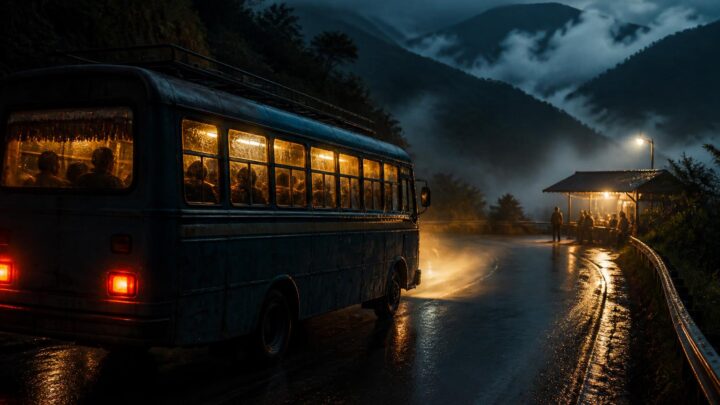
In the town nestled between two mountain ranges, people called the bus that departed at nine in the evening the last bus. After that hour, the road through Cloud Pass was almost swallowed by darkness. The houses along the road closed their doors, the eateries gradually turned off their lights, and the sound of engines echoing up from the foot of the pass seemed like a reminder that the day was nearly over.
The bus was not large. Its blue paint had faded, and red dust streaks that could never be washed away still marked its body. It ran from the town up to the mountain district, stopping at seven stations, three of which consisted only of a corrugated-metal shelter and an old wooden bench. The driver was named Mr. Lam. He had driven this route for nearly twenty years, long enough to recognize every bend by the sound of the tires grinding against the road.
People often thought that the last bus carried only those in a hurry. But Mr. Lam knew that every passenger who boarded brought along a story of their own. Some were going to visit their mothers, some were returning to old homes after years of making a living far away, and some simply wanted to sit quietly in the darkness for a while before entering a difficult conversation. He did not ask many questions. He simply drove, switched on the yellow light in the passenger compartment, and gave everyone just enough silence.
The Woman Standing Under the Shelter
On the last Friday evening of the month, just as the clock on the dashboard reached nine, Mr. Lam saw a woman standing at the first stop. She wore a brown sweater and carried a small cloth bag. Beside her was an old suitcase whose wheels were misaligned to one side. She stood very straight, but her posture did not look like that of someone waiting for a bus. It looked like the posture of someone who had waited too long and would not allow herself to give up.
Mr. Lam opened the door. The woman boarded, paid her fare, and chose the back row. When the bus started moving, she placed the cloth bag on her lap and kept the suitcase close to her feet. The streets gradually thinned out behind them. In the rearview mirror, he saw her looking out the window, where the town’s lights were receding into tiny points of brightness.
At the second stop, a boy of about ten came running up. He wore a school uniform with an oversized raincoat over it, and his hair was soaking wet. He climbed aboard while panting, clutching a white envelope tightly in his hand.
“Did I make it in time, sir?” he asked.
“If you’re going to the last stop, you’ll still catch the bus down the mountain tomorrow morning,” Mr. Lam replied. “But where are you going?”
The boy looked toward the woman in the back row and fell silent. She looked at him too. For a moment, the two recognized each other, but neither spoke. The boy sat in the middle row, hugging the envelope to his chest.
Mr. Lam did not ask anything else. He simply slowed down as the bus entered the steep section of road, even though he knew it might make the bus a few minutes late.
Those Who Boarded in the Night
At the third stop, an elderly man boarded with a birdcage covered by a cloth. He sat right beside the door, carefully holding the cage between his knees. At the fourth stop, a young woman carrying a box of pastries got on; every few minutes, she checked to make sure the lid had not come loose. At the fifth stop, an electrician boarded with hands still stained with grease and a hard hat hanging behind him.
No one spoke to anyone else. Each person sat within a silence of their own. Yet the bus was not entirely without sound. There was the rain tapping on the roof, the windshield wipers sweeping steadily across the front glass, and the faint rattling of the birdcage over every pothole. Those small sounds came together into a peaceful rhythm understood only by people traveling the roads at night.
By the time they reached the foot of Cloud Pass, the rain had begun to fall heavily. Low clouds spilled down the mountainside, hiding the treetops. Mr. Lam switched on the fog lights and drove slowly. The winding road appeared only within a brief patch of light in front of the bus, then vanished again behind the curtain of rain.
Just then, the boy in the middle row stood up and walked toward the back. He stopped in front of the woman and held out the white envelope with both hands.
“Read it, Mom,” he said.
The woman did not take it immediately. Both her hands tightened around the cloth bag on her lap. Only after a long while did she reach out and take the envelope. She did not open it. She only looked at the boy, her face appearing beneath the pale yellow light.
“Where did you get it?”
“From your desk drawer. I already read it.”
“You shouldn’t read other people’s letters.”
“But if I hadn’t read it, you would have left without telling me.”
The passenger compartment fell completely silent. The man with the birdcage looked down at the floor. The young woman holding the pastry box turned toward the window. Mr. Lam continued looking straight at the road, but the hand resting on the steering wheel slowly tightened.
A Forgotten Promise
The woman opened the envelope. Inside was a sheet of paper folded into quarters, covered in slanted, childlike handwriting. The boy had written that he knew his mother had sold the house to go work in another city. He knew she did not want him to drop out of school, and he also knew that she had called many times without being able to say anything. He wrote that if she still had to leave, he would try hard at school and take care of his grandmother. But before his mother left, he wanted to hear her say one thing clearly: that she would come back.
The woman read to the end and folded the paper again. She did not cry. Only her shoulders trembled very slightly, like the bus shaking over the rough road.
“I was planning to get off at the last stop,” she said. “I’ll take the early-morning bus. I thought that if I left quickly, everything would be easier.”
“Are you coming back?”
She looked at her son. Outside the window, rain slid down in long streaks.
“I don’t know when,” she said. “But I will come back.”
The boy lowered his head. Perhaps that was the answer he had been waiting for, even though it did not resolve anything. He returned to his seat. The woman watched him, then tucked the paper into her coat pocket as though putting away something precious.
From the front row, the electrician suddenly spoke. He said that he had once left home after arguing with his father. He had thought that if he simply earned enough money and bought another house, everything would naturally pass. But when his father died, he understood that some conversations, if they did not happen at the right time, would never happen at all.
The elderly man with the cage quietly said that he had once kept a myna bird that could imitate human speech. Every morning, the bird used to call his wife’s name. After she died, he took it up into the mountains and set it free. He said he did not want the house to continue echoing with a name that no one remained to answer.
Hearing this, the young woman with the pastry box said that she was taking the pastries to her father, whom she had not seen in many years. She did not know whether he would accept them, nor did she know what words would begin their meeting. But she thought that if she waited until she was no longer embarrassed, perhaps the two of them would never see each other again.
No one offered anyone else advice. It was simply that, on a cramped bus in the middle of a rainy night, strangers took turns setting down a part of their stories. Those stories did not make the road less winding, but they made it seem less cold.
The Bend Before the Last Stop
As they neared the summit, the bus suddenly shook hard and stopped. Mr. Lam turned off the engine and tried starting it again, but the motor produced only a dry, harsh sound. The rain continued to fall, and wind passed through the gaps in the doors, creating a long, whistling noise.
Mr. Lam took a flashlight and stepped outside to inspect the bus. A large rock had become lodged against the rear wheel, breaking part of the mudguard and jamming the wheel. The electrician immediately got out to help. The two men used an iron bar from the luggage compartment to pry the rock loose. The elderly man also stepped down to hold the light. The young woman stood by the door with her pastry box, while the boy and his mother looked at each other through the fogged window.
It took nearly half an hour before the bus could move again. Mr. Lam climbed into the driver’s seat, wiped the rain from his face, and smiled wearily.
“Tonight, everyone has something to do before daybreak,” he said. “The bus does too.”
No one laughed loudly, but a sense of relief spread through the passenger compartment. Sometimes people only need to push something heavy together, hold up a light, or wait a few extra minutes by the roadside to feel that they are no longer as alone as before.
The bus reached the last stop later than usual. The woman and the boy got off first. She did not pull her suitcase away immediately, but turned back to Mr. Lam.
“Thank you for driving slowly through the pass.”
Mr. Lam shook his head. “The road is wet, so I have to drive slowly.”
She knew that was not the whole truth. He had seen them from the first stop, had heard their conversation, and had allowed the bus enough time for a promise to be spoken. But she said nothing more. She took her son’s hand, and together they walked into the small house beside the bus stop.
The remaining passengers got off one by one. The man with the birdcage walked toward the slope. The young woman holding the pastry box stood beneath the eaves, waiting for the rain to ease. The electrician shook Mr. Lam’s hand firmly before leaving.
When everyone had gone, Mr. Lam remained sitting alone. On the back seat was a small piece of paper, perhaps fallen from the envelope. He did not pick it up immediately. He looked through the windshield. In the distance, a light had just come on in the woman’s house. The silhouettes of a large person and a small person moved back and forth behind the curtain.
Mr. Lam started the engine. The blue bus turned around, preparing to return to town. The road downhill was still dark, and the rain had not stopped, but tonight did not feel as heavy to him as it usually did. Perhaps it was because the last bus did not merely take people to a destination. It brought them closer to something that had been delayed for far too long.
What Remained After the Journey
The next morning, the people of the town still saw the blue bus parked at the station as usual. Mr. Lam wiped the windows, checked the wheels, and brewed a pot of hot tea. No one knew what had happened on Cloud Pass, because those who had been there that night were not in the habit of retelling other people’s stories.
As for Mr. Lam, from that day on, whenever he saw someone running toward the bus stop at the last minute, he always waited a little longer. Waiting did not always change the outcome. Some buses could not be late, and some roads had to be traveled on schedule. But sometimes, even a short amount of time was enough for someone to say goodbye, hand over a letter, or realize that they still had a place to return to.
Life often makes people believe that they must move quickly so they will not miss what matters. Yet there are moments when the most precious thing is to slow down. Slow down to notice someone standing beneath a shelter. Slow down to hear a sentence that has not yet been spoken. Slow down to keep a promise from being left behind.
Related articles
The Keeper of the Last Bell at the End of the Alley
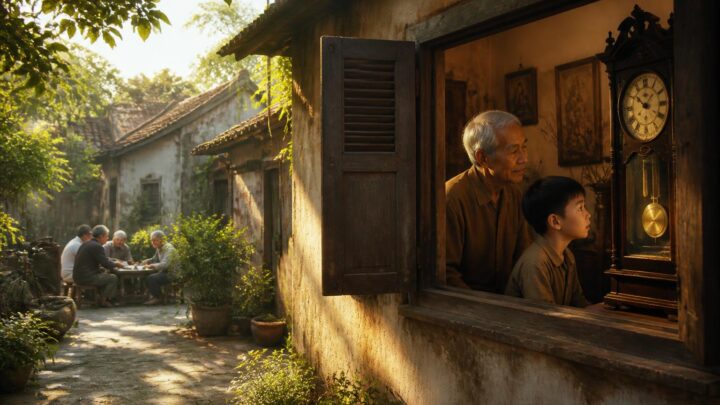
The Bell in the Early Morning At the end of a small alley stood a low, tiled-roof house, with a faded pendulum clock on the front porch. Every morning at exactly six o’clock, the bell inside the house would ring. It was neither clear nor lingering like the church bell across the street. Its sound
Read more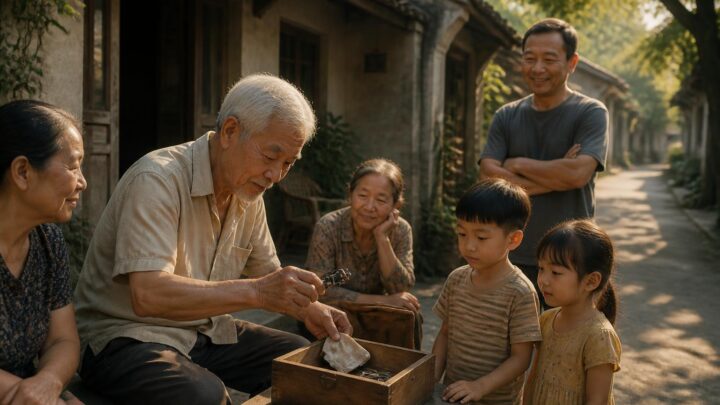
The One Who Collected Forgotten Things
The Wooden Box Beside the Veranda At the end of a small street stood an old tile-roofed house, with a dark-brown wooden box always placed outside its veranda. The box was not large, just big enough to hold a few odds and ends such as keys, buttons, handkerchiefs, hair clips, or crumpled bus tickets. Beside
Read more
The Clock Shop at the Bottom of the Hill and the Day Time Stopped
At the bottom of the hill leading down to the riverbank stood a small clock shop. The wooden sign in front of the door had faded, but the words carved into it could still be read: Repairing the Things That Missed Their Beat. The townspeople called it Mr. Bay’s shop, though no one knew what
Read more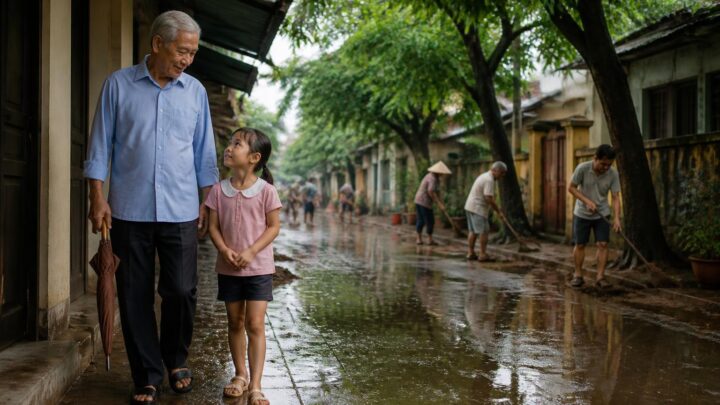
The Keeper of the Rainy Season and the Umbrella That Never Opened
At the end of the street lined with old golden shower trees, where the low-roofed houses gradually gave way to a stretch of land along the river, there was a man who often appeared just as the sky was about to rain. He was in his early sixties, thin, with mostly gray hair, and always
Read more
The Bougainvillea Wall at the End of the Alley
At the end of a small alley stood a wall covered in bougainvillea. Every sunny season, delicate clusters of flowers burst into bloom against the backdrop of peeling limewash, making the stretch of road that few people had ever noticed suddenly seem brighter. The people in the alley had grown so accustomed to the wall
Read more
The Wooden Bridge and the Guide for Those Who Are Lost
To the north of a small village stood a forest shrouded in mist all year round. The villagers called it the Misty Forest, not because the trees were too dense, but because anyone who entered easily forgot where they were going. Some people went in to gather firewood and returned a few hours later, but
Read more