
Zodiac Signs · 24 November, 2026
The Moon in the Natal Chart and How to Recognize Your Own Emotional Needs

When talking about the zodiac, many people usually start with their Sun sign, meaning the sign determined by their date of birth. However, in everyday experience, that prominent aspect of personality does not always explain how a person reacts when tired, hurt, or in need of protection. Some people are very open on the outside but withdraw when something sad happens. Others appear calm and rational but inwardly need a great deal of reassurance and a sense of stability. Astrology often uses the image of the Moon to approach this more private layer of life.
The Moon in a natal chart should not be understood as a label that determines a person in their entirety. It is better suited to the role of a symbolic language, helping readers ask questions about emotional needs, defense habits, and reactions that often arise before reason has time to intervene. This approach is most valuable when used for self-observation, not for judging oneself or putting others into boxes.
What does the Moon represent?
In astrological interpretation, the Moon is often associated with private emotions, memories, habits, and a sense of security. If the Sun is linked to self-awareness, one’s direction of development, or how a person wants to express themselves, the Moon is generally viewed as the more instinctive realm of reaction. It may include how we seek comfort after a stressful day, how we receive care, or how we face the feeling of being abandoned.
This concept does not mean that each person has only one fixed emotional pattern. Emotions are also influenced by family, living environment, personal experiences, health, and many different relationships. The Moon’s position, if used at all, should only be a suggestion for reflection. It cannot replace psychological knowledge, professional counseling, or direct listening when dealing with serious issues.
A useful question when reading about the Moon is: “What makes me feel as though I have returned to myself?” For one person, the answer may be a quiet space. For another, it may be a sincere conversation, a familiar routine, or the feeling of being free to make their own decisions. These needs are sometimes obscured by the social roles we take on each day.
Three layers of information to observe
Initial reactions under pressure
When faced with bad news, conflict, or an unexpected change, we often have a fairly quick initial reaction. Some people immediately seek out a loved one to talk to, some want to be alone, and others start dealing with tasks so they do not have to face their emotions. No reaction is automatically better than another. What matters is recognizing whether that reaction genuinely helps us recover or merely postpones an issue that needs to be faced directly.
Observing our initial reactions also helps distinguish genuine needs from established habits. For example, someone may say that they value independence, but whenever they are stressed, they quietly wait for someone else to reach out and ask how they are doing. Another person may often appear strong, yet need to be informed about changes in advance so they do not feel out of control. This difference is not a contradiction to be ashamed of. It simply shows that inner life is more complex than outward appearances.
How we receive care
Many disagreements in relationships do not stem from a lack of affection, but from each person understanding “being cared for” in a different way. Some people feel loved through clear verbal expressions. Others need consistent presence, practical actions, or enough personal space. If we do not recognize our own needs, we can easily feel disappointed when others show care in ways that do not match what we expected.
Observing the Moon in this way is not intended to provide a formula for romance or communication. It encourages each person to express their needs more specifically. Instead of saying, “You never care about me,” one might say, “When I am going through something difficult, I need you to listen before offering advice.” A clear statement often opens up more possibilities for dialogue than a general accusation.
Habits that create a sense of security
A sense of security is often built from small, repeated things. These may include relatively consistent sleep times, a tidy workspace, staying in touch with loved ones, or the habit of writing down what is causing worry. When disrupted, these habits can become anchors that help a person regain their balance.
In symbolic interpretation, the Moon sign is often associated with different ways of seeking security. Some people need material stability and a clear schedule. Others feel relieved when they can talk, learn, or change their surroundings. Some need the feeling that they are taking care of someone, while others need private boundaries. These descriptions should be viewed as prompts for reflection, not as conclusions to be applied mechanically to everyone with the same placement.
Reading the Moon’s position with discernment
Information about the Moon in a natal chart is often interpreted together with the zodiac sign, house, and aspects. However, for beginners, trying to interpret every factor at once can leave readers feeling overwhelmed. A simpler approach is to choose one specific topic, such as “what I do when I am rejected” or “what I need in order to rest,” and then compare it with real-life experience.
An astrological description should not be used to justify behavior that causes harm. Saying that one is “the jealous type,” “unable to control their emotions,” or “unable to trust anyone” does not make those behaviors harmless. Self-awareness only has meaning when accompanied by responsibility. If someone frequently overreacts, avoids communication, or hurts others, the necessary step is not to find a more suitable personality label, but to examine the causes and how to change.
It is also important to avoid using the Moon sign to speculate about other people’s private lives without their consent. A person may not want to share their past, fears, or emotional needs. In such cases, astrology should be used as a tool for self-reflection rather than as a means of reading other people. Respecting boundaries remains more important than any symbolic chart.
From recognizing emotions to daily practice
After recognizing an emotional need, the important thing is to turn it into a concrete action. If you need security, you can make plans for what lies within your control instead of trying to predict every change. If you need to be heard, you can choose someone you trust and clearly say whether you want them to listen or offer advice. If you frequently withdraw, you can start with a short message rather than forcing yourself to share the entire story at once.
Keeping a journal is also a useful way to distinguish events from interpretations. Record what happened, what emotions arose, what need lay behind them, and what action you chose. Over time, patterns may become clearer. For example, a feeling of being forgotten may arise whenever a message goes unanswered for several hours, even though there is no evidence that the relationship is experiencing a problem. Once we recognize the pattern, we have more opportunity to examine our assumptions before reacting.
In addition, caring for the body should not be overlooked. Lack of sleep, irregular eating, and prolonged stress can make emotions more sensitive. Not every anxiety requires a mystical explanation. Sometimes the body is signaling that we need to rest, reduce our load, or seek appropriate support. A responsible approach to reading astrology must make room for these practical factors.
Conclusion
The Moon in a natal chart can be viewed as a lens through which to examine our emotional needs and familiar reactions. Its value does not lie in making certain predictions, but in prompting questions that are easily overlooked amid the pace of daily life: When do I feel safe? How do I usually seek care? What makes me become defensive before I even understand the situation clearly?
The answers do not necessarily have to come from a zodiac sign. They can be tested through experience, sincere conversations, writing down our emotions, or support from a qualified professional. When we use astrology as a language for self-observation rather than as a predetermined mold, we can remain curious without losing our ability to choose. That is the practical starting point for a healthier relationship with ourselves and with the people around us.
Related articles

The Four Elements in the Zodiac and the Art of Understanding Differences Between People
In conversations about the zodiac, people often begin with the familiar questions: What sign are you? What sign is the other person? Are the two of you compatible? This approach sparks curiosity, but it can sometimes reduce astrology to a personality classification chart. One person is labeled hot-tempered, while another is regarded as cold, practical,
Read more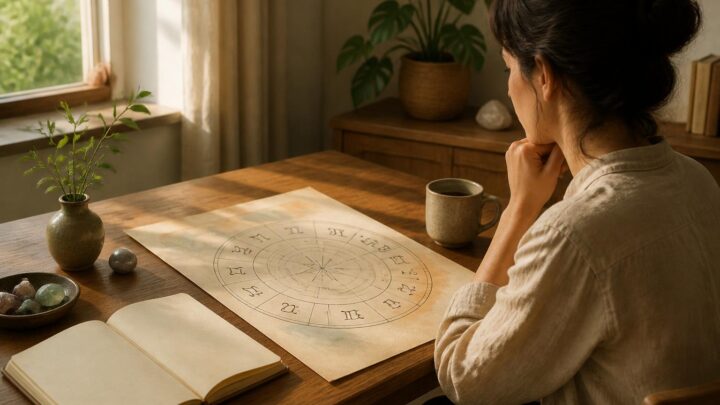
The Zodiac as a Language for Self-Observation, Not a Predetermined Mold
In modern life, the zodiac appears in many places: in conversations among friends, in entertainment sections on social media, in articles about love, or in forecasts read at the beginning of the month. Some people see it as a way to relax, some find in its familiar descriptions a language for talking about themselves, while
Read more
Mercury Retrograde: Turning a Pause into Time for Review
In astrology, Mercury is commonly associated with thinking, communication, learning, paperwork, schedules, and the means by which people exchange information. When Mercury retrograde appears in the sky, many people tend to worry about conversations that may be easily misunderstood, trips that run into problems, or electronic devices that fail to work reliably. However, this perspective
Read more
The Moon in the Birth Chart and the Need for Emotional Safety
When discussing birth charts, many people usually begin with the Sun sign because it is the most familiar and accessible placement. However, if we want to understand inner life, how a person reacts to upheaval, or what makes them feel that they belong, the Moon is a noteworthy symbol. In common astrological interpretation, the Moon
Read more
The Moon in the Birth Chart: An Emotional Landscape That Needs to Be Heard
While many people know the Sun sign as a symbol of identity and self-expression, the Moon in a birth chart points to a more private layer of experience. It speaks to the emotions that often arise before reason has a chance to speak, the need to be cared for, reactions under stress, and the feeling
Read more
The Ascendant and How Each Person Enters the World
When studying a birth chart, many people usually begin with the Sun sign because it is the most familiar placement. However, this single factor can hardly fully describe how a person appears in everyday life. Some people belong to the same zodiac sign but make entirely different impressions: one may be open and quick to
Read more