
Story Collections · 26 November, 2026
The Lighthouse Keeper and the Map of Returns

At the far end of Vạn Chài Village stood a short lighthouse, its body painted white but streaked with salt stains. During the day, people almost forgot it existed. Only when evening fell, and the boats offshore began switching on their lights, did the lighthouse become the clearest point of brightness along the long stretch of coast. The villagers called the place the Sea-Eye Tower, while Mr. Lâm, who had tended it for more than thirty years, simply called it home.
There was not much remarkable about his work. Every morning, he cleaned the glass, checked the wiring, recorded the condition of the generator, and swept the yard. Every evening, he switched on the light at exactly the right time, watched the sea through a small window, and turned the light off once the sky had brightened. These tasks were repeated so regularly that many people thought he had no need for a clock. He only had to look at the color of the sky and listen to the waves to know when to begin.
Yet in the small room at the foot of the tower, Mr. Lâm kept something that made the villagers even more curious than the light itself: a wooden box containing fragments of maps. Some were nothing more than a corner of paper; others had faded so badly that the lines had nearly dissolved into the background. On them were the names of old docks, paths along the hills, a stream that had once run through the fields, and houses that now belonged to different people. He did not use them to find his way out to sea. He used them to remember the people who had once left.
Maps That Did Not Show the Way
Ten years earlier, a boy named Quân often rode his bicycle to the foot of the lighthouse every afternoon. Quân was not good at school, and he was even less skilled at conversation, but his eyes always looked farther than those of other children his age. He liked listening to Mr. Lâm talk about currents and the boats that had once become lost in the fog. One day, Quân asked why the maps in the box were not pieced together into one complete map.
Mr. Lâm replied that some roads existed only in memory. If they were pieced together, people might think they could travel exactly as they had in the past. But the village had changed, the shoreline had receded, the casuarina trees had been cut down, and the dirt road had been paved with concrete. An old map could help us remember where we had once stood, he said, but it could not take the next step for us.
Quân did not fully understand that answer. He only remembered that whenever someone asked for directions, Mr. Lâm did not point the way immediately. He usually asked where the person wanted to go, where they had been before, what they were carrying, and why they did not want to take the familiar road. To him, finding one’s way was not only about knowing east from west. It was also about understanding what the person standing before him was afraid of.
For instance, Mrs. Năm, who sold fish, once came to ask for directions to the neighboring commune to find a younger sister she had not seen in years. She knew the bus route well, but she still stood outside Mr. Lâm’s house for a long time. He gave her a fragment of a map showing the old ferry landing and told her that the landing was no longer in operation. Mrs. Năm laughed and said she needed the current route, not a story from the past. He only replied that sometimes people had to remember the old place in order to realize whom they truly wanted to meet.
The next day, Mrs. Năm went to look for her sister. Three days later, she returned with a bag of traditional cakes and a story about a reunion that had been delayed for nearly twenty years. She said the two sisters had not resolved all their resentments, but at least they had sat beside each other until the afternoon was over. From then on, whenever anyone asked about the box of maps, Mrs. Năm would say: there are no shortcuts inside it, only things people thought they had forgotten.
A Visitor Returns
At the beginning of the rainy season that year, Quân returned to the village. He was no longer the boy who had ridden his bicycle there. Quân wore a wrinkled shirt, carried a cloth bag, and had the weary look of someone who had been away too long. He stood beneath the lighthouse, looked up at the slowly rotating lamp, and asked Mr. Lâm whether he still remembered him.
Mr. Lâm said that a lighthouse keeper did not forget children who had once asked too many questions. Quân smiled, but the smile passed quickly. He said he had worked at many jobs in the city, moved several times, and recently wanted to come back. His father had been dead for a year, the old house was about to be sold, and his mother firmly refused to leave the village. Quân did not know whether he should stay or keep moving on.
Mr. Lâm did not offer advice immediately. He opened the wooden box and took out a fragment of a map showing the outline of the hill to the south. On that piece of paper there had once been a small house where Quân’s father had repaired nets for the villagers. Now only a cement foundation and a few broken bricks remained.
Quân held the map fragment for a long time, then said he did not want to become someone held back by the past. Mr. Lâm nodded. He said that returning did not mean standing still, just as leaving was not always moving forward. Some people carried their homeland in their luggage. Some had to return once in order to understand that they no longer belonged to that place in the same old way.
That evening, the two of them sat on the porch looking out at the sea. Quân asked Mr. Lâm whether he had ever wanted to leave the lighthouse. He remained silent for a long time. After his wife died, he had once thought of quitting, selling the small house, and going to live with his son in another province. But that year, a boat ran into trouble, and the light flickered in the middle of heavy rain. He stayed to repair the machinery. After that, he never left.
He said he had once thought that staying was a noble choice. Later, he came to understand that sometimes people stayed not because they were brave, but because they were not strong enough to face another place. The lighthouse had become a very convenient excuse for him not to ask himself how he wanted to live after his losses.
When the Light Went Out
A few weeks later, a powerful storm passed through. Rain lashed the glass windows white, and the wind shook the entire tower. Near midnight, the generator suddenly stopped. Mr. Lâm immediately put on his raincoat and took a flashlight and a tool kit. Quân, who was sleeping in the room next door, ran after him.
It took them more than an hour to discover that the main wiring had short-circuited. While Mr. Lâm repaired the machinery, Quân stood on the stairs holding the flashlight. The small beam trembled constantly across the wet iron steps. Outside, the sea was pitch-black. There was no sound of people, only the waves striking the foot of the tower and the clatter of metal against metal.
When the light came on again, a beam swept across the sea. Quân followed its circle of light and suddenly realized that it could not illuminate everything. Each time it turned away, the sea sank back into darkness. The light revealed only a very small part, but that small part was enough for those far away to know that they still had a sense of direction.
Quân said that perhaps this was what he had forgotten in the city. He had always wanted to see the entire road before taking a step, wanted to be certain that his choices would not lead to mistakes. But no one could see farther than a limited area of light. People could only continue after seeing enough for the next step.
The next morning, Quân decided not to sell his father’s house yet. He would repair the roof, clear the garden, and live with his mother for a while. It was not a promise to stay forever. It was simply a decision not to leave immediately out of fear of facing the things that remained unfinished. After hearing this, Mr. Lâm only told him that he should draw a new map for himself and not keep using other people’s lines forever.
The Road Beyond the Lighthouse
The following summer, Quân opened a small workshop near the old landing, repairing wooden items and making toolboxes for fishermen. His mother still complained that her son worked slowly, but every afternoon she set aside a portion of hot food for him. The old house was kept, not as a museum for someone who had died, but as a place where the living could continue to meet one another.
Mr. Lâm finally asked to retire. The person who replaced him was a young man from the village who had gone up the tower many times to inspect the machinery. Before leaving, Mr. Lâm gave the box of maps to Quân. Quân asked what he would do if he no longer had to switch on the light every evening.
Mr. Lâm said he would probably visit his son, then look for a coastal road he had never traveled. He did not know whether he would like the new place, but for the first time in many years, he wanted to try. The wooden box was left behind not so that Quân would become the keeper of memories in his place, but so that he would understand that every map eventually grows old.
The lighthouse continued to shine steadily every night. From a distance, it looked much the same as before. Only the lighthouse keeper had changed, and below the tower, a newly opened woodshop often rang with the sounds of planing and sawing. Those passing by could still ask Quân for directions to the landing, the market, or the southern slope. He would give them directions, but he would never forget to ask where they truly wanted to go.
Perhaps that is the deepest meaning of a guiding light. It does not lead anyone all the way to their door, nor does it guarantee that the sea will always be calm. It only gives the person who is traveling a moment of sufficient light to recognize their direction. The rest, each person must walk for themselves, redraw their own map, and take responsibility for the place they choose to return to.
Related articles
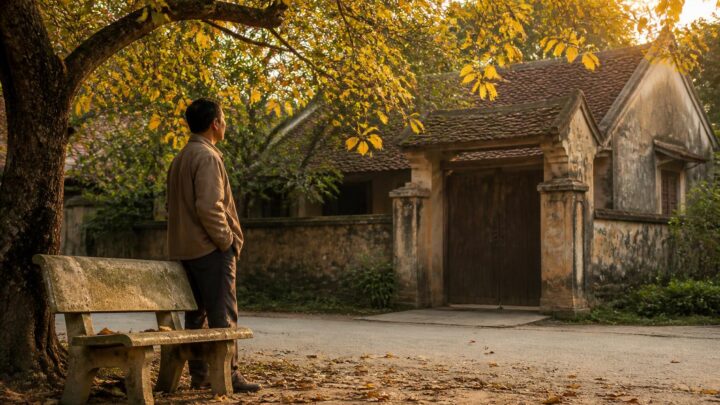
The Stone Bench Beneath the Old Banyan Tree
Minh returned to the village one late-October afternoon, when the dirt roads had dried after several days of rain. The bus dropped him off at the head of the slope and drove away, leaving behind a thin cloud of dust suspended in the pale sunlight. He pulled his small suitcase past the areca palms at
Read more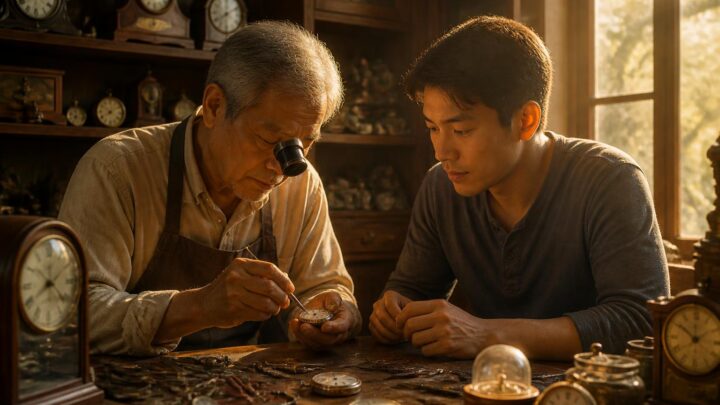
The Watchmaker and a Day Without the Hands Moving
The Watch Whose Hands Had Stopped At the end of the street stood a watch-repair shop so small that anyone walking quickly could easily pass it without noticing. The wooden sign above the entrance had faded, with only a few faint strokes of lettering remaining. Inside the shop, hundreds of watches lay still on narrow
Read more
The Scent of the Wooden Box
The wooden box lay in the bottom drawer of the low cabinet, where Grandmother often kept things that were no longer used but absolutely must not be thrown away. It was not large, just big enough to hold a spool of thread, a few buttons, and several neatly folded scraps of fabric. The surface of
Read more
The Ferry Crossing Keeper and the Bell of Promises
At the end of a red dirt road, where rows of bamboo leaned down to gaze at their reflections in the broad river, there was a small ferry crossing that the local people called Cloud Ferry. The name came from summer mornings when mist covered the entire surface of the water, making the passenger ferry
Read more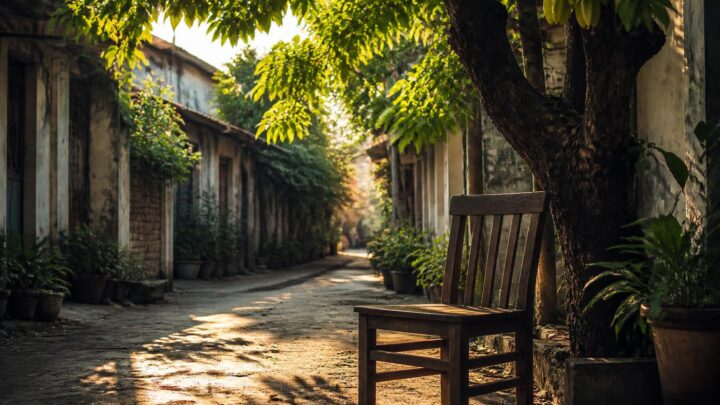
The Empty Chair at the End of the Alley
At the end of my alley stood an old wooden chair. It sat beneath a star-fruit tree, its back against a wall whose lime coating had almost entirely peeled away. In the dry season, it caught patches of dappled sunlight; in the rainy season, it was sheltered by the low eaves of the neighboring house.
Read more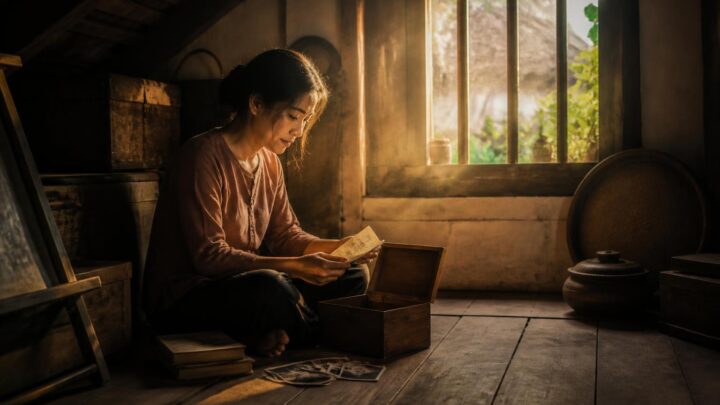
The Unsent Letter from the Little Attic
The old key lay in An’s palm, cold and light, yet it made her feel as though she were holding a piece of her childhood. The wooden door of the house opened with the harsh sound of dry hinges. The smells of dust, damp wood, and old sunlight blended together, creating a familiar scent she
Read more