
Children's Stories · 28 November, 2026
Little May’s Paper Bridge
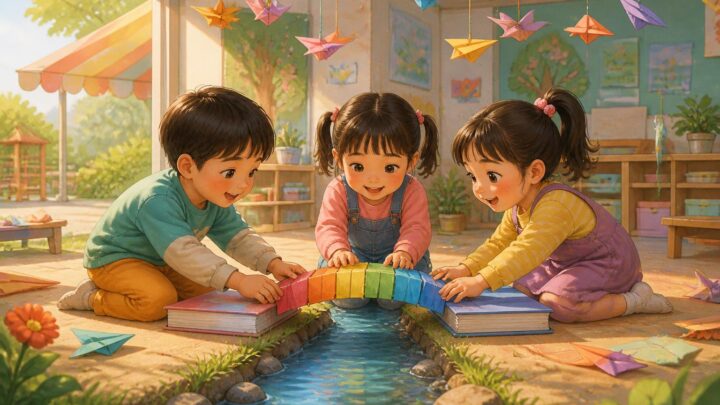
The Forgotten Bridge
At the end of the road leading to Sunshine Preschool, there was a small ditch. It was not deep, and water merely trickled over the round pebbles, but after every rain, mud washed in and made the path slippery. The children usually crossed by stepping on old planks that the security guard had placed there temporarily.
Little May loved the ditch. Every morning, she would stop to watch the yellow leaves drifting along with the current. May even gave each leaf a name. The leaf with three brown spots was Sailboat, the long, curved leaf was Goldfish, and the tiny leaf that always spun around and around was called Dancing Friend.
May’s two best friends were Bin and Na. Bin ran fast, liked playing soccer, and always carried a blue whistle. Na was skillful with her hands and liked folding paper into birds, boats, and funny animals. The two friends usually sat next to each other in class. Bin helped Na get things from high places, while Na folded paper birds for Bin to decorate his study corner.
But one afternoon, Bin and Na suddenly became angry with each other.
During playtime, Na folded a beautiful paper airplane. She carefully pressed each fold, then drew a round dot on the airplane’s wing. Na planned to give it to Bin because that day he had done the best work in the class.
But just as Na placed the airplane on the table, Bin ran past and accidentally knocked it onto the floor. One of the airplane’s wings broke. Bin quickly said that he had not meant to do it, but Na was upset and only shook her head. She picked up the airplane, put it in her bag, and turned away.
Bin felt hurt too. He thought Na refused to listen to his explanation. He took his blue whistle and ran outside to play soccer by himself. From that day on, the two friends no longer sat next to each other. When Na needed to get her pencil case, she stood up and got it herself. When Bin wanted to look at a beautiful drawing, he also turned away as if he had not seen it.
An Idea Made of Paper
May looked at her two friends and noticed a very strange empty space in the classroom. That space was not on the floor, nor was it between the two desks. It lay in unfinished conversations, in eyes that avoided one another, and in two apologies that no one had yet said.
That afternoon, on her way home, May walked past the ditch. The old plank had been swept away by the water after the rain. To get to the other side, she had to step very slowly across several slippery stones. When she set her foot down on the last stone, an idea suddenly came to her.
She ran home and took out a stack of colored paper, glue, popsicle sticks, and a length of yarn. May sat at the table, cut the paper into many long strips, and folded them back and forth. She glued the strips into small squares, attached them to two strands of yarn, and tied both ends to popsicle sticks. By evening, she had finished making a tiny paper bridge.
The bridge could not be used by people. It was only two handspans long, but every paper square had been folded firmly. May placed the bridge on the table and examined it. She thought that if a real bridge could connect the two banks of a ditch, perhaps a small bridge could also remind people to reconnect a friendship.
The next morning, May brought the paper bridge to class. She placed it between Bin’s and Na’s desks. The two friends saw it, but neither of them said anything.
At recess, May took two small pieces of paper from her bag. On one piece, she drew an airplane with a broken wing. On the other, she drew a blue whistle. May gave the first piece to Bin and the second to Na, then said:
“Each of you should write what you want to say on the back. You don’t have to say it out loud. Just write what you haven’t been able to say.”
Bin held his pencil but sat still. Na also looked at her piece of paper for a long time. May did not hurry them. She went to the corner of the classroom and rearranged the storybooks, giving her two friends time to think.
Words at Both Ends of the Bridge
After a while, Bin folded his piece of paper and placed it beside the bridge. Na did the same. May opened Bin’s paper first. He had written: “I’m sorry for damaging your airplane. I didn’t mean to, but I ran away because I felt embarrassed. I should have helped you fix it.”
After reading it, Na’s eyes softened. On Na’s piece of paper were the words: “I’m sorry too for not listening to your explanation. I was sad about the airplane, but I shouldn’t have made you feel abandoned.”
Bin looked at Na. Na looked at Bin. Neither of them spoke right away, because sometimes an apology is easier to write on paper than to say aloud. May placed the paper bridge between them and gently said:
“A bridge has two ends. If only one side steps forward, you still can’t get to the other bank.”
Bin took a breath and said:
“Na, I’m sorry.”
Na nodded slightly:
“I’m sorry too.”
Bin took the airplane out of Na’s bag to look at it. One wing was still wrinkled, but it was not torn. He asked Na to let him repair it. Na took out some glue and a piece of blue paper. The two friends cut out a new wing together. Because both of them wanted to choose the prettiest colors, they argued for a little while, then finally decided to attach one yellow wing and one blue wing.
The airplane did not look the same after being repaired. It had two bright colors and a slightly crooked fold. But when Bin launched it across the yard, the airplane flew farther than either of them had expected. Na ran after it, laughing loudly. Bin laughed too. May stood behind them and saw that the empty space between the two desks seemed to have grown smaller.
A Bridge for the Whole Class
That afternoon, the teacher learned about the paper bridge. She did not praise May because she had made something very beautiful, for the bridge was indeed still crooked, and some parts of it were not glued firmly. She praised her because she had thought about her friends’ feelings.
She suggested that the whole class make a bigger bridge to place in the activity corner. Each child was given two strips of paper. One strip was for writing something they wanted to thank someone for, and the other was for writing something they could do if they accidentally made another person sad.
Bin wrote that he would stop and listen to his friend explain before walking away. Na wrote that she would clearly say what had made her sad instead of staying silent for too long. May wrote that she would not try to solve every problem for her friends, but would stay beside them when they needed someone to accompany them.
The whole class connected the strips of paper into one long bridge. It was hung between two bookshelves, with paper birds folded by Na and colorful airplanes underneath. No one called it a perfect bridge. In some places the paper was wrinkled, and in others the string was tied a little loosely, but every child had contributed a part, so everyone thought it was special.
A few days later, a new plank was placed over the ditch. May, Bin, and Na crossed together. Bin did not run ahead as he usually did. He walked slowly so he could wait for Na. Na also did not remain absorbed in watching the leaves drift through the water. Instead, she turned to ask May which leaf she would name that day.
May pointed to a small leaf drifting in the middle of the current. The leaf tilted to the left, then tilted to the right, but it continued moving forward.
“That’s Connecting Bridge Leaf,” May said.
Bin burst out laughing, while Na said the name sounded very cute. The three friends continued toward the school together. The ditch was still there, and the water still flowed over the pebbles, but the path seemed wider than before.
A Small Lesson for Unhappy Days
Young children may become angry with one another over things adults consider very small: an object being damaged, being left out of a turn to play, or a sentence spoken at the wrong moment. Even so, children’s feelings are no less important. When they are sad, they need to be listened to instead of being quickly told that the matter is not important.
May’s story reminds us that making up does not mean having to immediately forget what hurt us. First, each person needs to honestly say how they feel, acknowledge their share of the responsibility, and give the other person a chance to make things right. A sincere apology cannot erase what happened, but it can open the first step toward both sides moving closer to each other.
Adults can support children with gentle questions such as: What are you sad about? What do you want your friend to understand? And what do you think you can do to make things better? When children are allowed to find their own ways to resolve problems, they gradually learn patience, empathy, and responsibility for their words and actions.
Not every friendship returns to normal immediately after an apology. Sometimes it takes more time, another conversation, or a specific action to rebuild trust. But as long as someone is brave enough to step onto the first plank of the bridge, the distance between angry friends will no longer be impossible to cross.
Related articles

The Wind Chime That Called the Dawn
The Wind Chime by the Porch Once upon a time, in a small village nestled against a mountainside, there lived a boy named Tí. The village was not wealthy, but it was filled with laughter all year round. In the mornings, the adults went up to the hillside fields, the children went to the stream
Read more
The Little Seed and the Garden That Knew How to Listen
At the edge of the Lush Green Forest, there was a small garden beside a crystal-clear stream. The garden was not large, but it was always filled with the rustling of leaves, the buzzing of bees, and the calls of birds hopping from branch to branch. Mrs. Hedgehog cared for the garden. Every morning, she
Read more
The Little Bell on Wind Hill
Once upon a time, at the end of a green valley, there was a village beside a crystal-clear stream. Behind the village stood a high hill that welcomed year-round gusts of wind blowing in from the distant fields. The villagers called that place Wind Hill. At the top of the hill stood a wooden hut
Read more
The Wind Chime That Kept the Little House’s Secret
At the end of a winding road leading up a hill covered in silver grass stood a small house with a blue-tiled roof. The house belonged to little An’s family. In front of the porch grew an old starfruit tree, its branches spreading wide like two arms always reaching out to welcome the wind. Whenever
Read more
The Little Girl and the Garden That Awakened the Raindrops
At the edge of White Cloud Village stood a garden that had been neglected for a very long time. All around it was a bamboo fence faded with age, and the wooden gate often creaked whenever the wind blew through. Inside, weeds grew higher than the knee, cracked garden beds lay still beneath the sun,
Read more
The Boy and the Seed of Tomorrow
The Boy Who Wanted to See Tomorrow At the edge of a small village stood a red-tiled house where a boy named An lived with his mother and grandmother. Behind the house was a neat, square patch of land that had not been tended for a long time. The soil was dry, weeds grew sparsely,
Read more