
Horoscopes · 28 November, 2026
The Wealth Palace in Tử Vi: Understanding Money, the Ability to Create Value, and Spending Habits
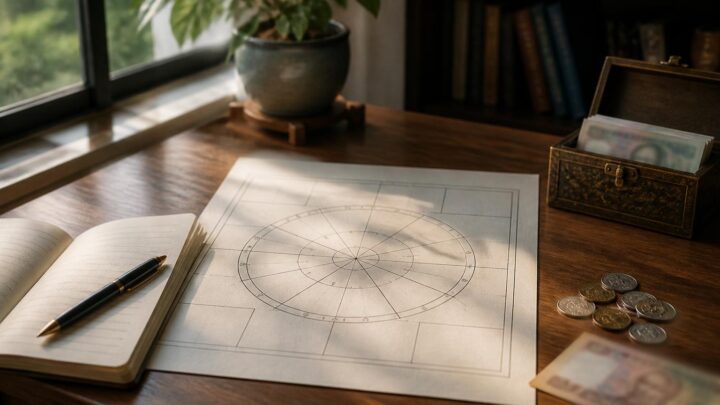
In everyday life, money is rarely just a set of numbers in a bank account. It is connected to a sense of security, the ability to make choices, family responsibilities, and even the way each person evaluates their own worth. Therefore, when exploring a Tử Vi chart, many people are interested in the Wealth Palace as a place that reflects their relationship with material resources. However, if it is viewed merely as the palace of “wealth or poverty,” readers can easily overlook its deeper meaning.
According to the traditional approach, the Wealth Palace should not be separated from the chart as a whole. A careful interpretation usually considers the palace’s position, the stars located there, the stars casting their influence, its connections with other palaces, and the life circumstances of the individual concerned. These factors are not a fixed verdict about the future. Rather, they can be used as a symbolic language for reflecting on the ability to create value, habits of using money, and the way a person responds to opportunities and risks.
What does the Wealth Palace represent?
At the most basic level, the Wealth Palace is often associated with finances, income, assets, and methods of earning money. But its scope is broader than answering a simple question such as “Does one have a lot of money?” This palace also points to how a person recognizes value, seizes opportunities, prices their efforts, and allocates what they have.
Some people are good at earning money but have difficulty keeping it because they spend according to their emotions. Others do not have especially large sources of income but know how to plan, save consistently, and maintain their independence. Some people view money as a tool for learning, building a family, or pursuing meaningful work, while others see money as the sole measure of success. These differences show that financial fortune is not only about income level, but also about management ability.
Therefore, when reading the Wealth Palace, it is useful to ask additional questions: Through what abilities do resources come to me? Do I usually make financial decisions based on reason or emotion? Do I tend to take initiative or wait? Do I prefer stability or accept change? And what causes me to miss opportunities? These questions are more practical than trying to find an absolute conclusion about wealth or poverty.
Distinguishing the ability to make money from the ability to keep it
One of the points most easily confused when interpreting financial fortune is equating the ability to earn money with the ability to keep it. These two abilities are related but not entirely the same. People who can generate income are often sensitive to market needs, know how to develop their expertise, communicate effectively, or dare to try a new direction. Meanwhile, the ability to keep money requires discipline, patience, habits of monitoring cash flow, and the capacity to delay immediate desires.
From the symbolic perspective of Tử Vi, a structure considered dynamic in the Wealth Palace may suggest a tendency to seek opportunities, work in an environment of frequent change, or resist being limited to a single source of income. But this dynamism also needs to be accompanied by principles. Without a plan, constantly expanding or changing direction can cause money to become scattered, decisions to overlap, and risks to increase.
Conversely, a tendency to value stability can help a person preserve what they have achieved, but it may sometimes also make them hesitant to experiment or cause them to overlook suitable opportunities. No type of financial fortune is entirely good or entirely bad. What matters is recognizing the strengths that should be developed and the areas prone to imbalance in order to build an appropriate approach to management.
The relationship between money and work
The Wealth Palace is often considered together with the Career Palace when exploring career direction. If the Career Palace emphasizes the working process, social position, and the way a person develops their abilities, the Wealth Palace points to material results, how abilities are converted into income, and the level of comfort one has when handling financial matters. These two aspects may support each other, but they do not always correspond.
A person may work in a job that suits their interests very well but have a modest income during the early stages. Another person may earn a great deal of money in a particular field but frequently feel exhausted or have no time left for their personal life. Therefore, looking at only one palace to conclude someone’s career or level of success is an incomplete approach. Sustainable finances usually take shape when professional ability, health, collaborative relationships, and management habits are all given attention.
When reflecting on themselves, people can view money as a form of feedback about the value they are providing, but they should not turn it into the only measure. Income can rise or fall depending on circumstances, profession, and different stages of life. A person’s value is not therefore fixed according to how much money they currently have.
Common patterns in dealing with finances
Readers can use the theme of the Wealth Palace to observe certain habits in daily life. For example, some people are very good at spotting opportunities but often make decisions too quickly. They are easily attracted by promises of profit or by the feeling that they must act immediately. For this group, setting aside time for consideration, checking information, and determining a limit for potential losses may be more important than finding yet another new opportunity.
Conversely, some people are always afraid of not having enough and therefore find it difficult to spend money even on reasonable needs. Caution helps them avoid many risks, but if it becomes a constant fear, it can reduce their quality of life and make them afraid to invest in education, health, or the tools necessary for work. In this case, creating a budget by category of need can help distinguish purposeful saving from rejecting every expense.
Some people also use money to seek recognition. They shop beyond their means, take on unsuitable financial responsibilities, or try to maintain an image of success in front of others. If the Wealth Palace is used as a mirror for reflection, this is the time to ask whether one is spending money on actual needs or to soothe emotions. The answer may help adjust specific behavior more effectively than any prediction.
The role of the Virtue Palace and relationships
Finances do not exist in isolation. The way a person earns and uses money is often influenced by family, personal beliefs, the social environment, and experiences from childhood. Therefore, in an overall interpretation, the Wealth Palace is often considered alongside the Virtue Palace, Property Palace, Spouse Palace, or Siblings Palace, depending on the purpose of the examination.
The Virtue Palace may point to a person’s spiritual foundation and system of values, thereby helping readers reflect on what money serves in their lives. The Property Palace relates to feelings about housing, assets, and material foundations. Family relationships, meanwhile, show how money is shared, used to provide support, or allocated. These connections remind us that an individual financial decision can sometimes affect many people, especially in families with shared responsibilities.
Read in this way, “financial fortune” is not merely unexpected luck. It also includes the ability to build trust, keep one’s word, cooperate transparently, and clearly state one’s limits. An income source may not be large immediately but can become stable through healthy relationships and consistently high-quality work over the long term.
Turning Tử Vi into a tool for self-observation
To make exploring the Wealth Palace more useful, readers should avoid a passive, fatalistic mindset. They can begin with a simple record of income, fixed expenses, flexible spending, debt, and goals for each stage. Then they can compare it with the tendencies suggested by the chart: Am I too inclined to take risks? Do I often postpone making plans? Or am I allowing emotions to guide too many decisions?
Self-observation should be accompanied by measurable goals. Someone with a tendency toward impulsive spending might apply a waiting rule before purchasing an expensive item. A person who often misses opportunities due to a lack of confidence might spend time improving their expertise or find a trustworthy person to consult. Someone who depends on a single source of income can gradually build an emergency fund instead of rushing into choices they do not yet understand well.
In every case, Tử Vi should not replace financial knowledge, professional advice, or practical consideration. Decisions involving borrowing, investing, insurance, and assets should be based on specific information, risk tolerance, and personal circumstances. If used, a chart is better suited to the role of raising questions and encouraging self-awareness.
Conclusion
The Wealth Palace in Tử Vi can be viewed as a symbolic map of the relationship between people and resources. It prompts reflection on how value is created, the ability to preserve what has been achieved, spending habits, and the beliefs behind every financial decision. A responsible interpretation will not rush to assert that someone is certain to become rich, poor, lucky, or unsuccessful. Instead, it focuses on tendencies that can be adjusted through awareness and action.
Sustainable financial well-being usually does not come from a single prediction. It is built through ability, discipline, transparency, a willingness to learn, and a clear-headed approach to opportunities. When the Wealth Palace is understood in this way, readers can move beyond waiting for good fortune and become more proactive in managing their resources and designing a life that aligns with their values.
Related articles

The Điền Trạch Palace in Tử Vi: Living Space, Family Values, and Ways to Create a Home
In life, a home is not merely a place that shelters us from the rain and sun. It is also a space that preserves memories, shapes habits, and reflects how a family treats one another. Some people believe that a large house represents abundance, while others find peace in a small but tidy and warm
Read more
The Career Palace in Tử Vi: Reading the Imprint of a Career Through Abilities and Choices
What does the Career Palace say about one’s professional journey? In Tử Vi, the Career Palace is often mentioned when people want to learn about work, career, social roles, and how a person asserts their abilities. If the Life Palace offers clues about one’s temperament, reactions, and way of entering the world, the Career Palace
Read more
The Phúc Đức Palace in Tử Vi: The Spiritual Foundation and How to Cultivate Peace
In the Tử Vi system, the Phúc Đức Palace is one of the palaces often mentioned when seeking to understand a person’s spiritual life, family patterns, and inner feelings. If the Quan Lộc Palace brings to mind one’s career path, and the Tài Bạch Palace relates to one’s view of money, then the Phúc Đức
Read more
The Phúc Đức Palace in Tử Vi: The Spiritual Foundation and How Each Person Cultivates Blessings
In life, there are people who seem always able to remain steady in the face of change. They do not always encounter favorable circumstances, but they often know how to get back up, find support, and see a way forward when things become difficult. There are also people who possess many good conditions yet are
Read more
The Career Palace in Tử Vi: How to View One’s Career Path and the Value of Work
In life, work does more than provide income. It is also where a person demonstrates their abilities, develops their character, meets colleagues, and seeks the feeling that they are contributing something meaningful. Therefore, when studying a Tử Vi chart, many people pay particular attention to the Career Palace, an area commonly associated with occupation, aspirations,
Read more
The Career Palace in Tử Vi: Reading the Career Path Through Abilities and Choices
In modern life, questions about one’s career are rarely limited to how much money one earns or what position one holds. Many people want to know whether they are better suited to a stable or dynamic environment, whether they should work independently or collaborate with a team, develop deep expertise or take on a coordinating
Read more