
Story Collections · 28 November, 2026
The Scent of Rain in a Wooden Suitcase
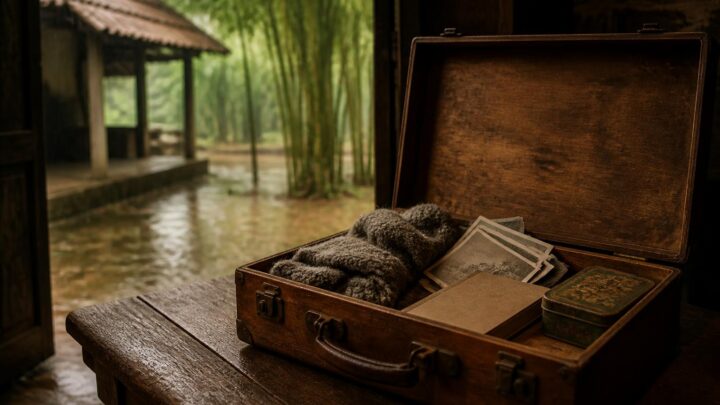
The day An returned to the village, the rain had just stopped. The dirt road leading into the old neighborhood still glistened with water, while the two rows of bamboo bent over the pale pools of afternoon light. The bus dropped him off at the foot of the slope and continued on, leaving behind a thin veil of exhaust and the fading sound of its engine. An stood there for a long while, pulling a cloth bag with a frayed strap, looking at the old roof barely visible behind the banana trees.
His mother had called that morning and said only that Uncle Bay, their neighbor, had found a wooden suitcase in the kitchen shed. He said it belonged to An’s father, who had died nearly three years earlier. His mother did not want to open it herself, nor did she want to take it anywhere, so she had waited for An to come home and decide.
An had never intended to return during the rainy season. He had always thought that the last time he saw his father in the hospital room had been a clear enough farewell. There had been no final conversation between them, no complete apology, and certainly not the embrace An had imagined many times but never carried out. His father had passed away in his sleep, while the things that needed to be said remained somewhere amid the years when the two of them had kept silent.
The Kitchen Shed and the Dust-Covered Suitcase
His mother opened the wooden gate just as An arrived. She was thinner than he remembered, her hair more than half gray, but the way she looked at her son was exactly the same as before: both joyful and searching, as though by looking a little longer she might learn how the person standing before her had lived during all those years away from home.
Mother and son did not say much. She asked whether he was hungry, and he asked whether they still grew mustard greens in the garden behind the house. Small questions followed one another on the porch, avoiding the larger things standing between them. Only after it had grown completely dark did his mother take a flashlight and lead him to the kitchen shed.
The shed had been almost entirely forgotten. The smell of firewood smoke, damp earth, and dry leaves mingled together. In the far corner, behind several empty sacks, the wooden suitcase lay tilted beneath an old tarp. It was not large, its surface scratched in many places, and its brass lock had turned green with age. On the lid was a faint circular mark, perhaps left by a hot pot placed there long ago.
“Your father kept it from when he was young,” his mother said. “I never saw him open it.”
An sat down and wiped the dust from the lid with his sleeve. A scent of dry wood mixed with rain rose from it, gentle and familiar enough to suddenly remind him of the mornings when he went to school as a child. Back then, his father would rise before everyone else to light the stove and boil water. Whenever it rained, he would place An’s sandals beside the edge of the stove to dry, then quietly leave for work without saying a word.
The lock was not fastened. An slowly lifted the lid.
Things Without Any Value
Inside were a faded blue raincoat, a tin box containing a few nails, a spool of fishing line, a small watch that no longer worked, three old photographs, and a brown-covered notebook. At the bottom of the suitcase lay a gray knitted scarf, even though it rarely grew cold enough in the village to need one.
An took out each item and placed it beside him. There were no important documents, no savings, and no secret that could surprise him. There were only odds and ends that an ordinary person might keep simply because he had not yet been able to bring himself to throw them away.
Besides the nails, the tin box held a small white plastic shirt button. An recognized it as the button that had once fallen off his school uniform when he was in eighth grade. That day, he had broken a neighbor’s window while playing soccer and his father had beaten him. That night, his father sat beneath the yellow light and sewed the shirt back together for him. He did not talk about the window, nor did he mention the punishment. The next morning, An put on the neatly mended shirt, looked at the clumsy stitching on the cuff, and went to school without saying thank you.
The three photographs had been taken at different times. One was his parents’ wedding photograph, from when they were both young and standing in front of a house that did not yet have a fence. The second showed An at the age of five, holding a paper kite in the yard. The last was a photograph An did not remember ever seeing: he stood beside an old bicycle with a sulky expression, while his father stood behind him, turning away but with the corners of his mouth slightly raised.
An opened the notebook. Most of the pages contained only short numbers, dates for repairing the roof, money spent on medicine, and money paid to the man who repaired the water pump. Scattered among the calculations were a few fragmentary notes.
“An likes pepper-braised climbing perch, but he keeps saying he doesn’t.”
“Remember to buy blue ink. He doesn’t use black pens.”
“Heavy rain. Check the roof of An’s room.”
The words made An set the notebook down. He had never thought his father paid attention to such things. In his memory, his father was a man who only knew how to work and fix things, who occasionally lost his temper and almost never asked his son what he wanted. An had once believed that he had grown up because of his mother, while his father had existed only as a stern shadow in the house.
What Was Forgotten in an Argument
That night, An could not sleep. Rain began falling again, lightly but steadily tapping on the corrugated metal roof. He lay in his old room, watching the glow from the porch light slide across the ceiling. Many years earlier, also on a rainy night, he had had his final argument with his father.
At the time, An had just found a job in the city and wanted to borrow money to invest with a friend. His father refused. He said the money was meant to repair the roof and pay for An’s mother’s medical treatment; it could not be put into something uncertain. An thought his father was always afraid, always trying to keep him trapped in a narrow life. He said harsh things—that his father had never understood him, that all he had ever known was working and holding other people back.
His father did not argue. He only asked, “If you leave, when will you come back?”
An replied that perhaps he would never come back.
The next morning, he left the village. His work in the city did not work out, his business partner moved elsewhere, and it took him many years to pay off the money he had borrowed. An still did not return. At first it was because he was ashamed; later, it was out of pride. Whenever his mother called, he would ask briefly about his father’s health and then change the subject. He waited for his father to call him first, while his father was perhaps also waiting for him to come back.
The two of them kept waiting for each other in silence until there was no longer any opportunity.
The next morning, An brought the notebook out onto the porch. His mother was picking vegetables, slowly separating the withered leaves one by one.
“Did Father often mention me, Mom?” An asked.
His mother did not look up immediately. After a while, she replied, “He did. But he never called you.”
“Why not?”
“He said you were busy. And he thought that if he called, you would think he wanted you to come back because of the house.”
An lowered his eyes to the drops of water gathered on the leaves. His mother continued, her voice even, as though telling an old story: “After the time you two argued, he still repaired the roof of your room whenever it leaked. Once I told him the room was empty and asked why he bothered fixing it. He said, ‘What if he comes home and it rains?’”
An did not know whether he should grieve over that or grieve because he had learned it too late.
The Gray Knitted Scarf
At noon, An took the scarf out of the suitcase. It was poorly knitted, the stitches uneven and short threads still hanging from both ends. When his mother saw it, she gave a very soft laugh.
“Your father knitted that. When you went away to work, you got a sore throat during your first winter. I told him you didn’t have a scarf, so he learned how to knit.”
An ran his hand over the rough yarn. He remembered receiving a package from home that winter. Inside were several oranges, a jar of shrimp paste his mother had made, and a gray scarf. He had tried it on, decided it did not go with his coat, and put it away in a drawer. Later, the scarf disappeared amid his many room changes.
“Why didn’t you tell me Father had knitted it?”
“He wouldn’t let me. He told me to say that I had made it.”
An smiled, but the smile quickly faded. His father had always been that way: doing something and then finding a way to stand outside of it. Perhaps he was afraid that if he said so, his love would become a debt that the other person had to repay.
That afternoon, An washed the suitcase clean. He did not know whether he was doing it to preserve the objects or to find something for his hands to do so they would stop trembling. After drying it, he placed the suitcase on the table and put everything back in its proper place. He kept the notebook.
His mother looked at him and asked, “Are you planning to take it back to the city?”
“Yes. I want to read it all.”
“There isn’t much in it.”
“But there is to me.”
A Way of Returning
An stayed in the village for three more days. He repaired the door of the kitchen shed, replaced several broken roof tiles, and cleared the overgrown brush around the well. Those were things his father used to do every rainy season. His mother told him to hire someone to do the work more quickly, but An shook his head. He wanted to do it with his own hands, even though he knew he would not be able to do it like his father.
On the last day, it rained again. An sat beneath the porch roof, the wooden suitcase at his feet. His mother brought out two bowls of boiled sweet potatoes. She said nothing about his return and did not ask when he would come back. After a while in silence, An spoke:
“Mom, I think I blamed Father for too long.”
His mother peeled a sweet potato, blew on it gently, and replied, “Everyone is partly right and partly wrong. Your father wasn’t good at talking, while when you were young, you only wanted other people to speak in a way you could understand.”
“I said I would never come back.”
“But you still came back.”
An looked at the white curtain of rain across the yard. His mother’s words were simple, but they opened a space inside him. Some words could not be taken back, and some years could not be returned to and repaired. Even so, a person could still choose a day to stop running away.
Before leaving, An placed the stopped watch on the wooden shelf in the living room. When his mother asked why he did not take it with him, he said he wanted to leave it there so the house would have one more thing that had once belonged to his father. He kept the notebook and the knitted scarf, while leaving the other items inside the cleaned suitcase.
“When will you come back?” his mother asked as he stood outside the gate.
This time, An did not answer with a vague promise. He said, “I’ll come back next month to repair the kitchen roof. If you agree, I’ll stay a little longer.”
His mother nodded and turned away to wipe her eyes with the hem of her shirt.
On the way to the foot of the slope, the rain had grown lighter. An pulled the suitcase behind him; it had no wheels, so every step made a dry scraping sound against the ground. He suddenly realized that the damp wood in the suitcase smelled very much like the old kitchen, like the mornings when his father dried his sandals for him, like a kind of love that had once been right beside him but had been obscured by all the things left unsaid.
An could not bring his father back to life, nor could he turn the years of separation into something that had never happened. But he could return to his mother, repair a roof, finish reading a notebook, and stop treating his father’s silence as proof that he had not loved him.
Sometimes, what a person leaves behind is not property or final words. It may be nothing more than a shirt button kept in a tin box, a bedroom roof always repaired before the rainy season, or a clumsily knitted scarf. Such small things make no noise, but they know how to remain for a very long time, waiting until the day people are calm enough to understand.
Related articles
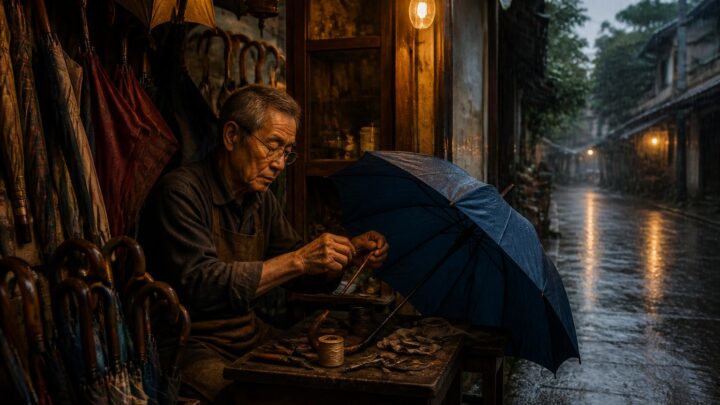
The Umbrella Repairman and the Late-Arriving Rainy Season
At the end of the old street stood a small shop just large enough for a wooden table, a rack, and a low chair worn down by the years. On the faded sign, people could still read the words: “Umbrella Repair.” Several strokes of the lettering had peeled away, but Mr. Lam had never once
Read more
The Clock That Wouldn’t Run and the Lesson About the Things Worth Waiting For
On a weekend afternoon, the small street behind the market still moved at an unhurried pace. The shops gradually pulled down their shutters, the sound of brooms sweeping dust blending with the motorcycles growing sparser on the road. At the end of the row of old houses, Mr. Lam’s clock-repair shop still glowed with a
Read more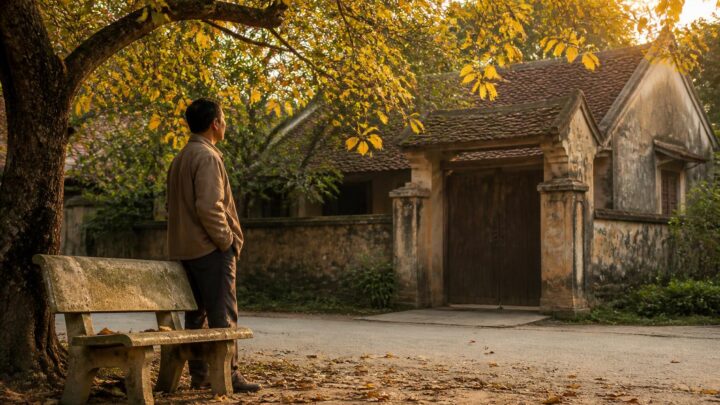
The Stone Bench Beneath the Old Banyan Tree
Minh returned to the village one late-October afternoon, when the dirt roads had dried after several days of rain. The bus dropped him off at the head of the slope and drove away, leaving behind a thin cloud of dust suspended in the pale sunlight. He pulled his small suitcase past the areca palms at
Read more
The Lighthouse Keeper and the Map of Returns
At the far end of Vạn Chài Village stood a short lighthouse, its body painted white but streaked with salt stains. During the day, people almost forgot it existed. Only when evening fell, and the boats offshore began switching on their lights, did the lighthouse become the clearest point of brightness along the long stretch
Read more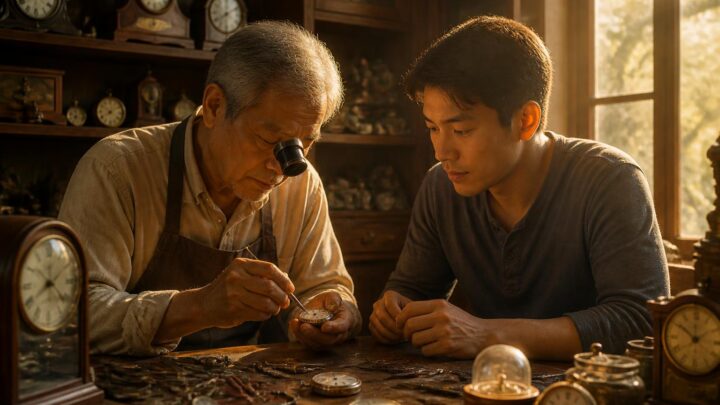
The Watchmaker and a Day Without the Hands Moving
The Watch Whose Hands Had Stopped At the end of the street stood a watch-repair shop so small that anyone walking quickly could easily pass it without noticing. The wooden sign above the entrance had faded, with only a few faint strokes of lettering remaining. Inside the shop, hundreds of watches lay still on narrow
Read more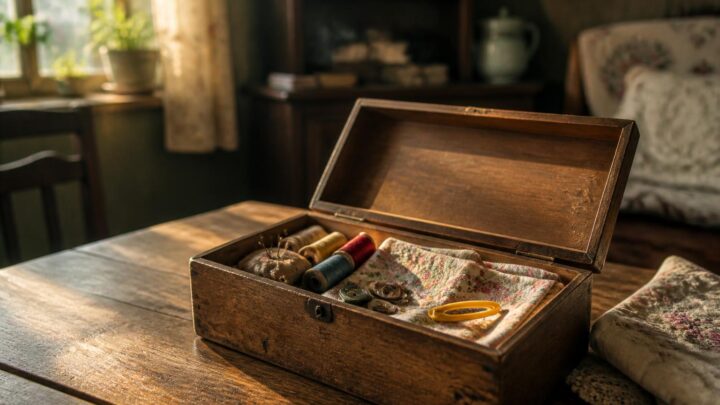
The Scent of the Wooden Box
The wooden box lay in the bottom drawer of the low cabinet, where Grandmother often kept things that were no longer used but absolutely must not be thrown away. It was not large, just big enough to hold a spool of thread, a few buttons, and several neatly folded scraps of fabric. The surface of
Read more