

 Tiếng Việt
 日本語
日本語 한국어
한국어 中文 (中国)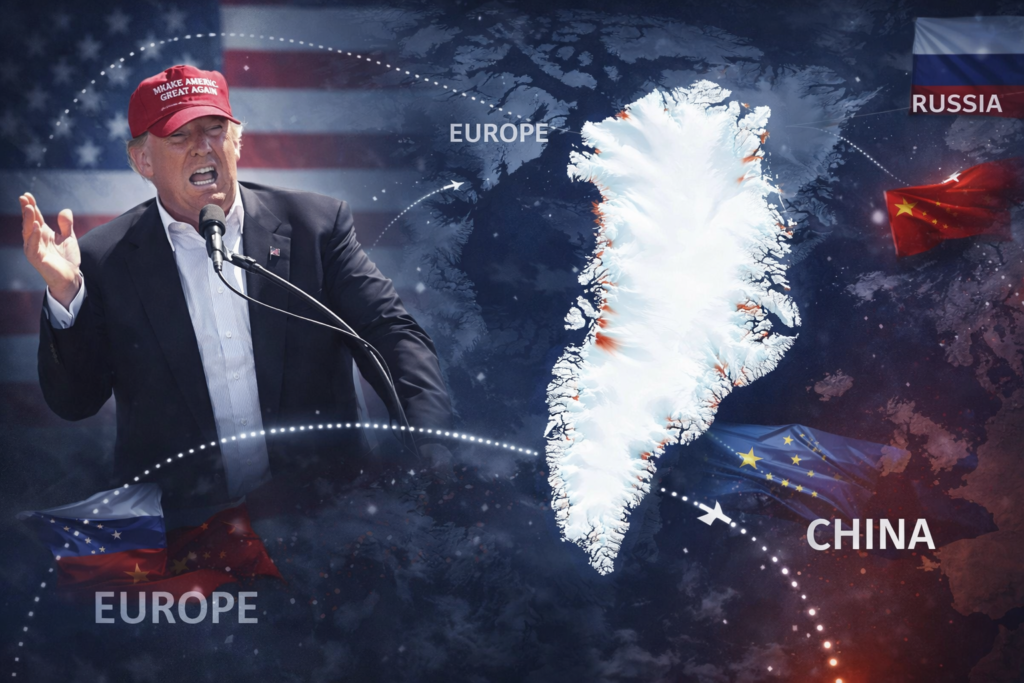
Three Geopolitical Scenarios and the Risk of U.S. Isolation in the Trump Era
Introduction: Greenland – a small piece on a very large chessboard
Greenland, a frozen island with fewer than 60,000 inhabitants, long stood on the periphery of global affairs. Yet in the 2020s, it has emerged as a new geopolitical focal point, where the strategic ambitions of the United States intersect with European security interests, Russia’s Arctic resurgence, and China’s long-term global calculations.
Donald Trump’s past suggestion to “buy Greenland” was widely mocked as eccentric. In reality, it reflected a deeper strategic logic: control over the Arctic, dominance over future strategic space, and the reshaping of global power balances. Should the United States attempt to consolidate control over Greenland—directly or indirectly—under Trump or a similar “America First” leadership, the consequences would extend far beyond a territorial dispute.
Why Greenland Is Strategically Critical to the United States
First, Greenland is a cornerstone of North Atlantic security. Positioned between North America and Europe, it functions as a natural defensive buffer. The Pituffik Space Base (formerly Thule Air Base) remains vital for missile early-warning systems and space surveillance, especially as strategic competition intensifies.
Second, the Arctic is opening. Climate change is rapidly reducing ice coverage, unlocking new shipping routes and strategic access. If Washington fails to secure Greenland, it risks ceding influence to Russia and China in a region that will define future geopolitical competition.
Third, Greenland carries symbolic weight. The question is no longer whether the U.S. wants Greenland, but whether it still possesses the legitimacy and capability to shape outcomes in a contested multipolar world.
Scenario 1: Soft Reactions – Tacit Compromise and Strategic Adjustment
In this scenario, the U.S. expands its influence through security agreements, investment, and political leverage rather than formal control. Denmark issues diplomatic objections without escalation. Europe calls for respect for international law but avoids confrontation. Russia and China protest rhetorically while refraining from direct action.
For Washington, this represents strategic success at limited cost. Trump could frame it domestically as a victory, while internationally the U.S. preserves alliance cohesion. Europe plays the role of stabilizer, and Asia watches cautiously without challenging U.S. dominance.
Scenario 2: Controlled Confrontation – A Fragmented World
Here, Denmark reacts strongly and internationalizes the issue. Europe becomes divided between legal principles and geopolitical pragmatism. The U.S. responds with diplomatic and economic pressure. Russia and China openly oppose Washington and expand Arctic activities.
America retains strategic leverage but loses soft power. Trump may strengthen his domestic standing, yet alliance trust erodes. Europe’s lack of strategic unity is exposed, while China uses the crisis to argue that U.S.-led order is increasingly unstable.
Scenario 3: Full Confrontation – Is Trump’s America Isolated?
This is the most severe outcome. Denmark, the EU, Russia, and China jointly oppose U.S. actions. Washington proceeds regardless, using military, economic, and political pressure. The Arctic becomes militarized, and the global order enters a new era of confrontation.
In this scenario, the risk of U.S. isolation is real—though relative, not absolute. Diplomatic backlash intensifies, transatlantic relations fracture, and economic retaliation grows. Trump may rally nationalist support at home, but international legitimacy erodes.
Still, the U.S. would not be fully isolated. Its economic scale, military power, and the dominance of the dollar ensure continued influence. Yet America would increasingly resemble a powerful but solitary actor, rather than a broadly accepted leader.
Russia and China benefit strategically: Moscow strengthens its Arctic position, while Beijing advances its vision of a multipolar world. Europe accelerates strategic autonomy, and Asia diversifies partnerships to hedge against instability.
Greenland and the future of the world order.
Greenland is not merely about territory. It is a stress test for the evolving world order. Scenario one offers adjustment without rupture. Scenario two brings fragmentation and instability. Scenario three risks prolonged confrontation and strategic isolation.
If Trump chooses confrontation, the United States may remain strong—but less trusted, less influential, and more alone. That, ultimately, may be the highest price America pays in the 21st century.

ARTICLES IN THE SAME CATEGORY
Learn to Repair Before Replacing: A Slower Way of Living in an Age of Fast Consumption
Knowing How to Set Boundaries So You Can Live Kindly Without Exhausting Yourself
The Necessary Pause to Regain Agency in Digital Life
The Art of Repairing a Relationship After Words Cause Hurt
How to Build a Reliable Day Instead of Waiting for Inspiration
A Page Can Change the Way We Understand Ourselves
ARTICLES IN THE SAME GENRE
Learn to Repair Before Replacing: A Slower Way of Living in an Age of Fast Consumption
Living Mindfully in an Age of Information Overload
From Knowing a Lot to Understanding Deeply: How to Build Systematic Thinking
Setting Boundaries in Digital Life to Regain Focus
The Art of Slowing Down in a World That Is Always Urging Us On
Listen to Understand, Not to Respond, in Difficult Conversations