

 Tiếng Việt
 日本語
日本語 한국어
한국어 中文 (中国)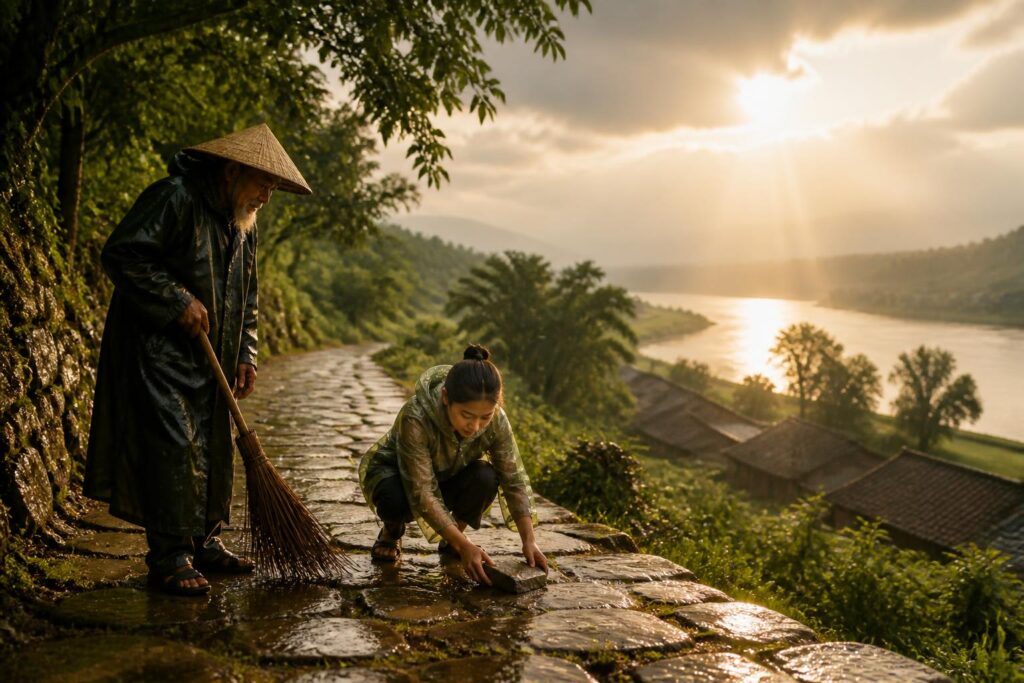
At the edge of Van Bai Village, a stone path winds along the hillside, curving between wild-myrtle bushes and rows of old bamboo. The path is not wide, only broad enough for two people to pass each other, but long ago it was the only route from the lower hamlet to the market on the other side of the river. Every flood season, when the rising river swallowed the cornfields and the trails along the bank, villagers would take the stone path to reach safety.
No one knows when the path was paved. The stone slabs have been polished smooth by rain, sun, and footsteps; many places are covered with green moss, while in others, tree roots have pushed the stones up into low ridges. The village elders say the path was built by a craftsman named Lam when he was still a young man. For twelve years, he carried each stone from the foot of the mountain, chiseled it flat, and laid it on the ground. But after a concrete bridge was built near the village entrance, the path gradually fell into neglect. People took the new road because it was faster, while the stone path was left only to the sound of dry leaves and the footsteps of those who liked seeking out a quiet route.
The Stoneworker Beside the Hillside
Lam lived in a small house right beside the path. He was over seventy, his back bent like a bamboo branch in the wind, and his rough hands were always marked with small scratches. Every morning, he took a bamboo broom and swept the leaves from the path. In the afternoons, he carried a bucket of water to tend the four-o’clock flowers growing along the stone embankment. Villagers often teased him, saying that hardly anyone used the path anymore and asking why he went to such trouble caring for it.
Lam only smiled. He said a path did not need many people walking along it to deserve care. Some things exist not because they are seen every day, but because one day, someone might need them.
He had a granddaughter named An, who had lived with him since she was little. An’s parents worked far away and returned only once every several years. An grew up in a house that smelled of damp stone and cooking smoke, with the sound of a bamboo broom sweeping steadily every morning. The girl did not like the old path. An thought her grandfather was devoting too much time to a useless task, while the house needed its roof repaired, the well needed cleaning out, and he himself was growing weaker by the day.
Whenever she saw him crouching to gather leaves, An would ask:
“Why do you take care of this path, Grandpa?”
Lam would often look toward the moss-stained slabs and reply:
“So that those who come after us won’t have to start from nothing.”
An did not understand what he meant. She only thought he was trying to find a beautiful reason for an old habit.
The Rising Waters
When An was sixteen, heavy rain fell for three days straight. Dark clouds covered the mountain range, and water from upstream rushed down, churning muddy and opaque. The river, usually gentle, suddenly overflowed onto the lowlands, carrying branches, straw, and pieces of planks from the huts along the bank.
The newly built concrete bridge was blocked by earth and stones at one end. The rapidly rising water made it impossible for people in the lower hamlet to cross to the market to buy food. The electricity went out, phone service flickered, and the commune loudspeaker sounded intermittently through the rain. Adults frantically moved their belongings to higher places. The children were taken to the cultural center, which stood on sloping ground.
By the afternoon of the third day, a family at the end of the hamlet discovered that Old Lady Tam was trapped in her low-lying house. She lived alone, her legs were weak, and she could not wade through the water rising around her yard. Her son worked far away. The neighbors wanted to rescue her, but no one knew of a safe route to the higher ground behind the hill.
When Lam heard, he immediately took his old flashlight and a raincoat. An ran after him and grasped his hand.
“Where are you going at a time like this?”
“To bring Lady Tam to the cultural center.”
“But the bridge is blocked. The lower road is flooded too.”
Lam did not answer. He turned toward the stone path. An stood stunned. All these years, she had never imagined that the moss-covered path could lead them anywhere in a major flood.
At first, the path was still dry. But the higher they climbed, the more water poured from the earthen channels, forming small streams across the stone surface. Lam went ahead, using a stick to test each step. He stopped at places thick with moss, swept away the mud with his foot, and only then continued. An followed, supporting him while shining the flashlight.
The path, which had seemed short, suddenly became endless. In the darkness, drenched bushes brushed against their shoulders. The roar of water at the foot of the hill mingled with the sound of rain, forcing them to speak very loudly to hear one another.
When they reached Lady Tam’s house, the water was already level with the doorstep. The old woman was terrified and insisted on staying because she wanted to keep a wooden box containing her family photographs. Lam did not argue. He took a plank, tied the box up high, and then carried her on his back. An followed behind, holding tightly to the woman’s arm so she would not slip.
On the way back, a stone slab beneath Lam’s feet suddenly gave way. He fell to his knees, striking them hard against the edge of the stone. An quickly helped him up, while Lady Tam clung to a bamboo stalk beside the path. In that moment, An saw small carvings on the stone surfaces. Some slabs bore the mark of a leaf, others a curved line resembling flowing water, while on some only a few faint strokes remained.
Lam breathed with difficulty but still pointed them out to An:
“In the old days, whenever a section was finished, I carved a mark. So I would remember how far we had come.”
“Did you really do it all by yourself?”
“No. People helped. It’s just that, later on, everyone forgot.”
The Carvings Beneath the Moss
They managed to bring Lady Tam to the cultural center just before dawn. News of the old path quickly spread throughout the village. Thanks to it, many families from the lower hamlet moved one by one to higher ground before the water spilled across their house foundations. Those who had once thought Lam was preserving something useless began coming to ask him about the route.
Lam rested for several days because his knee had swollen badly. An swept the path in his place. For the first time, she walked slowly across each stone slab, bending down to look at the carvings hidden by time. She realized they were not random symbols. Each mark recorded the name or image of someone who had contributed: the people who carried stones, dug channels, planted bamboo, or brought meals up the mountain. There were even marks belonging to people who had left the village long ago.
An asked him about it.
Lam remained silent for a long while before telling her that the path had been built after a major flood when he was still a boy. That year, a wooden bridge had been swept away, leaving many villagers stranded. Lam’s father had proposed opening a route up the hill so no one would be isolated during the next flood season. At first, everyone worked together. But as the work dragged on, people gradually gave up, until only a few remained persistent.
Among them was Mr. Quy, a hot-tempered carpenter. Mr. Quy had once argued with Lam’s father because he thought the path required too much work. The two men stayed angry with each other for years. When the path was completed, Mr. Quy did not attend the opening ceremony. Later, before he died, he sent Lam an old chisel and asked him to carve his name at the final section.
“Did you carve it?” An asked.
Lam nodded.
“Because he had contributed from the very beginning.”
“But the two of you had been angry with each other.”
“Being angry with someone doesn’t mean you have to erase all the good things they did.”
Those words made An think of her mother. Many years earlier, her parents had argued with Lam because they wanted to take An to the city to live with them. He had refused because An was still young and often ill, while her parents’ work kept them extremely busy. After the argument, they left in anger and returned very rarely. An had always thought that he had kept her with him out of selfishness. But she had never asked what he had truly been thinking.
That afternoon, An sat on the veranda, listening to the rain falling on the tiled roof. Lam brought out an old wooden box. Inside were letters An’s parents had sent over many years. Some had yellowed, and the ink had blurred. He had never hidden them from An; she had simply never asked.
“Why didn’t you give them to me?”
“Because the letters contained things adults needed to say to each other themselves. I didn’t want you to have to take anyone’s side.”
An lowered her head. She suddenly understood that some silences did not come from coldness. Sometimes people stayed silent because they feared a clumsy explanation would cause more pain to the person they loved.
The Path Is Given a Name
After the flood, the villagers gathered to repair the stone path. Some contributed bamboo, some brought sand, and others took charge of clearing the overgrown bushes. Young people who had previously known only how to ride motorbikes on the new road now had to learn how to wedge stones into place and dig drainage channels. Children followed the adults, curious to find the carvings beneath the moss.
An proposed creating a notebook to record the story of the path. She asked each village elder about those who had contributed. Some remembered names; others remembered only a conical hat, a basket of rice, or singing drifting out from the mountainside. An wrote down everything she heard, including details that could not yet be fully verified, carefully marking them as memories passed down through the generations.
While working, she discovered that the final section of the path was missing a stone slab. The flood had caused it to slide into a ravine. Lam said there was no need to replace it because the section could still be crossed, but An insisted on finding a new stone. She asked everyone to carry one up, then handed the chisel to him.
“Whose name will you carve?”
Lam looked at her and smiled.
“The names of the people who repaired the path this time.”
An shook her head.
“I want to carve a sentence.”
He handed her the chisel. An sat down and slowly carved these words into the surface of the stone: “This path is for those who come after.”
No one knew how long the path would continue to exist. Perhaps one day people would build another, more convenient road. Moss would cover the stones again, vegetation would grow close to the path, and the carvings would gradually fade beneath the sun and rain. But after the flood, whenever they passed by, the villagers all slowed their steps. They remembered that something that seemed old-fashioned could still save lives at the most critical moment.
An no longer asked her grandfather why he took such care of the path. She understood that the answer lay in the unnamed footprints, in the hands of people who worked without waiting for anyone’s thanks, and in the quiet preparation for a day no one knew would ever come.
Many years later, after Lam had died, An became the keeper of the key to the house beside the hillside. Every morning, she still swept the leaves from the stone path. On fine days, the village children followed her to listen to the stories. On days of heavy rain, the adults checked every drainage channel and every stone slab.
No one called it Lam’s path anymore. They called it the village path. Because what is built through the efforts of many hearts ultimately belongs not to one person alone. It belongs to everyone who ever contributed a stone, a meal, a day’s labor, a reminder, or simply the patience to keep the path from disappearing.
And whenever someone asked why they had to preserve a path so few people used, An would point to the stones beneath their feet and reply:
“Because we never know what day the person who needs it will come.”

ARTICLES IN THE SAME CATEGORY
The Map of Things Left Unsaid
The Empty Chair Beside the Veranda
The Lamplighter and the Road Without Darkness
A Small Promise Can Keep a Family’s Warmth Alive
When the Meal Slows Down, Family Grows Closer
The Unextinguished Lamp at the End of the Alley
ARTICLES IN THE SAME GENRE
Stepmother and Stepchild