

 Tiếng Việt
 日本語
日本語 한국어
한국어 中文 (中国)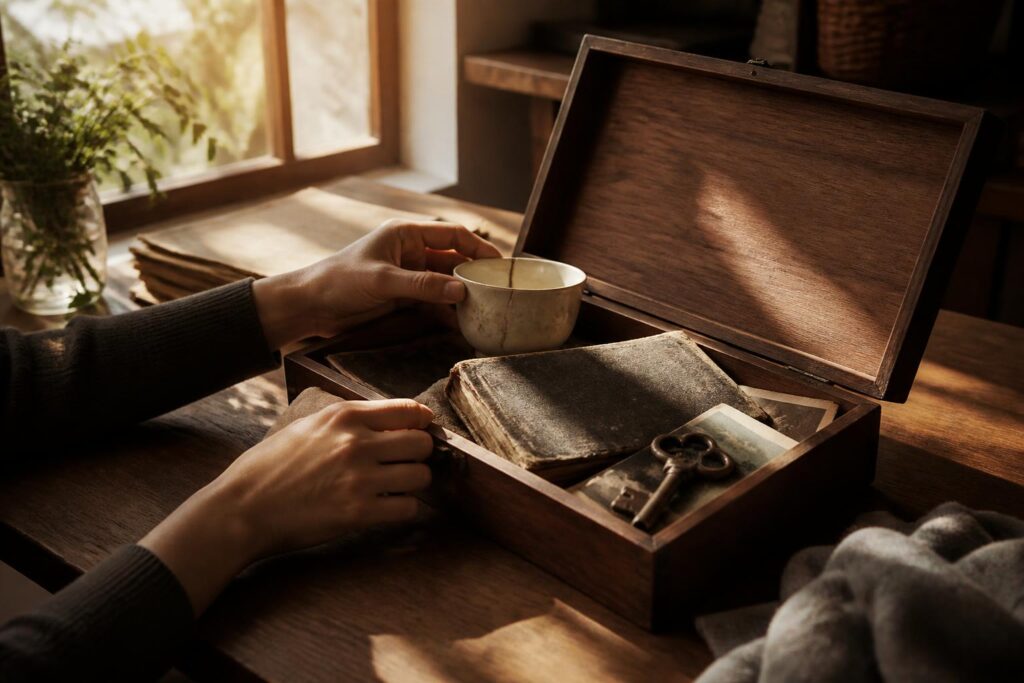
There are days when, while cleaning the house, we come across a shirt with worn shoulders, a notebook with only a few pages written in it, a chipped mug, or an old ticket forgotten in a drawer. These things no longer have much practical value. They may be outdated, damaged, or completely unsuited to our current lives. And yet our hands often hesitate before throwing them away. Not because the objects are especially precious, but because behind them lies a period of time that was once very real.
Objects have their own way of preserving memories. They do not tell stories with words, but their colors, scents, scratches, or the feeling of touching them can open a door in the mind. A jacket can take us back to cold school mornings. An old cooking pot can evoke our mother’s kitchen. An outdated mobile phone can remind us of a time when we were still excited every time a message arrived.
Looking back at these things is not merely an act of nostalgia. It is also an opportunity to recognize how we have changed, what we have lost, and what we want to carry with us on the road ahead.
Objects Often Preserve What Memory Has Blurred
Human memory is not a film that can be replayed intact. Over time, many details are left out. We remember a trip but forget the sounds of that afternoon. We remember someone who was once close to us but no longer recall exactly when the two of us last laughed together. We remember that we were once very happy, very sad, or full of hope, but we cannot always name the reason.
Objects can make these fragments of memory more concrete. A bus ticket brings a road to mind, a scarf evokes a room, and a pen recalls the days when we worked tirelessly on a particular plan. An object does not replace a memory, but it gives the memory something to rest on as it returns.
What is noteworthy is that an object does not have to be expensive to be meaningful. Many people keep something very ordinary because it is connected to an extraordinary moment. It might be a small spoon used during the first days of taking care of oneself, a keychain given before a long journey, or an old pair of slippers that accompanied someone while they were moving to a new home.
The value of these things lies beyond their material worth. They are quiet milestones in our lives. When we see them, we may realize that we have passed through stages that once seemed as though they would last forever.
Not Every Memory Needs to Remain Intact in the House
However, cherishing memories does not mean keeping everything. A room packed with old things can sometimes allow the past to take up all the space meant for the present. We can keep a memory box, but we do not necessarily have to turn every cabinet into an archive of years gone by.
The difficulty often lies in the feeling of guilt. We fear that throwing away an object means betraying the person who gave it to us. We worry that if we no longer have that shirt, we will forget a period of our youth. We think that discarding something connected to a memory means denying what once happened. But in reality, memory does not depend entirely on the object’s continued existence.
A relationship that once mattered does not become meaningless simply because we no longer keep the old gift. A period that helped us grow does not disappear just because the ticket or paper associated with it is thrown into the trash. What remains most deeply is usually the way that experience changed us, not the keepsake itself.
Before deciding whether to keep or discard something, we can ask ourselves: Is this object making my present life warmer, or is it simply keeping me trapped in an old story? This question is not meant to force us to become decisive. It helps us distinguish between appreciation and holding on.
Organizing a Drawer Can Also Mean Looking at Ourselves
Sorting through our belongings is often regarded as a small task, but it can lead to a fairly deep conversation with ourselves. When we sort old things, we are forced to look at many versions of who we have been: the person who once dreamed of this, the person who once feared that, and the person who once thought a promise would last forever.
Some objects make us laugh when we remember our own clumsiness. Some make us fall silent when we realize that we once endured something for far too long. Others make us feel grateful because they remind us that, during a difficult period, someone helped us or we ourselves tried as hard as we could.
Looking back is not about judging the person we were in the past by the standards of the present. We have more experience and more information today, and we may be calmer. But the person we were back then had only what they knew at that time. If they made the wrong choice, they may have chosen with the best ability they had. If they moved slowly, perhaps they needed time to understand what we now see clearly.
For that reason, a cleaning session can become an opportunity to treat ourselves more kindly. We can thank our former selves for bringing us to where we are today, even if they were not perfect. We do not need to keep every object to prove our gratitude. We only need to look at them honestly and with less harshness.
Keep Selectively So the Present Still Has Room to Breathe
A simple way to preserve memories without allowing objects to overwhelm us is to choose a limited space. It could be a box, a drawer, or a small shelf. When the space devoted to memories is limited, we naturally begin to consider what is truly important. Each object we keep should be connected to a story we still want to remember, rather than existing merely because we have not yet found the courage to let it go.
We can also write a few lines about an object before putting it away. There is no need to write much. Just one sentence about the time, person, or emotion connected to it can be enough to preserve the memory in a gentler way. Once the story has been written down, we may see that we do not necessarily have to keep the physical object forever. Sometimes the telling has already fulfilled its purpose.
For things that can no longer be used but carry sentimental value, we can photograph them, reuse part of their material, or place them somewhere appropriate. An old shirt can be turned into a cleaning cloth, a piece of fabric can become a small decoration, and a notebook can have a few important pages kept. These approaches are not always necessary, but they allow us to carry the memory forward instead of cutting it off abruptly.
More importantly, keeping things should serve our present lives. A home may hold memories, but it still needs light, open space, and comfort. A person who knows how to value the past also needs to give themselves permission to move forward, change their interests, start again, and create new stories.
What Remains Is Not Inside the Object
At some point, we come to understand that old things are only doors. What truly lies on the other side is affection, lessons, and growth. The mug is not the family morning when everyone still gathered together. The shirt is not our entire youth. The ticket is not the journey. These objects merely help us touch what once mattered.
Therefore, when we have to throw something away, we do not necessarily have to see it as a loss. We can view it as a way of returning some space to the room, allowing today to be more fully present. We can still remember, still feel grateful, and still tell the story, without turning the past into a permanent home.
Old things remind us that people are always changing. Some things that once fit us now feel confining. Some sorrows that were once enormous have become no more than a faint mark. Some dreams we thought we had forgotten are still quietly searching for a new form. In the end, looking back at our belongings means looking back at the journey we have taken, with all its clumsiness, courage, and hope.
We can keep some things, give some away, and let the rest leave our lives. Whatever we choose, the most important thing is to recognize this: memory does not exist only in drawers. It has become part of who we are, and it is the way we live today that allows those old years to continue being written.

ARTICLES IN THE SAME CATEGORY
The Basket Weaver by the Old Riverbank
The Bell Keeper and the Season of Low Water
The House with a Door Opening into Dawn
The Blue Garment Sewn for the Day of Return
The Clock That Did Not Run Through the Rainy Season
The Keeper of Seeds by the Dry River
ARTICLES IN THE SAME GENRE
Tam Cam Part 2: The Vengeful Spirits of the Palace
Tam and Cam: The Palace Intrigue and the Original Ending – Part 1
The world is never short of those who judge others by their material possessions; however, the most concerning poverty of all is the lack of wisdom and self-cultivation.
Stay Away from Foolishness: Seven Forms of Self-Deception and the Path to Awakening
Letting Go of Attachment to Overcome Anxiety: When What Exhausts Us Is Not Life Itself, but the Way We Hold On to It
Drinking Tea or Living Life: When People Get Lost in Material Glamour and Forget Themselves