
 Tiếng Việt
 日本語
日本語 한국어
한국어 中文 (中国)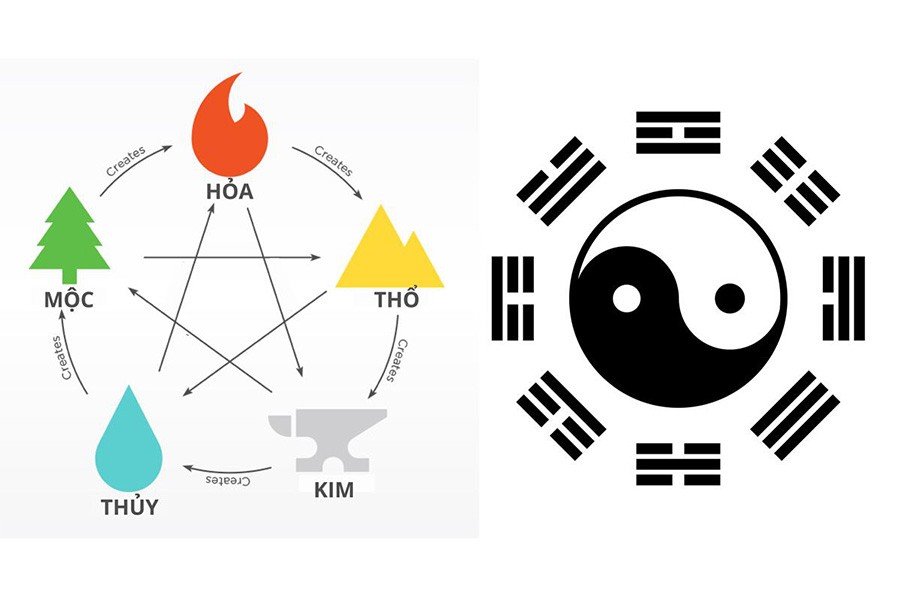
Ancient Eastern philosophical concepts such as Yin-Yang, the Five Elements (Wu Xing), and the Eight Trigrams (Ba Gua) have existed for thousands of years, shaping the medicine, culture, and thought of many civilizations. Rather than being mystical knowledge, these theories can be viewed as a comprehensive system that describes energy, the laws of interaction, and the movement of the universe.
Yin-Yang: The Fundamental Law of Interaction
The theory of Yin-Yang is not just an abstract concept but a foundational law of nature. It represents two opposing sides that always coexist and complement each other. This is evident in many aspects of the physical world:
- Physics: Pairs of particles and antiparticles, such as electrons and positrons, have opposite charges but coexist. In magnets, the North (N) and South (S) poles are also a clear example of polarity, much like Yin and Yang.
- Biology: Yin and Yang are expressed in the opposition of genders (male and female), the balance of bodily systems (anabolism and catabolism), and the biological cycle of organisms (day and night).
In traditional medicine, an imbalance of Yin and Yang is considered a cause of illness. Practitioners seek to regulate this energy flow to restore health, for example, by using “hot” (Yang) medicine to treat a “cold” (Yin) condition.
The Five Elements (Wu Xing): Five Primary Forms of Energy
The Five Elements—Wood (Mộc), Fire (Hỏa), Earth (Thổ), Metal (Kim), and Water (Thủy)—are not five specific materials but five types of energy with distinct characteristics and laws of interaction:
- Wood: Symbolizes growth, development, and expansion.
- Fire: Symbolizes upward movement, explosion, and dispersion.
- Earth: Symbolizes stability, balance, and nourishment.
- Metal: Symbolizes contraction, condensation, and concentration.
- Water: Symbolizes accumulation, downward flow, and potential.
These five types of energy interact with each other according to two main laws: mutual generation (nurturing and promoting each other) and mutual conquest (controlling and restraining each other), creating a balanced and harmonious cycle. For example, Water generates Wood (water helps trees grow), and Water conquers Fire (water puts out fire).
In medicine, the Five Elements are used to explain the relationship between the internal organs. For instance, the liver belongs to Wood, the heart to Fire, the spleen to Earth, the lungs to Metal, and the kidneys to Water. The balance between them is key to maintaining health.
The Eight Trigrams (Ba Gua): Encoding the States of the Universe
The Eight Trigrams (comprising Qian, Kun, Zhen, Xun, Kan, Li, Gen, Dui) are a symbolic system used to describe the eight fundamental states of all things and their transformations. Each trigram is made up of three lines, representing Yin (a broken line) and Yang (a solid line), reflecting the states of heaven, earth, wind, thunder, water, fire, mountain, and lake.
Some researchers have attempted to find a connection between the Eight Trigrams and modern scientific classification systems. One example is the similarity between the Eight Trigrams and the periodic table of elements. The periodic table arranges elements into eight main columns based on their outer electron configuration, corresponding to eight different energy types, which suggests a similar law of classification as that found in the Eight Trigrams.
Qi: The Essential Energy Flow
In ancient Eastern theories, Qi is a central concept, representing the essential energy flow that sustains life. Practices like Qigong and Tai Chi aim to regulate and circulate Qi through the body’s meridian system to achieve health and balance.
While modern science does not have a clear definition of Qi, studies have shown that these exercises improve blood circulation, reduce stress, and strengthen the immune system, demonstrating a correlation between ancient theory and scientifically proven physiological effects.
Conclusion
The theories of Yin-Yang, the Five Elements, and the Eight Trigrams are not outdated ideas. They are a profound philosophical system that provides a framework for understanding the energy and laws of nature. Instead of rejecting them, integrating this ancient wisdom with new scientific discoveries could open up new avenues of research, giving us a more comprehensive view of the universe and of ourselves.

ARTICLES IN THE SAME CATEGORY
Memory Is Not a Camera: Understanding It Correctly to Argue Less with Ourselves
A Warm Kitchen Begins with the Way Family Members Listen to One Another
When Attention Is Fragmented: How to Regain the Ability to Focus in a Distracted Life
The Art of Closing Out the Day So the Mind Can Rest
Healthy Boundaries: How to Protect Yourself Without Becoming Cold
Knowing What Is Right Is Still Not Enough: Why It Is Difficult for People to Change Their Habits
ARTICLES IN THE SAME GENRE
Do the 12 zodiac signs usually make major decisions with reason or emotion?
The Four Elements and How Each Zodiac Sign Moves Through Uncertain Periods
Twelve Different Ways of Loving: Learning Dialogue Through the Language of the Zodiac Signs
When Recognized, What Needs Do the 12 Zodiac Signs Often Reveal?
How Do the 12 Zodiac Signs Restore Their Energy After Overwhelming Days?
How Do the 12 Zodiac Signs Usually React When Plans Suddenly Change?