

 Tiếng Việt
 日本語
日本語 한국어
한국어 中文 (中国)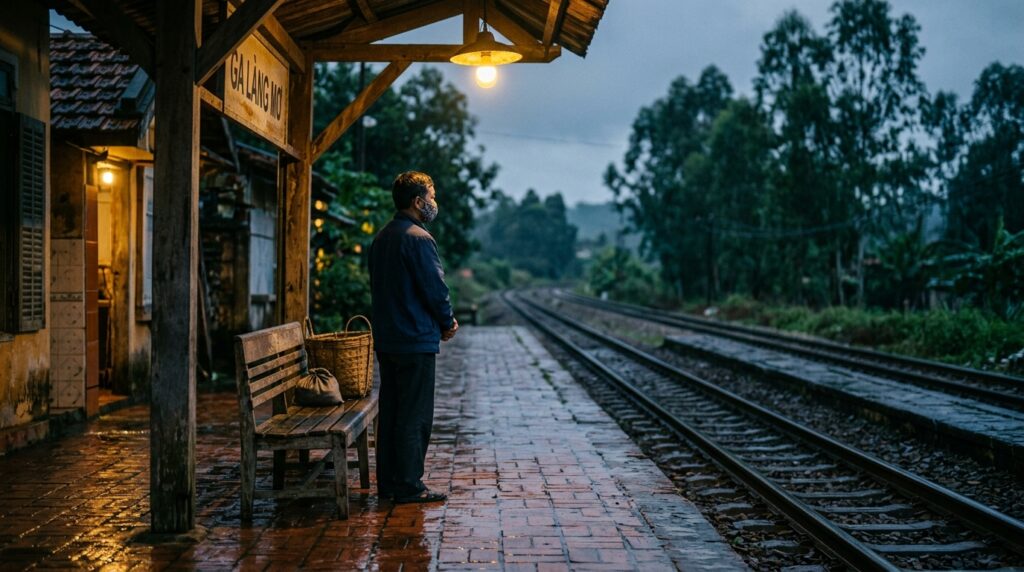
The Ticket with No Return Date
Minh returned to his hometown on an October afternoon, when the first seasonal rains had just been enough to make the road in front of the station glisten with water. The station was still there, tucked beside a row of old eucalyptus trees, its tiled roof darkened and its nameboard faded by sun and wind. Only the neighborhood in front of it had changed. Aunt Tam’s teahouse was gone, the repair shop had been repainted a bright blue, and the wall that had once been covered with posters was now covered in streaks of moss.
He stood beneath the porch, tightly gripping an old train ticket that had been folded many times. The ticket was no longer valid. It had lain in the drawer of his desk for nearly twenty years, among invoices, documents, and a few family photographs. The date on its face had blurred until it was almost unreadable. Minh only remembered that it was for the train he had taken one summer morning, after an argument with his father.
Back then, he was twenty-two, convinced that the whole world was waiting for him in a distant city. His father, Mr. Lam, asked only one question when Minh pulled his old suitcase out to the gate: “Are you sure you’ve thought this through?”
Minh took it as doubt. In a cold voice, he replied that he was grown-up and did not need anyone making decisions for him. Mr. Lam said nothing more. He went back inside the house, then returned a moment later with a light jacket, even though the weather was hot. He said that the train was often cold at night.
Minh did not take the jacket. He walked away, leaving his father standing beside the wooden gate. When the train departed the station, he looked through the window and saw that Mr. Lam was still there. The thin man, wearing a faded shirt, had one hand on the brim of his hat and the other hanging loosely at his side. Behind him was the lamp hanging beneath the porch, its pale yellow light flickering in the wind.
Minh had thought his father would call soon. He was a man of few words, but whenever his son went away, he always reminded him to let them know when he arrived. Yet there was no call from that train journey. Minh did not call either. The pride of youth kept them both silent, while the distance grew day by day.
The Last Station Keeper
Now Minh had returned because the house was about to be sold. After his mother died, his father lived alone for several more years before also passing away one winter night. Minh was abroad at the time, busy with a long-running project and a succession of meetings. He returned for the funeral, signed a few necessary papers, hired someone to look after the house, and then left again. That was the last time he had stood before the lamp by the station porch.
In the old station office, Mrs. Hanh was rearranging some battered notebooks. She had once worked with Minh’s father at this station. Since Mr. Lam retired, she still occasionally stopped by to look after the waiting room and tend the potted plants outside.
“Have you come back to clear out the house?” she asked.
“Yes. I’ll probably sell it.”
Mrs. Hanh nodded, showing no surprise. She poured him a cup of hot tea, then looked out at the empty platform. The afternoon train had just passed, leaving a long vibration of metal in the air.
“Your father used to come out here at night,” she said.
Minh lowered his eyes to the teacup. “He worked at the station. It was normal for him to come out here, Auntie.”
“Not for work.”
Mrs. Hanh opened the lower cabinet and took out a brown-covered notebook. The pages inside were filled with Mr. Lam’s handwriting. Minh recognized his father’s handwriting immediately, even though it had been many years since he had seen it.
“I found it in the toolbox. I was waiting to give it to you when you came back.”
Minh took the notebook but did not open it right away. There was no name on the cover, only an arc-shaped blue ink mark. He remembered that, when he was little, his father often used that kind of pen to record train schedules, correct notices posted in the waiting room, and mark the days Minh had school holidays.
“What did Dad write in it?”
“I haven’t read it. Things belonging to the dead should be opened first by their family.”
That afternoon, Minh returned to the old house. The smells of damp wood, camphor, and cooking smoke still lingered in the rooms. His mother had died many years before his father, but the wool scarf she had knitted was still neatly folded over the back of a chair. In the kitchen, the dented aluminum pot sat beside an empty jar of sesame-salt mixture. Everything seemed as though it had only just been set down, as if his father might step out from the inner room and ask whether he had eaten.
Nights with the Light On
Minh opened the notebook when it began to grow dark. The first pages contained records of train arrival and departure times, the names of passengers needing assistance, and a few small expenses for the station. But from the middle of the notebook onward, the writing changed. His father began recording the people who often appeared beneath the porch at night.
“March 12. A boy about ten years old sleeping on the bench. Called his relatives, but no one came. Gave him a bowl of noodles; he was picked up the next morning.”
“June 27. A woman missed her train; it was raining. Lent her a gray raincoat. She said she would return it, but there was no need.”
“November 8. An old man waiting for the first train. Asked three times how much longer it would be. Made him tea.”
Minh turned each page. It was not a diary, nor was it exactly a work log. His father had recorded the people who passed through his life for very brief periods. Some had missed their trains, some did not have enough money for a ticket, and some simply needed a seat out of the rain. Mr. Lam did not write where they went afterward. He only recorded what he had been able to do for them.
Near the end of the notebook, Minh found a page dated during the week he had left home.
“July 16. Minh took the 6:40 train. Would not accept the jacket. Put it in his suitcase when he wasn’t looking.”
Minh stopped. He remembered very clearly that he had not accepted the jacket. He also remembered that the suitcase that day contained only a few sets of clothes, a pair of shoes, and an old book. He did not remember there being a jacket in it.
He continued reading.
“July 17. Called but could not reach him. He must have arrived.”
“July 19. Still no word. Perhaps he is busy with work.”
“July 25. Minh hasn’t called. It’s all right; young people need time to begin.”
The entries that followed became increasingly sparse. There were no reproaches, no questions about why. Only brief, regular notes, like the way his father had recorded train times every day.
“January 3. Minh sent money home. Told his mother that he still missed home.”
“August 14. Minh changed jobs. His mother said our son was capable.”
“February 2. Minh didn’t come home for Tet. The road is long; he shouldn’t be blamed.”
On the final page, the handwriting was shakier.
“October 9. The lamp outside the porch is flickering. Replaced the bulb. If Minh comes home, remember to tell the repairman to fix the roof. It leaks badly during the rainy season.”
Below it was a line written in very small letters, close to the edge of the paper.
“Some trains do not return, but the person waiting can still keep the light on.”
What No One Had Time to Say
Minh sat motionless for a very long time. Outside the window, the rain fell more heavily. He heard water flowing from the porch roof into a plastic basin, as steady as the ticking of a clock.
All these years, he had thought his father did not call because he was angry. He had also told himself that he did not call because it was too late to explain. The two thoughts reinforced each other, turning the silence into a wall that seemed impossible to cross. But in the notebook, there was no wall at all. There was only a man who continued writing, continued turning on the light, continued waiting without demanding that the person who had left return on time.
That night, Minh did not sleep. He walked through every room, opened old drawers, and touched household objects covered in dust. In a wooden chest beneath the bed, he found the light jacket from years ago. It had been washed and neatly folded, lying at the bottom of the chest together with an envelope that had not been sealed.
Inside was only a slip of paper.
“Minh, if you ever read these lines, then surely I am no longer healthy enough to repair the roof. Don’t dwell on the day you left. People need a train to begin their lives. I only hope you remember that, no matter how far away you go, when you return there will still be a lamp outside the porch.”
There was no signature. His father had never needed to sign his name on the notes he left for the family.
The next morning, Minh called the real estate agent and canceled the sale of the house. He gave no clear reason. The house was not large, the roof leaked, the fence leaned, and the garden was overgrown with weeds. Keeping it was certainly not a financially beneficial decision. But for the first time in many years, Minh did not want to measure everything by its benefits.
He stayed for another week. He repaired the roof, repainted the gate, cleaned the kitchen, and replaced the bulb outside the porch. Mrs. Hanh came over to help him find a repairman, then told him that after Minh left, his father still often asked travelers returning from the city for news of his son. He never said that he was sad. He only said, “He’s busy building his own life.”
On the final afternoon before leaving his hometown, Minh went to the station. The old lamp still hung beneath the porch, its yellow light falling across the wet tiles. He stood exactly where his father had stood years before and looked at the tracks stretching toward the horizon.
A train passed slowly. In the illuminated windows, a few passengers dozed, several children pressed their faces against the glass, and a woman reached over to adjust the scarf of the child beside her. Minh suddenly understood that everyone on the train was carrying a place to return to, even if that place might be a house, a rented room, or merely the memory of someone who had once left a light on while waiting for them.
He took out his phone and opened his contacts. His mother was gone, his father was gone, and many old phone numbers no longer had anyone answering them. Minh stopped at his daughter’s name; she was attending university in another city. He called her.
“It’s Dad. Have you had dinner?”
There was a one-second silence on the other end, then she laughed. “Did you call just to ask that?”
Minh looked at the lamp shining above him. “Yes. And also, if you’re free this weekend, come home, okay?”
“Is something wrong, Dad?”
“Nothing’s wrong. I just want to turn on the light and wait for you.”
After the call, Minh sat down on the wooden bench in the waiting room. The station was empty of people. A gust of wind slipped through the porch, making the bulb tremble slightly, but the light did not go out.
Perhaps his father’s love had never taken the shape of tender words. It lay in the jacket quietly tucked into the suitcase, in the call that was never mentioned again, in the uncomplaining lines of writing, and in the bulb replaced before the rainy season. Some people do not know how to keep us from leaving, so they quietly keep a way home lit.
Minh returned home after night had fallen. From the road, he saw the yellow light by the porch spilling into the small yard. For the first time, he did not see it as the light of someone standing there waiting for him. He saw it as the love his father had passed on to him, so that he could continue lighting it for the people he loved.

ARTICLES IN THE SAME CATEGORY
The Keeper of the Bell at the Dry River Crossing
ARTICLES IN THE SAME GENRE
Stepmother and Stepchild