

 Tiếng Việt
 日本語
日本語 한국어
한국어 中文 (中国)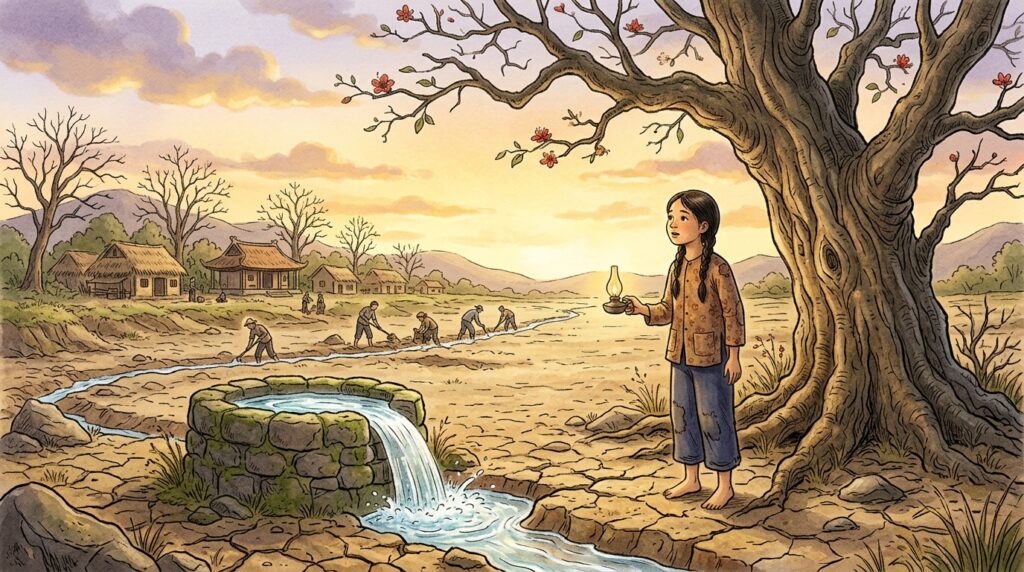
Once upon a time, at the edge of a windy plain, there was a village beside a river that had run dry. The villagers called the place the Dry River Crossing, though no boats passed by anymore, and beneath the riverbed there remained only strips of cracked earth winding like the lines on an old person’s palm.
Long before that, the river had been so wide that from one bank, one could not clearly see the roofs on the other. The river rose and fell with the seasons, carrying silt to the rice fields, and carrying ferryboats filled with people going to market, going to school, and seeking another life. But then, after many years without rain, the river grew thinner and thinner, shrinking into a muddy pool before finally disappearing beneath a layer of dry mud.
Only the bronze bell on the old kapok tree beside the river crossing was still there.
The bell was not large, its bronze surface had dulled, and one side of its handle was chipped. Whenever the wind blew through, it gave off a very soft chime, like someone calling from far away. The villagers said the bell had once been hung to warn of rising water. Whenever they heard three consecutive bell tones, everyone had to take the small children and the elderly up to the high mound. Since the river had dried up, no one paid any attention to it anymore.
Except Mai.
Mai was twelve years old and lived with her mother in a low, tiled-roof house at the end of the village. Her mother wove bamboo baskets every day, while Mai often went to the river crossing to collect pottery fragments, seashells, and seeds blown there by the wind. She liked to sit beneath the kapok tree and listen to the bell, though it rarely rang.
Mai’s mother did not like her daughter going to the river crossing alone. She often warned her that there was nothing there now but hot wind and old stories. The adults in the village also said that Mai should find work to help her mother and stop wasting time sitting around waiting for a river that had died.
Mai did not argue. She only thought that a river could run out of water, but it might not be completely dead. On hot, humid afternoons, she pressed her ear to the cracked earth and imagined that she could hear a very deep, very distant trickling sound.
One year, the drought lasted longer than it ever had before. The rice fields failed to produce ears, and the village well sank until only a layer of black mud remained. The villagers began to leave. Families with relatives elsewhere carried their belongings away first. Those who remained sold their buffaloes, their gardens, and even the houses that had sheltered several generations.
The village chief said they should take down the bronze bell and sell it. A dealer in old goods who had passed through had offered a fairly high price, enough to buy rice for the entire village for several weeks.
That afternoon, several men carried a ladder to the kapok tree. Mai ran over and wrapped her arms around the trunk.
She said that the bell did not belong to anyone alone. It was a reminder from the people who had once lived there.
The village chief looked at her and sighed. He said that a reminder could not be cooked into rice, nor could it fill a well with water. Mai knew he was right, so she did not try to argue. That night, she simply sat beside her mother for a long time, then asked her why the bell had been hung on the kapok tree.
Mai’s mother remained silent for a long while. At last, she took an old piece of cloth from the bottom of a wooden chest. Inside was a small iron key, already rusted.
She told Mai that when her mother was a child, Mai’s grandmother had once said there was an ancient stone well beneath the river crossing. The well was not in the village but on the other side of the bend, covered by earth and grass. Their ancestors had dug the well so that people traveling by boat could draw water. When the river receded, the way down to the well was buried. This key was used to open a stone door there, but no one had ever found the door.
Mai’s mother did not know whether the story was true. Her mother had died before she could point out the way. She had only warned that if one day the bell chimed three times when there was no wind, whoever heard it had to search for the ancient well, because that would be when the earth was ready to return what it had kept hidden.
After hearing this, Mai felt a burning excitement in her heart. That night, the moon was thin as a sickle. When the entire village was asleep, three chimes echoed from the direction of the river crossing.
Dong. Dong. Dong.
Mai sprang up. Her mother heard it too, but she held her daughter back. She was afraid it was only the sound of metal striking a tree branch. Yet there was no wind outside. The banana leaves stood still, and the tips of the grass did not move.
Early the next morning, Mai took the key, a coil of rope, a small hoe, and the last jug of water in the house. She walked north along the riverbed, where the dry reeds grew more densely. After the third bend, she saw a stone surface exposed beneath the earth. On the stone was the image of a fish, exactly like the faded pattern on the body of the bell.
Mai dug all morning. The earth was hard as brick, and her hands blistered. When the sun tilted westward, the blade of her hoe struck something hollow. She brushed away the dirt with her hands and saw a low stone door, with a rusted lock above it.
The key fit perfectly.
The door opened with a slow, rumbling sound. Behind it was a flight of steps leading down into the earth. Cool air rose from below, carrying the damp scent of moss and stone. Mai tied the rope to a clump of reeds, took an oil lamp, and went down.
At the bottom of the stairs was a round chamber. In the middle stood a stone well, its walls covered with strange carvings. On the opposite wall, someone had written a sentence in ancient script that Mai could not read. At the foot of the wall was a sealed earthenware jar covered with wax.
Mai opened the jar. Inside there was no gold or silver, only small, dark-green seeds.
Just then, the sound of the bell echoed down from above. One chime, then another. Mai hurried back up. As soon as she stepped out through the stone door, the ground trembled slightly. A thin stream of water welled up from the depths of the well, slipping through the cracks in the earth, so clear that each grain of sand could be seen.
Mai tasted a sip. The water was cool and sweet.
She ran back to the village to call everyone. At first, no one believed her. The village chief thought Mai had found only a small puddle, not enough to save anyone. But when they followed her to the river crossing, the water had already flowed into a long channel. It did not gush, nor did it create any grand miracle. It simply spread patiently, soaking into the dry earth.
The villagers widened the waterway. They used the remaining jars to lead the water to the well. Mai’s mother planted the seeds from the jar in a patch of land near the crossing. No one knew what kind of plants they were, nor whether they could grow after so many years of drought.
Day after day, the water continued to flow. Slowly but steadily. The first seeds sprouted after a brief rain. They grew into low plants with thick, green leaves that could retain water in the soil. The villagers gathered the seeds for propagation and planted them along the riverbed. During the rainy season the following year, water flowing down from the hills no longer ran straight away. The roots held the soil, the soil held the water, and the water found its way back into the riverbed.
Three years later, the river had not returned to the vastness described in the stories of the old people, but a clear stream now ran along its bottom. The village children once again learned how to row small boats. Families that had once left began returning to repair their homes.
And the bell remained hanging on the kapok tree.
From then on, the villagers no longer regarded it merely as a flood-warning bell. Every planting season, they gathered beside the tree, cleaned the bronze surface, and told the children about the people who had dug the well, planted trees, and protected the soil long before the children were born.
Mai grew up to become the keeper of the water crossing. She never claimed that she had saved the village. She said that the village had saved itself, because the people only truly found the water when they stopped mourning beside the dry riverbed and dug down together.
Many years later, a little boy asked Mai whether the bell would still chime if there were no wind. Mai looked at the river flowing beneath the evening light and smiled.
She said that some calls did not come from the wind. They came from memory, from the earth, and from things people had forgotten. But to hear them, one had to be quiet enough. And to turn a call into life, people had to work together.
That night, at the river crossing, the bell rang out once, clear and bright. No one knew whether it was caused by the wind or by the kapok branch moving gently. The villagers simply stopped to listen. Beneath their feet, the water quietly flowed toward the fields, carrying silt and the promise of a new green season.

ARTICLES IN THE SAME CATEGORY
The Lamp by the Station Porch
ARTICLES IN THE SAME GENRE
Tam Cam Part 2: The Vengeful Spirits of the Palace
Tam and Cam: The Palace Intrigue and the Original Ending – Part 1
The world is never short of those who judge others by their material possessions; however, the most concerning poverty of all is the lack of wisdom and self-cultivation.
Stay Away from Foolishness: Seven Forms of Self-Deception and the Path to Awakening
Letting Go of Attachment to Overcome Anxiety: When What Exhausts Us Is Not Life Itself, but the Way We Hold On to It
Drinking Tea or Living Life: When People Get Lost in Material Glamour and Forget Themselves