

 Tiếng Việt
 日本語
日本語 한국어
한국어 中文 (中国)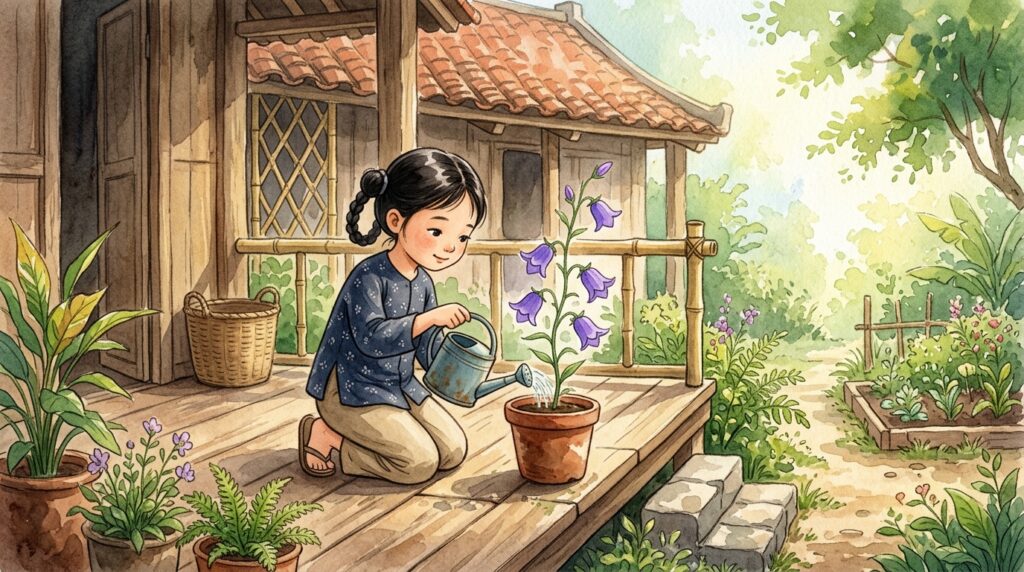
At the end of a small alley stood a house with a brown tile roof, where a little girl named An lived with her grandmother. In front of the house was a narrow patch of land, not wide enough for an entire flower garden, but Grandmother still carefully tilled the soil every spring. She said that soil was like the human heart: if it was cared for with gentleness, one day something beautiful would sprout.
An loved listening to her grandmother’s stories, but the little girl did not truly believe those words. An thought, what could such a tiny seed do? It lay still beneath the ground, unable to speak or run and play, and unable even to find water for itself. In An’s eyes, the things worthy of admiration had to be tall trees, large flowers, or birds that could fly very far.
One morning at the beginning of summer, Grandmother gave An a small, round seed, light brown in color.
“This is the seed of a wind chime flower,” she said. “When it grows up, the plant will bloom with bell-shaped flowers. Whenever the wind blows through, the flowers will sway as though they are singing.”
An placed the seed in the palm of her hand. It was so light that even a gust of wind could carry it away.
“Will it really become a plant, Grandma?” An asked.
“If you sow it in the soil, water it, and patiently wait, it will try its very best to grow.”
An dug a small hole beside the veranda, placed the seed inside, and covered it with soil. Grandmother gave the little girl an old green watering can. It had a long spout and a small dent on its side. Because it had been used for many years, it was no longer shiny, but when An picked it up, she heard a soft voice.
“Water it just enough, all right? A seedling likes to be cared for, but it does not like to be drowned.”
An startled and looked around. There was no one in front of the house except Grandmother, who was picking up leaves. The little girl bent down toward the watering can.
“Did you just talk?”
“I often talk,” the watering can replied. “It’s just that not everyone is willing to listen.”
An opened her eyes wide. From that day on, the little girl called the watering can Tiny. Every morning, An carried Tiny out to the veranda, scooped up a little water, and watered the place where she had planted the seed. She did not pour it all at once, but tilted the can very slowly, letting the drops fall like misty rain.
The first day passed. Nothing appeared.
The second day was the same.
On the third day, An used a stick to gently poke at the soil to see whether the seed had moved. Tiny quickly spoke up:
“Don’t dig it up. Some things need to happen in the darkness before they can be seen in the light.”
An was a little annoyed. She wanted to see the result immediately, just as she could see a marble roll right away when she dropped it down a slope. Even so, she listened to Tiny, only watering the spot and then sitting down to wait.
On the fifth day, a heavy rainstorm poured down. Water rushed over the veranda roof and flooded the small patch of soil. An anxiously ran outside and used both hands to mound the soil back into place. Tiny lay tilted beside the step, its voice sorrowful:
“I told you the seedling needed water, but too much can make it difficult for it to breathe.”
An took several bricks and arranged them in a ring around the place where she had planted the seed. Grandmother saw her and smiled.
“You are learning how to care for it now. Caring is not only about giving a great deal; it is also about knowing what is enough.”
A few days later, the weather suddenly became scorching hot. The leaves outside the alley drooped. The soil in Grandmother’s flowerpot cracked into tiny lines. An had to carry water up from the well many times, until her shoulders ached. One day, halfway there, the little girl already wanted to give up.
“Do I really have to water it every day, Tiny?” An asked. “The seed still hasn’t sprouted. Maybe it has already died.”
The watering can was silent for a moment before speaking:
“I don’t know what the seed is doing beneath the soil. But not seeing something does not mean that nothing is happening. A tree’s roots often begin with a step that human eyes cannot see.”
An sat down on the step. She looked at her dust-covered feet and remembered Grandmother’s words: beautiful things often needed to be cared for quietly. Perhaps the seed was trying its best; it simply could not tell anyone yet.
From that day on, An no longer watered the plant merely because she wanted to see a green sprout. She watered it because she thought of the seed being thirsty. She covered the soil with a layer of dry leaves when the weather was hot and moved pebbles aside so the roots would have room to push through. Each time she finished, An often sat beside the veranda and told the seed about the day: about the yellow cat chasing butterflies, about Grandmother making sweet potato cakes, and about how the little girl had learned to fold her blanket neatly by herself.
One morning, just as the first rays of sunlight touched the step, An saw a tiny green sprout poking out of the soil. It was curved like a fishhook, with a piece of seed shell still clinging to its tip.
An cried out:
“Grandma, it’s growing!”
Grandmother came out and placed a hand on her granddaughter’s shoulder. Tiny also trembled lightly beside them as though clapping.
“See?” she said. “It has been working quietly all these days.”
An bent close to the sprout. She saw that it was very small, smaller than her little finger. Yet in An’s heart, it suddenly became more wondrous than every ancient tree in the stories her grandmother had ever told.
“Hello,” An whispered. “I’ll take very good care of you.”
The plant grew little by little. It had its first two leaves, and then more new leaves appeared. An set up a bamboo stick beside it so the young plant would not be knocked down by the wind. Every afternoon, the little girl checked the soil, picked off worms, and cleared away weeds. Tiny often reminded An to hold the watering can with both hands because the girl had grown taller, but the can was still heavy.
One day, the children in the alley invited An to play by the river. They brought colorful paper pinwheels with them. An really wanted to go, but there had just been a strong wind. She was afraid the young wind chime plant would break, so she stayed home to tie the string around the bamboo stick again.
Her friend Minh called from outside the gate:
“An, it’s only a plant. You can take care of it tomorrow!”
An looked at the young plant leaning in the wind. She wanted to run off too, but then she remembered the days when the seed had lain beneath the soil, patiently waiting for someone who would not forget it.
“You go ahead. I’ll come after the plant is standing firmly.”
Minh shrugged and ran off with the others. An stayed behind, using a strip of old cloth to tie the stem to the bamboo stick. The wind blew so hard that the little girl’s hair flew into a tangled mess. Tiny lay beside An’s feet, doing its best not to roll down the step.
When the wind had passed, the young plant was still intact. It had only lost one small leaf. An picked up the leaf, feeling sad, but Grandmother told her:
“Growing up does not mean never suffering loss. What matters is that after every time we are shaken, we learn how to sink our roots deeper.”
Summer passed. The wind chime plant grew as tall as An’s shoulder, its stem slender but sturdy. One morning at the end of the season, lovely round flower buds appeared on the branches. An counted seven buds. She was so happy that she ran around the yard, but Tiny reminded her:
“Don’t pull the buds open to look. Flowers also need time to open on their own.”
An laughed. She had grown accustomed to waiting. She knew that some things would be ruined if rushed, just as a seed would never reach the light if it were dug up too soon.
Three days later, the first flower opened. Its pale purple petals were arranged in the shape of a bell. When the wind brushed past, the flower swayed and made a clear sound, very soft but loud enough for someone sitting beside the veranda to hear. Then the second and third flowers opened in turn. The whole plant seemed to have draped itself in a string of tiny bells.
An stood silently for a long while. Suddenly, the little girl understood that what made the flower beautiful was not only the color of its petals. That beauty also lay in every morning she had carried water, every time she had covered the soil, and every moment she had persisted despite not yet seeing the result. Without those quiet days, there would be no gentle bells ringing today.
That night, An placed Tiny beside the window.
“Thank you,” the little girl said. “If it weren’t for you, I might have given up long ago.”
The old watering can trembled softly. The dent on its side gleamed beneath the moonlight.
“I only held the water and reminded you not to forget. You are the one who truly cared for the seed.”
An shook her head:
“But you taught me how to listen.”
The watering can said nothing more. Perhaps it had fallen asleep, or perhaps objects only spoke when people were patient enough to sit beside them.
From then on, the patch of land beneath the veranda became An’s favorite place. She planted a few other small plants, but she never forgot the first wind chime plant. When a baby in the alley dropped some seeds, An picked them up and showed the child how to sow them. When a friend felt sad because they had not yet achieved what they hoped for, An said that roots always grew before branches and leaves appeared.
Grandmother watched her granddaughter care for the garden, her gentle eyes shining with joy.
“Do you understand what I told you before?”
An nodded.
“A tiny seed can create an entire garden if someone patiently cares for it. And a good deed, no matter how small, can bring joy to many people.”
Night fell, and the wind passed over the veranda again. The purple flowers swayed, ringing out a clear sound like very distant laughter. An lay in her room with her eyes closed, listening. She knew that beneath the warm soil, the roots were still quietly stretching farther. Out there, there might still be many seeds that had not yet sprouted, and many beautiful things that had not yet been seen. But as long as there was someone willing to sow, willing to care, and unwilling to give up too quickly, one day they would surely find their way upward toward the light.
A Small Lesson from the Story
The Seedling Beneath the Veranda and the Little Watering Can reminds children that all growth takes time. When we have not yet seen the result, we should not be quick to think that our efforts are useless. A kind word, a good habit, or a small deed is like a seed planted in the soil. If nurtured with perseverance and love, it will grow in its own way.
The story also teaches us to care in moderation. Giving does not always mean doing a great deal; sometimes it means observing, listening, and understanding what others truly need. An learned to water gently, provide shade when the weather was hot, protect the plant when the wind was strong, and patiently wait for it to bloom on its own. That is also how we show care for our families, friends, and the precious things around us.

ARTICLES IN THE SAME CATEGORY
The Boy Who Heard Rain in a Bean
THE STORY OF SOWING SEEDS
The Power of Silence
Coconut Skull
Saint Giong
The Proud Rooster
ARTICLES IN THE SAME GENRE
Tam Cam Part 2: The Vengeful Spirits of the Palace
Tam and Cam: The Palace Intrigue and the Original Ending – Part 1
Tam Cam
Coconut Skull
Saint Giong
The Legend of the White Chrysanthemum