

 Tiếng Việt
 日本語
日本語 한국어
한국어 中文 (中国)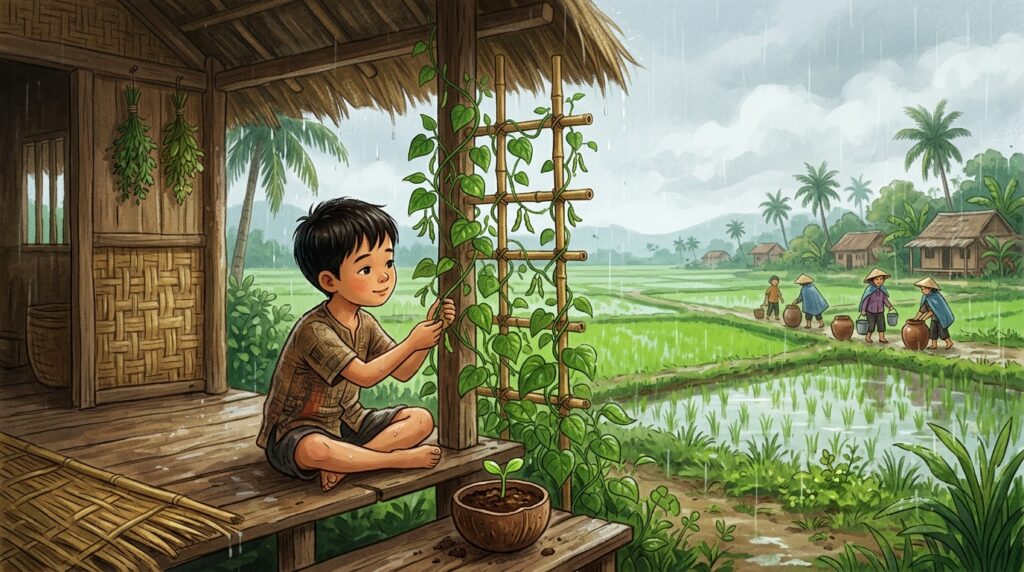
The Boy Who Heard Rain in a Bean
Once upon a time, at the end of a red dirt road, there was a small village nestled beside a vast field. The village was not wealthy, but it was peaceful all year round. Every morning, cooking smoke rose from the low-roofed houses, bamboo brooms rustled in front yards, and the children called out to one another as they went to play by the stream.
In the village lived a boy named Tí. Tí lived with his mother in a house with a gourd vine trellis in front of the porch. He was not as strong and healthy as the other children his age, and he did not have any particularly beautiful toys. Tí had only a coconut-leaf pinwheel, a brown cloth bag, and a pair of eyes that were always wide open, as though searching for something.
His mother often told Tí:
“You do not need to have a lot in order to be happy. You only need to pay attention, and you will see that the world around you is filled with many wonders.”
Tí listened to his mother. He noticed ants dragging a crumb across the doorstep, noticed sunlight sliding across the surface of the water jar, and even noticed the way the flowers of the four-o’clock plant folded their petals as evening fell. But what Tí liked best was sitting beneath the starfruit tree behind the house and listening to the rain.
To other people, rain was merely the patter on tile roofs, the sound of water running along bamboo gutters, and the wind blowing through the garden. To Tí, every rain shower had its own voice. Some rains murmured like a grandmother telling a story, some dripped like sparrows hopping across a roof, and some poured down like a troop of horses racing across the fields.
One year, the dry season lasted longer than usual. The earth in the fields cracked into winding lines. The stream, which had once been crystal clear, was reduced to a few small pools. The leaves drooped, and the bamboo grove by the village edge no longer rustled whenever the wind blew through.
The adults in the village grew worried. They took turns fetching water from a well very far away. The vegetable beds in the gardens gradually wilted. The chickens stopped scratching the ground because they could not find a single worm. The children no longer ran to the stream, because its banks had dried so completely that every pebble lying still at the bottom could be seen.
One afternoon, Tí sat beside the starfruit tree and looked up at the sky. White clouds drifted lazily, but they did not gather into rain. Suddenly, he heard a very small sound, almost just a sigh.
“Tí…”
He startled and looked around. There was no one there. There were only the yellowing starfruit leaves trembling softly in the wind.
“Who called me?” Tí asked.
The voice sounded again, thin as a thread:
“Beneath your feet.”
Tí bent down. In the dry soil lay a small brown bean nestled between two pebbles. The bean looked unremarkable; it was even covered in a faint layer of dust.
“Can a bean talk?” Tí asked in surprise.
“I do not speak with my mouth,” the bean replied. “I speak through something that those who know how to listen can hear.”
Tí carefully picked up the bean. He felt that it was warm, as though someone had just held it in their palm.
“Then what does the bean want?”
“I want to lie in soft soil. I want to drink a sip of water. I want to try reaching upward, even if only once.”
Tí looked at the water jar in the yard. His mother had told him that he could use water only sparingly, because the whole family had to conserve every ladleful. He also knew that there was not much water left in the jar.
Tí brought the bean into the house and told his mother everything. His mother did not laugh, nor did she say that he was imagining things. She simply sat down beside her son and looked at the bean for a long time.
“If you want to plant it,” she said, “think about how you can care for it without leaving less for anyone else.”
Tí thought for a very long time. He could not take much water from the jar. He also could not dig a deep hole in the plot of land that had become parched and barren. At last, Tí took a coconut-shell dipper, poked a few small holes in its bottom, and scooped up soil from a place near the kitchen, where cooled ashes had made the earth softer. He placed the bean inside and poured in only one spoonful of water.
“Will one spoonful be enough?” Tí asked anxiously.
“When it is given with care, even one spoonful is precious,” his mother replied.
That night, Tí placed the coconut shell beside the window. He lay down but did not fall asleep right away. Outside, the hot wind blew across the roof. He heard dry leaves brushing against one another, his mother turning in bed, and the little cat breathing steadily beneath the bed.
Near midnight, in the quiet room, Tí heard a strange sound. Tap. Tap. Tap.
He sat upright. The sound was coming from the coconut shell. Tí leaned closer and heard the sound of rain. It was not rain outside, but rain in some place very deep and very far away. Rain falling on green treetops, falling onto thatched roofs, falling into a pond full of water lilies.
“Bean, are you dreaming?” Tí whispered.
“No,” said the bean. “That is the memory of the earth. The earth still remembers the rains that once fell upon it.”
Tí closed his eyes and listened. Within the imagined sound of rain, he also heard frogs calling to one another, water winding through tree roots, and tiny seeds patiently waiting for the day they would awaken.
The next morning, Tí discovered a very small green sprout poking up from the soil. He happily ran to call his mother. Mother and son looked at the sprout together without daring to touch it.
“It grew so quickly,” Tí said.
“Not quickly,” his mother said with a smile. “You have simply learned to look more closely.”
Tí cared for the bean sprout every day. He used the water left after washing rice for a meal, collected a few drops of dew from leaves in the early morning, and covered the plant with a piece of banana leaf when the sun became too harsh. He did not pluck its leaves, pull at its stem, or urge it to grow. Every evening, Tí sat beside the window to listen to the rain inside the bean.
Then something strange happened. Whenever Tí heard the rain inside the bean, he remembered a small thing he could do for someone else. One day, he helped the old woman next door gather dry firewood. Another day, he shared half of his sweet potato with a hungry child. On yet another day, he led a lost calf back to its pen, even though he had to go around through the cracked field.
Those things did not make the rain come at once. The fields remained dry, and the village well was still running low. But the villagers began to realize that there were many ways they could help one another. The person who owned an ox cart used it to carry water to the houses at the end of the village. Those who still had seeds shared them with families whose crops had failed. The children gathered dry leaves and spread them around the bases of trees to preserve what little moisture remained in the soil.
One day, the bean sprout had grown into a lush green vine. It climbed the bamboo trellis in front of the porch and bloomed with gentle purple flowers. That very night, Tí heard the rain inside the bean again, but this time the sound was louder. The rain no longer came only from the coconut shell. It echoed in the garden, in the water jar, in the dry tree trunks, and even inside Tí’s heart.
Then, from the horizon, a gray cloud slowly approached the village.
At first, there was only a cool breeze. Then a drop of water fell onto the porch roof. Tí held out his hand to catch it. The second drop landed on his cheek. By the third drop, the sky suddenly opened wide and rain poured down.
Everyone in the village rushed out into their yards. Some people laughed, some cried, and some tilted their faces toward the rain as though welcoming a gift that had been lost long ago. Water ran along the dirt road and seeped into the cracks in the fields. The bamboo grove by the stream trembled and began to make its familiar rustling sound.
Tí ran to the bean plant. Its leaves shimmered beneath the rain. He leaned close to listen and realized that the rain inside the bean had disappeared. In its place was another sound, clear and warm.
“Thank you,” said the bean plant. “But not because you made the rain fall. No one can force the sky to do what they want. I thank you because you knew how to care for something small, and then let that kindness spread to the people around you.”
Tí looked out at the fields. The villagers were working together to clear the water channels. The children were jumping over muddy puddles. His mother placed clean jars beneath the eaves to catch rainwater. No one said that they had accomplished something great. Each person simply did the part of the work they were capable of doing, and yet the whole village had become different from before.
A few months later, the bean plant produced long pods. Tí picked the first pod, opened it, and found many plump, round beans inside. He did not keep them all for himself. Tí brought the seeds and shared them with every household in the village.
“Remember to plant them where the soil is soft,” he instructed. “If you do not have much water yet, care for them with what you do have. And if you hear the rain inside a bean, do not forget to listen very carefully.”
The adults smiled because they thought it was a funny way for a child to speak. But the village children believed Tí. One by one, they sowed the seeds, covered the plant bases with dry leaves, and took turns watering them. Before long, there was a green bean trellis in front of every house. When the wind blew through them, the whole village rang with the sound of leaves rustling like a gentle rain shower.
From then on, whenever he encountered a difficulty, Tí no longer immediately thought that he was too small to do anything. He remembered the bean that had once lain between two pebbles, the spoonful of water his mother had given, and the people who had worked together to bring the fields back to life.
He understood that some wonders do not begin with dazzling magic. They begin with a hand that knows how to cherish, a pair of ears that knows how to listen, and a small good deed done at the right time.
Lesson from the Story
Everyone, no matter how young, can care for something good and beautiful. A word of concern, a gift shared with others, or a quiet act of help can make someone else feel warm inside. Kindness does not always produce results immediately, but it often plants more trust, allowing many people to act together.
The story also reminds us to appreciate what we have. When water was scarce, Tí did not use up his family’s share but found another way to care for the bean. Knowing how to conserve, thinking of others, and being patient with things that are growing are precisely the ways to turn a small seed into hope for an entire garden.

ARTICLES IN THE SAME CATEGORY
The Seedling Beneath the Veranda and the Little Watering Can
THE STORY OF SOWING SEEDS
The Power of Silence
Coconut Skull
Saint Giong
The Proud Rooster
ARTICLES IN THE SAME GENRE
Tam Cam Part 2: The Vengeful Spirits of the Palace
Tam and Cam: The Palace Intrigue and the Original Ending – Part 1
Tam Cam
Coconut Skull
Saint Giong
The Legend of the White Chrysanthemum