

 Tiếng Việt
 日本語
日本語 한국어
한국어 中文 (中国)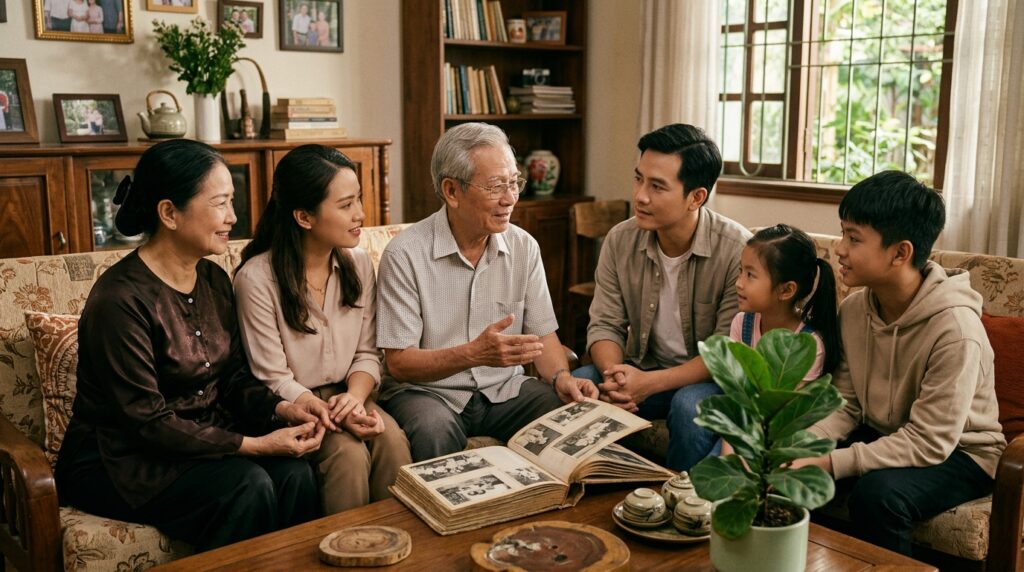
In a tử vi chart, some palaces easily attract attention because they are associated with money, career, or clearly defined turning points. The Phúc Đức Palace is usually quieter. It does not merely answer the question of whether someone will be lucky; it suggests how that person is supported by family, tradition, spiritual life, and habits formed over many generations. Therefore, this is one of the areas that needs to be read slowly, with a clear-headed and multifaceted attitude.
If tử vi is viewed as a symbolic language, the Phúc Đức Palace is not a document concluding that someone was born blessed or destined to lack good fortune. It is more like a mirror reflecting the invisible foundation behind present behavior. One person may inherit trustworthiness, a spirit of mutual support, and the ability to remain calm from their family. Another may carry anxieties, patterns of silence, or beliefs about sacrifice that have existed in their lineage for a very long time. Reading the Phúc Đức Palace means beginning to recognize those influences in order to understand what one is continuing and what needs to change.
How is the Phúc Đức Palace commonly understood?
In traditional interpretations, the Phúc Đức Palace is often associated with spiritual life, family traditions, relationships with relatives, the ability to receive support, and the feeling of inner peace. Depending on the school of thought, an astrologer may also examine factors related to blessings, longevity, emotional support, or the way a person seeks refuge when life encounters challenges. These interpretations should not be separated from the entire chart, the circumstances of life, and the native’s actual choices.
What is noteworthy is that the word “blessing” in the Phúc Đức Palace does not only mean unexpected good fortune. Blessings may appear in the form of a family that keeps its promises, a relative willing to help, an education that teaches children to distinguish right from wrong, or the ability to meet kind people at important moments. Sometimes a blessing lies in the ability to self-regulate, preventing one failure from turning into lasting bitterness. Therefore, viewing this palace merely as an indicator of wealth, poverty, or material enjoyment impoverishes its meaning.
Spiritual heritage is passed down through very ordinary ways
Families do not pass down only assets, surnames, or stories about their ancestors. They also pass down ways of dealing with money, ways of speaking during disagreements, attitudes toward vulnerable people, and beliefs about what makes a life worth living. A child who grows up in a home where people can apologize will learn that making a mistake does not mean losing one’s dignity. Someone who frequently witnesses coldness may become accustomed to hiding their needs, even while appearing strong on the outside.
When reading the Phúc Đức Palace, those who are interested can ask themselves what invisible resources their family has given them. These may include the habit of persistent work, respect for education, the ability to care for loved ones, gratitude for small things, or the belief that every difficulty can be shared. It is also worth looking directly at the heavier aspects, such as patterns that make people feel they must always please others, fear of being judged, or the belief that the more one sacrifices, the more deserving of love one becomes.
This way of asking questions is more practical than hastily labeling a palace as good or bad. No family heritage is entirely simple. A tradition can both create strength and impose pressure. Discipline helps a person get through difficult periods, but when pushed to extremes, it can prevent that person from allowing themselves to rest. Frugality helps a family remain stable, but an obsession with scarcity may prevent the next generation from investing in their health and education.
Why should the Phúc Đức Palace not be interpreted in isolation?
A tử vi chart is a system of many relationships, not a collection of independent boxes. When viewed together with other palaces, the Phúc Đức Palace can suggest how a spiritual foundation affects relationships, work, finances, and personal choices. For example, someone may come from a stable family background yet still have difficulty trusting others. This reminds us that external support does not automatically create a sense of inner security. Conversely, someone who grew up amid considerable deprivation may still build a strong spiritual life through healthy relationships and the ability to learn.
Interpretation should also avoid making absolute deductions from a single star or a single combination of stars. In tử vi practice, the same symbol can be interpreted differently depending on its position, interactions with other stars, and the overall structure of the chart. Moreover, a chart cannot replace information about mental health, economic conditions, social circumstances, or family history. If an interpretation causes the reader to panic, feel inferior, or believe they must take responsibility for every misfortune in their lineage, that interpretation has gone far beyond the purpose of reflection and self-understanding.
Read the Phúc Đức Palace to recognize the strengths already present
One useful approach is to begin with specific manifestations in daily life. When you are tired, whom do you usually turn to? Are you able to accept help easily, or do you always feel that you must manage on your own? In your family, are difficult issues resolved through dialogue, silence, or blame? Do you have a private space in which to recover your energy? These questions help bring the meaning of the Phúc Đức Palace out of abstract language.
Next, distinguish between blessings received and blessings that continue to be created. Some people inherit a kind family but take it for granted, only realizing as adults that they have never learned how to express gratitude. Others do not have a favorable foundation, but actively build a circle of trustworthy friends, learn to manage their emotions, and create a home different from what they themselves experienced. Both are participating in the process of creating blessings in the broad sense, because blessings are not only something that lies behind us; they are also the way we treat others in the present.
Signs of a strong spiritual foundation are often quiet. They include the ability to rest without feeling guilty, knowing when to seek help, not using success to conceal every wound, and maintaining kindness even when it is not immediately reciprocated. These are abilities that can be cultivated, not privileges reserved only for people with a favorable chart.
Turning awareness into action within the family
If looking at the Phúc Đức Palace ends merely in curiosity, it is unlikely to create lasting value. More important is turning awareness into manageable changes. A family can begin by setting aside one meal without phones, allowing each person to share something they are grateful for or something for which they need support. Conversations like these will not immediately erase old conflicts, but they create a habit of listening that many families have lacked for a long time.
With burdensome legacies, one should not force oneself to forgive immediately or maintain every custom simply because it is tradition. Respecting one’s roots does not mean protecting every behavior that has harmed people. We can be grateful for what is good while setting boundaries against insult, control, or violence. If a family issue persists and seriously affects one’s life, seeking a psychologist or an appropriately qualified professional is a practical choice, not a sign of weakness.
In personal life, cultivating Phúc Đức can begin with ordinary things: keeping promises, caring for one’s health, repaying debts on time, treating the people one works with fairly, and not directing one’s anger at uninvolved people. These actions do not create immediate miracles, but they build credibility, trust, and a sense of safety in relationships. Over time, that is precisely a form of spiritual asset that each person can leave to their family.
Maintaining clear-mindedness when exploring tử vi
Tử vi can open an interesting dialogue with oneself, but it should not become the sole basis for decisions about marriage, work, health, or how to treat one’s parents. In particular, predictions about blessings, karmic connections, or relatives can easily touch feelings of guilt and fear. Readers should remember that a responsible interpretation must leave room for choice, circumstances, and the possibility of change.
Instead of asking whether one has received many blessings, one can ask more practical questions: What resources am I receiving from my family, in what ways are those resources helping or pressuring me, and what do I want to pass on to the next generation? This way of asking brings tử vi back to its proper role as a tool for reflection. It does not live life for us or relieve us of responsibility, but it can help us see clearly influences that are often overlooked.
Ultimately, the Phúc Đức Palace is not a promise of a life that will always go smoothly. It is a reminder that people do not mature in a vacuum. We are shaped by family memories, by those who have supported us, by the wounds we have experienced, and by the choices we make about what to continue or stop. When we read this with gratitude but without superstition, with compassion but without self-pity, we can turn spiritual heritage into a foundation for a more intentional and kind life.

ARTICLES IN THE SAME CATEGORY
The Career Palace in Tử Vi: Reading How You Work, Not Just Predicting Your Position
How to Read Astrological Fortunes Without Letting Fear Guide You
Astrology as a Map of the Inner Self: Reading One’s Life Path to Understand Oneself and Live More Proactively
Heavenly Officials in Vietnamese Folk Belief: Bestowers of Blessings from the Celestial Realm
The Judge Figures in Vietnamese Folk Belief: Guardians of Justice in the Afterlife
Pig Zodiac Horoscope for the 3rd Lunar Month 2026: Effort Brings Results, Relationships Support Success
ARTICLES IN THE SAME GENRE
Knowing What Is Right Is Still Not Enough: Why It Is Difficult for People to Change Their Habits
Familiarity Is Not the Truth: Recognizing Reasoning Traps in Everyday Life
Greenland and the Great Test of the World Order