

 Tiếng Việt
 日本語
日本語 한국어
한국어 中文 (中国)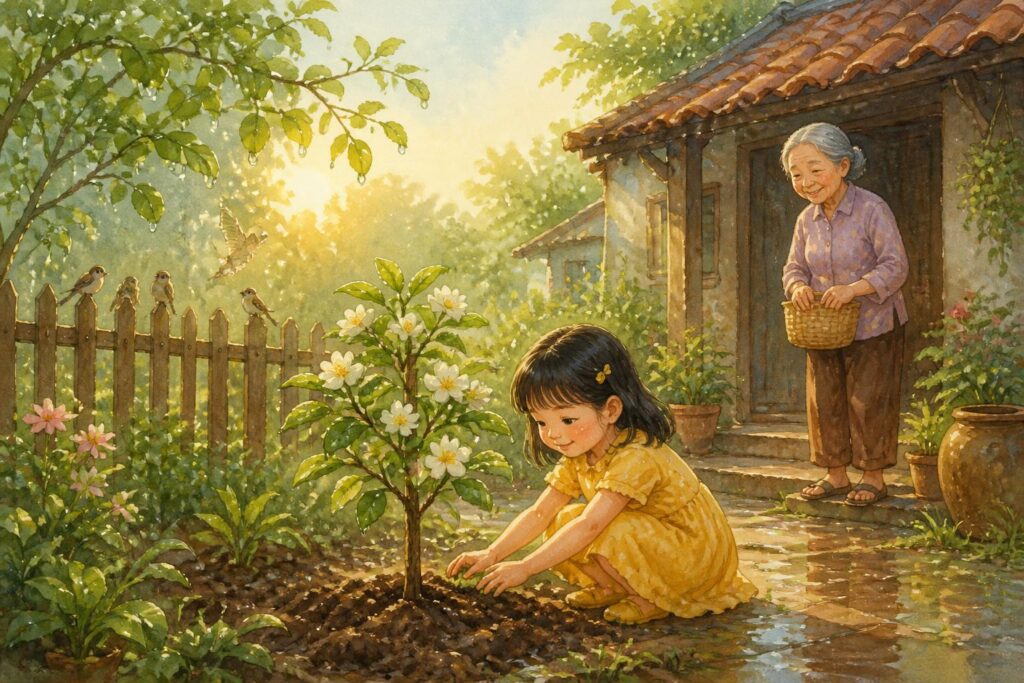
At the far end of White Cloud Village was a small garden behind Grandmother’s tiled-roof house. The garden was not large, but every season brought something worth looking at. In spring, yellow chrysanthemums blossomed beside the fence. In summer, the green gourd vines swayed in the breeze. When autumn came, the scent of dry leaves mingled with the fragrance of damp earth, making the path in front of the house feel gentle and peaceful. And in winter, the garden quietly rested beneath a thin blanket of mist.
Mi loved that garden very much. Every day after school, she ran out to visit the vegetable beds, check whether the tomatoes had turned red, and see if any insects had nibbled on the flowers. Grandmother often said:
“Every plant has its own way of speaking. A young plant speaks through a newly unfurled leaf, flowers speak through their fragrance, and the soil speaks through its silence. If you pay close attention, you will understand them.”
Mi listened, but she did not truly believe it. She thought plants could not talk the way people did. They simply stood in one place, grew very slowly, and never told anyone anything.
The Gift in the Wooden Box
One afternoon after a rainstorm, Grandmother called Mi into the kitchen. On the table sat a small wooden box that had darkened with age. The box had no lock, and its lid was tied with a brown string.
Grandmother opened the box very slowly. Inside was a tiny cloth pouch embroidered with the image of a water droplet. Mi asked curiously:
“What’s inside, Grandma?”
“A seed,” she replied. “I’ve kept it since your mother was little. Now I want to give it to you.”
Mi carefully held the pouch. The seed inside was smaller than her little fingernail, light brown, with a fine curve along its shell.
“What kind of plant will it grow into, Grandma?”
“I don’t know. It might be a flowering plant, or it might be a fruit-bearing tree. But what matters is not whether you can guess what it will become. What matters is whether you have enough patience to care for it.”
Mi happily agreed. She ran straight to a corner of the garden, where there was a patch of soft soil beside a rosemary bush. Using a small shovel, she dug a hole, placed the seed inside, and covered it with soil. Then she poured on a great deal of water.
Grandmother looked at the watering can, full of water, and gently reminded her:
“A seed needs water, but it doesn’t need a river. If the soil is always soaked, it will have trouble breathing.”
Mi nodded, though she thought Grandmother was worrying too much. She wanted the seed to grow very quickly so she could soon find out what kind of plant it was.
The First Day Without a Single Leaf
The next morning, as soon as Mi opened her eyes, she ran out to the garden. She knelt beside the patch of soil and looked very carefully. There was nothing at all. The ground was still flat, with only a dry leaf lying askew beside it.
“Perhaps the seed is sleeping,” Mi told herself.
At noon, she went out to look again. Still nothing. That evening, before going to bed, she took a lamp out to the garden once more. The seed remained silent beneath the soil.
The second day, the third day, and then the fourth passed the same way. Mi began to grow impatient. She poured on more water and used a stick to poke gently into the soil to see whether the seed had sprouted. Each time she did so, Grandmother told her not to disturb the place where the seed was struggling.
“But I can’t see it doing anything,” Mi pouted.
“Not everything important happens before our eyes,” Grandmother said. “Some things begin in the dark.”
Mi did not understand. She only felt that it was terribly unfair. A tiny seed was allowed to lie still beneath the soil, while she had to wait, water it, and pull the weeds around it. She wanted to see the result immediately.
That afternoon, while Mi was sitting sadly beside the patch of soil, a sparrow swooped down onto the fence. It tilted its head at her, then hopped closer.
“What are you waiting for?” the sparrow asked.
Mi was surprised but not frightened. Perhaps it was because Grandmother’s garden was a place where all gentle things could happen.
“I’m waiting for a seed to grow. But it’s too slow.”
The sparrow pecked lightly at a millet seed on the ground and said:
“I once waited a very long time before I learned how to fly. If every day I had only looked at my wings and complained, I would probably still be sitting beneath the eaves.”
With that, the sparrow darted up to a plum-tree branch. Mi watched it, feeling a little calmer inside.
The Whisper of the Rain
That night, the rain fell for a very long time. It tapped on the tiled roof in a steady rhythm, sometimes near and sometimes far away. Lying beneath her blanket, Mi listened to the rain and suddenly thought of the seed. She worried that the soil would flood, that the seed would be washed away, and that all her efforts would disappear.
Early the next morning, Mi hurried out to the garden. Rainwater had collected in small puddles, and several branches had lost leaves to the wind. The patch of soil where she had planted the seed had also been eroded a little. Mi burst into tears.
“The seed must be dead!”
Grandmother did not answer right away. She gave Mi a bamboo stick, and together they made a small channel to lead the water away from the patch of soil. When they finished, Grandmother sat down beside her.
“Listen,” she said.
Mi stopped crying. Amid the sound of running water, she heard something very faint, like someone breathing out after a long night.
“What is that sound, Grandma?”
“It could be the soil drinking water. Or it could be the seed opening its eyes.”
Mi pressed her ear close to the ground. At first, she heard only raindrops falling from the leaves. But after sitting very still for a while, she sensed a fragile tremor beneath the soil. She could not tell whether it was a real sound or merely her imagination, but it made Mi sit quietly for a very long time.
“The seed isn’t silent,” Grandmother said. “It is working in its own way. It has to split its hard shell, find a path through the soil, and receive warmth. Those things take time.”
From that day on, Mi no longer dug up the soil to check. She gave it just enough water, pulled out weeds by hand, and covered the patch with a few dry branches when the sun grew harsh. Every morning, she sat quietly for a while. She listened to the birds, the wind, the sound of leaves brushing against one another, and even the silence of the soil.
A Very Small Green Shoot
One morning at the beginning of the week, Mi noticed a thin crack in the surface of the soil. The next day, a curved green shoot emerged from the crack, so small that if one did not look carefully, one might mistake it for a blade of grass.
Mi cried out with delight, but immediately lowered her voice for fear of startling the plant.
“Grandma, it’s growing!”
Grandmother came outside, braced her hands on her knees, and bent down to look. She smiled but did not touch the shoot.
“Isn’t it beautiful, Grandma?” Mi asked.
“It is. Because you were patient enough to see it.”
Mi cared for the plant more carefully than before. She made a small fence from wooden sticks so the calico cat would not accidentally step on it. She used a coconut shell to scoop up small amounts of water, no longer pouring it all over the plant as she had in the early days. She even told the plant stories about school, about the sparrow that often perched on the fence, and about how delicious Grandmother’s mung-bean sweet soup was.
At first, Mi thought she was talking to herself. But then she realized that whenever she told her stories, her heart felt lighter. The plant did not need to answer with words. As long as its young leaves trembled gently in the breeze, Mi felt that she was being heard.
The plant grew little by little. It had a slender stem, round leaves, and a very faint fragrance that appeared only in the early morning. Grandmother did not know what kind of plant it was either. Relatives from the village who passed by each made a different guess. One said it was a star-flower plant, another thought it might be a medicinal plant, and someone else claimed that before long it would become a vine.
Mi was no longer impatient to know the plant’s name. She found growing alongside it interesting enough.
The Flower That Bloomed Only When No One Urged It On
Nearly a year later, the plant had grown taller than Mi’s knee. One early morning, a round, plump flower bud appeared at its tip. Mi was so happy that she wanted to call the whole village to come and see, but Grandmother told her to let the plant bloom in its own rhythm.
On the first day, the flower bud opened only a little. On the second day, it opened wider, revealing petals the color of ivory. By the morning of the third day, the whole garden had suddenly filled with a gentle fragrance. The flower spread open, with tiny golden specks sparkling in the sunlight at its center.
Mi stood before the flower for a very long time. She suddenly understood why Grandmother said that every plant had its own way of speaking. The flower did not tell a story in human words, but it spoke of the days spent in darkness, the heavy rainstorm, the care that had been given in just the right amount, and the patience of a little girl who had once wanted to see everything immediately.
The sparrow flew over and perched on the fence. It looked at the flower and asked:
“Do you know now what the seed wanted to become?”
Mi shook her head.
“I only know that it has become itself. That is enough.”
Grandmother heard her and smiled. She told Mi to pick a flower whose petals had fallen and place it in the wooden box, but Mi did not want to pick a flower that was still blooming. She waited until the flower naturally fell from the branch, then picked up a small seed that had dropped to the ground.
Mi placed the seed in the cloth pouch embroidered with the image of a water droplet. She did not yet know where she would plant it. Perhaps beside the stream, where the village children often sat and played. Perhaps in the schoolyard, where many children passed by every day. Or perhaps in an unfamiliar garden, where there was a child who needed to learn how to wait.
The Lesson in the Garden
From then on, whenever anyone asked how to help a seed grow, Mi did not answer that they only needed to pour on lots of water. Nor did she say that if one wished for something long enough, everything would simply happen on its own. Mi told them about choosing a suitable patch of soil, caring for it regularly, paying attention to the weather, and knowing when to stop.
She said that there were days when we thought we were making no progress at all, but inside, something important was still quietly taking place. Sometimes action was needed, sometimes protection was needed, and sometimes the best thing we could do was wait patiently.
Grandmother often sat by the veranda listening to Mi speak. She did not correct her words, only turned her eyes toward the white-flowered plant swaying in the breeze. The garden was still small, and the path in front of the house was still peaceful, but Mi now saw everything differently. She knew that a young leaf was a greeting, that rain was the care of the earth and sky, and that silence was sometimes a sign that something beautiful was beginning.
And if one day you happen to pass through White Cloud Village, try stopping by the garden behind the tiled-roof house. Perhaps you will see a white flower blooming. Do not be too quick to pick it. Sit down very quietly, listen to the leaves, and wait for the garden to tell its story.

ARTICLES IN THE SAME CATEGORY
The Button That Went Looking for Someone Who Keeps Their Word
The Lamp That Kept the Fire Burning at the End of the Slope
The Boy Who Heard Rain in a Bean
The Seedling Beneath the Veranda and the Little Watering Can
THE STORY OF SOWING SEEDS
The Power of Silence
ARTICLES IN THE SAME GENRE
The Button That Went Looking for Someone Who Keeps Their Word
Tam Cam Part 2: The Vengeful Spirits of the Palace
Tam and Cam: The Palace Intrigue and the Original Ending – Part 1
Tam Cam
Coconut Skull
Saint Giong