

 Tiếng Việt
 日本語
日本語 한국어
한국어 中文 (中国)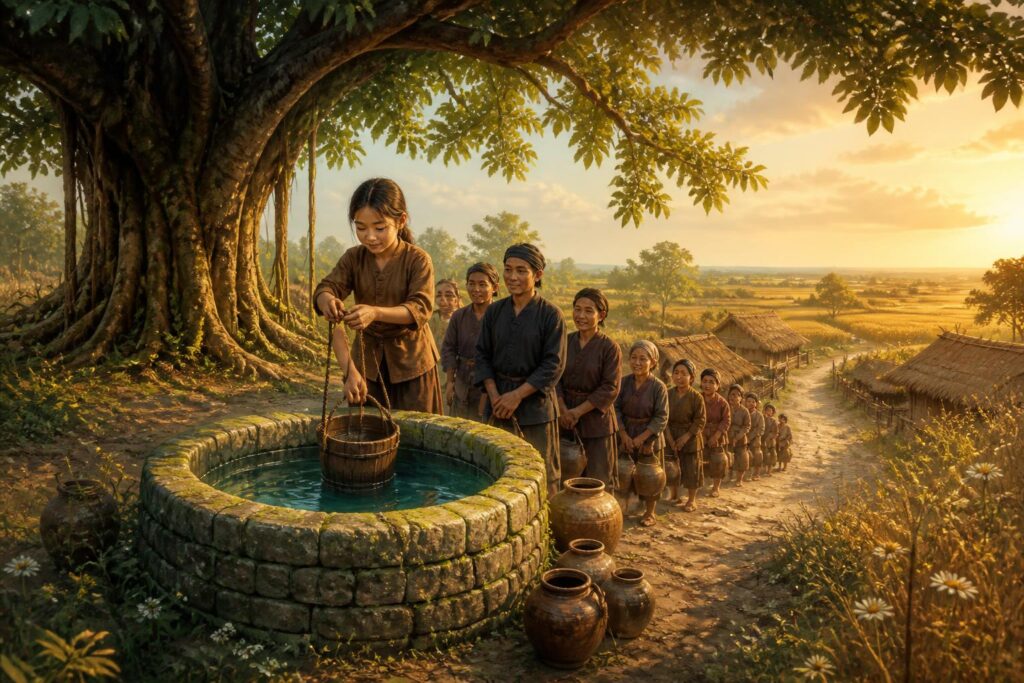
The Well at the End of the Slope
Long ago, at the end of a slope covered in wildflowers, there was a small village called An Moc. The village lay between a vast field and a low forest, where the mornings were often covered by a layer of mist so thin that the rooftops looked as though they were floating on a white sea. The people of An Moc lived peacefully, growing rice, weaving cloth, and raising herds of goats with coats as soft as clouds.
But the most precious thing in the village was not the alluvial fields or the looms that made a clicking sound every afternoon. It was an ancient well beneath a banyan tree at the end of the slope. The well walls were built of smooth, polished blue stones and remained cool throughout the year. The water in the well never ran dry, even during dry seasons that lasted so long that the earth cracked. The village elders said that the well had existed before An Moc was founded, but no one knew who had dug it.
Because of that water source, the villagers established a simple rule. Each household could take only enough for its needs, while any extra water had to be left for those who came later. No one was allowed to lock the well, and no one could claim to be its owner. That rule endured for many generations, until one year when the dry season arrived earlier than usual.
The Little Girl Who Kept the Key
That year, the rice had only just begun to form panicles when the tips of its leaves started to dry. The village pond gradually emptied, and the puddles along the roads turned into patches of cracked mud. The villagers had to travel farther to find grass for their livestock. The village head at that time was Elder Lam, a white-haired man whose eyes were still bright. He called everyone beneath the banyan tree and said that someone needed to be appointed to oversee the drawing of water, so that no one would take more than their share out of fear.
The person chosen was Mai, a thirteen-year-old girl who lived with her mother in a thatched house on the slope. Mai was not the strongest person in the village, nor did she come from a wealthy family. But she was known for being careful. Every morning, Mai helped her mother measure rice, dry corn, and remember the goods that villagers asked her to keep track of. Elder Lam gave her a small brass key, even though the lock was used only to open the shed containing the well ropes and spare jars.
“You are not keeping the water,” the elder told her. “You are only helping everyone remember that this water belongs to the life of the whole village.”
Mai nodded. On the first day, everything proceeded peacefully. Each household brought a jar, took only enough, and made room for the others. Those with elderly people or young children were given priority. Everyone who finished used a dipper to rinse the well wall clean, making sure no dirt or sand fell into the water.
On the fifth day, a man named Phuc came to the well while it was still dark. He brought six large jars, even though his household consisted of only himself, his wife, and one child. Mai gently reminded him that each household should take only enough water for the day. Phuc frowned and said that during a dry season, no one knew what tomorrow would bring. He said that if people did not look after themselves in advance, then when they became thirsty, no one would bring them water.
Mai did not argue. She only asked, “If every household took six jars like you, how many days would the well have enough water left for?”
Phuc did not answer. He looked at the jars, then at the people waiting in line behind him. In the end, he took four of the jars back home. Even so, from that day onward, murmurs began to spread through the village. Some people thought Mai was too rigid. Others said she was still too young and should not interfere in adults’ affairs.
Kindness Cannot Do Without Clear-Sightedness
A few days later, an old woman from the neighboring village arrived. She had walked all morning, carrying only a small clay pot on her shoulder. Her village lay on the other side of the forest, where the well had long since dried up. She asked Mai to let her fill the pot, but behind her stood two men waiting with very large buckets.
Mai realized that they were not from An Moc. She remembered Elder Lam’s words that the well belonged to no one alone, but she also understood that if everyone were allowed to take water without limit, the source would quickly become cloudy and run dry. She invited the old woman to drink a dipperful first, then told the two men that each of them could take only one small bucket. The rest would be distributed in turn, after the villagers had enough water for their daily needs.
One of them became furious, accusing the people of An Moc of being selfish. Mai felt her hands tremble, but she still stood in front of the well wall. She did not want to send the old woman away empty-handed, nor did she want to turn compassion into an excuse for anyone to take all of someone else’s share.
Just then, Elder Lam arrived, leaning on his cane. He did not blame Mai, nor did he scold the visitors. He simply told the villagers to bring out a large jar, fill it, and place it by the roadside for passersby. Every day, the village would set aside some water for outsiders, but that amount had to be decided after the essential needs of young children, the elderly, and the livestock had been met.
“A well does not keep water for itself,” he said, “but the person drawing water needs to know whether they are drawing it with gratitude or with fear. Gratitude makes us take only enough. Fear makes us want to take everything before anyone else has a chance to arrive.”
The Night the Well Became Clouded
Those words made many people think, but the dry season continued. One night, after the entire village had gone to sleep, someone secretly removed the wooden cover from the well and lowered a large bucket into it. The next morning, the water in the well was murky. Dry leaves and mud floated up from the bottom.
The villagers panicked. Some immediately suspected Phuc because he had once wanted to take a great deal of water. Others thought it was someone from the neighboring village. The arguments grew increasingly heated. Phuc angrily swore that he had not done it, but no one was willing to listen.
Mai studied the well wall for a long time. She noticed that the well rope was frayed at one section, and there were footprints on the ground smaller than an adult’s. She followed the footprints behind the shed and found a little boy sitting there crying. It was Ti, the son of a poor family at the end of the village.
Ti confessed that he had secretly drawn water at night because his mother had a fever. He was afraid that if he asked for more, people would blame his family for using more than their share. While pulling up the large bucket, Ti had dropped it into the well. He had panicked and run away, afraid to tell anyone.
Mai took Ti to meet Elder Lam. The boy lowered his head, expecting to be punished, but the elder only asked why he had not called someone for help. Ti replied that he had heard many people talk about fairness, but no one had ever told him that a sick person could ask for more.
His words made the entire village courtyard fall silent. Everyone realized that although their rule was sound in principle, it lacked one important thing: concern for circumstances that were not the same. If people only divided things equally without seeing different needs, fairness could sometimes become cold and unfeeling.
How An Moc Village Preserved Its Water Source
The villagers worked together to make a long hook to pull the bucket out of the well. They replaced the rope, filtered the water with clean sand, and fired large clay jars for storing water. From then on, in addition to the record of how much water each household had taken, they created another list for families with sick people, newborn babies, and elderly people requiring special care.
Mai suggested that each household appoint someone to take turns watching over the well. She did not want the key to become a symbol of power. Elder Lam agreed. The brass key was hung in the shed, and anyone whose turn it was could use it. The person keeping watch over the well was not allowed to make every decision alone, but had to listen, take notes, and inform the entire village when there was a problem.
Phuc also changed. He used the good planks remaining in his storehouse to build a roof over the water-drawing area. The people who had once opposed Mai began helping her keep records. The old woman from the neighboring village, after receiving water, returned carrying seeds of a drought-resistant bean variety. The villagers planted them around the edges of the fields, then used the stalks as feed for their livestock.
The dry season lasted nearly another month, but the well still had water. It was not because there was more water in the well than before, but because the villagers had learned to use it more carefully. They no longer thought that keeping more for themselves was the safest way. They understood that a source of life can endure only when everyone protects it together, while also remembering to make room for different needs.
The Lesson Beneath the Banyan Tree
Many years later, Mai became the finest weaver in the village. The brass key was kept in the shed and no longer bore anyone’s name. Whenever a child asked why the well was not locked, the adults would usually retell the story of that year’s dry season.
They would say that kindness did not mean giving away everything one had to the first person who reached out a hand. Kindness needed to be accompanied by clear-mindedness so that it did not become unfairness toward those who were quietly waiting. They would also say that fairness did not mean giving every person a portion that was exactly the same. Fairness meant seeing what each person needed, how many resources remained, and what could be done so that no one would be left behind in difficult times.
The well still stood beneath the banyan tree, welcoming the moonlight each night. The water in the well reflected the face of anyone who bent down to look. Some people saw their own weariness, some saw worry, and some saw the eyes of those standing behind them. Perhaps that was why the well never truly belonged to one person: because each time people looked into it, they were reminded that their own lives were always connected to the lives of others.

ARTICLES IN THE SAME CATEGORY
The Library at the End of the Alley and the People Learning How to Open Doors for One Another
After an Argument, What Needs to Be Repaired First?
The Box That Holds the Rainy Season
The Watchmaker and the Forgotten Moments
Tam Cam Part 2: The Vengeful Spirits of the Palace
Tam and Cam: The Palace Intrigue and the Original Ending – Part 1
ARTICLES IN THE SAME GENRE
Stepmother and Stepchild