

 Tiếng Việt
 日本語
日本語 한국어
한국어 中文 (中国)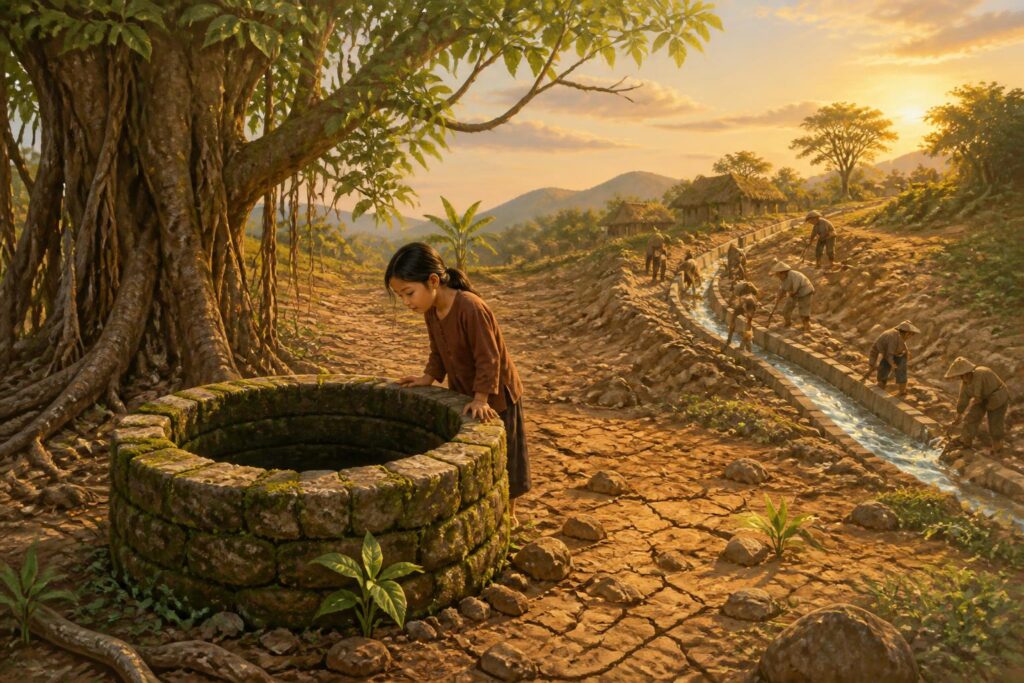
At the end of Moc Tam Village stood a stone well that had been dry for many years. Green moss covered its mouth, and the well wall was cracked with fine lines like birds’ footprints. Beside it grew an old fig tree that had leaves all year round but rarely bore fruit. No one in the village drew water from it anymore. They used the new drilled well near the communal house, even though its water often had a musty taste, and whenever the dry season came, the water level fell so low that people had to take turns waiting for half a day just to draw a bucket.
Even so, the elders still often warned children not to lie beside the old well. They said that long ago, when the village had only a few houses, the well had been deep enough to reach the underground water vein. Anyone who leaned down and said something untrue would find the well silent. But if someone spoke exactly what they thought, even if it made them ashamed or caused them pain, a very soft sound would echo up from the bottom of the well, like a drop of water falling onto the surface of a lake.
No one knew when that story had begun. Those who believed said it was a miracle. Those who did not laughed and said the elders of old had made it up to teach children to keep their word. As for An, a twelve-year-old girl who lived in a tiled-roof house at the entrance to the village, she had never regarded it as a joke. An believed that every spoken word left some kind of mark; it was simply that people were not quiet enough to hear it.
The Dry Season Comes Early
That year, the dry season came earlier than usual. For three straight months, no rain fell. The canal that ran around the fields had become nothing more than a strip of cracked mud. An’s grandmother’s vegetable beds wilted from morning to afternoon. The buffalo had to be led far away to find a muddy puddle, while the villagers began dividing every small container of water among themselves.
Mr. Phuc’s house, which had the largest storage area in the village, still had water. He had once dug an underground tank beneath his yard and bought many earthen jars to store water from the previous season. Every day, people lined up outside his house. He sold water at three times the usual price. Whenever anyone complained, he merely shrugged and said that his water existed because he had spent his money and labor on it, and no one had the right to force him to share it cheaply.
An’s grandmother did not have enough money to buy much. The two of them had to walk nearly an hour to collect water from the drilled well near the communal house. One day, when they returned, An saw her grandmother set the two buckets down on the porch and sit there panting. Her hands trembled with exhaustion.
“Tomorrow, you should leave earlier,” An said.
Her grandmother shook her head. “Whether we leave early or late, the water will not fill itself. What is frightening is not one season of drought, but that people are beginning to look at one another as containers that can be exchanged for money.”
An did not fully understand those words, but she remembered them for a long time.
That afternoon, An passed by the old well. The wind blew through the dry fig branches, making the leaves rustle. For some reason, she stopped, placed both hands on the ice-cold well wall, and leaned down.
“If there really is someone down there who can hear, please give my village a way to find water.”
An’s voice fell into the darkness. For a long while, nothing happened. She almost laughed at herself for being so foolish. But just as she turned away, a very small sound rose from the bottom of the well.
Click.
Exactly like a drop of water falling.
Words That Are Not Easy to Hear
That night, An told her grandmother what had happened. Her grandmother did not look surprised. She simply added more firewood to the stove and asked:
“Have you said anything sincerely?”
“I told the truth. I want to find water for the whole village.”
“That is what you want other people to hear. But what do you really think?”
An fell silent. Outside in the yard, chickens rustled uneasily in the darkness. After a while, she said softly:
“I’m afraid. I’m afraid our house will run out of water. I’m also afraid that Mr. Phuc won’t sell to us anymore. And sometimes I feel angry at people who have a lot of water.”
Her grandmother looked at her, the firelight reflected in eyes lined with many wrinkles.
“Then tomorrow, say those things beside the well.”
The next morning, An went to the old well before setting out to collect water. She leaned down and said, one by one, that she was frightened, envious, and angry. Each time she finished speaking, a faint click echoed up from the depths. At the very end, An suddenly burst into tears.
“But I don’t want to become someone who only knows how to keep what is hers. I want everyone to make it through this dry season together.”
This time, the echo was not like a drop of water. It sounded like a small stone rolling across the ground, then it abruptly fell silent.
An told a few of her friends about it. The children ran over curiously to try it themselves. One said he had broken his mother’s bowl, another confessed that he had hidden a ripe guava instead of sharing it with his younger sibling. The well answered with soft sounds, sometimes like drops of water, sometimes like pebbles knocking against one another. But when one boy folded his arms and said that he had nothing to hide, the well remained completely silent.
The story spread throughout the village. At first, the adults did not believe it. Some even said the children were playing tricks. Nevertheless, anyone who passed the well could not help glancing down, because during a drought, people often found it easier to believe in something than to believe in their own indifference.
The Meeting Beneath the Fig Tree
The village chief organized a meeting beneath the old fig tree. Mr. Phuc also came, wearing an annoyed expression. Everyone argued about how to distribute the water. Some said the wealthy households had to open their stores, while others feared that doing so would make them unwilling to stockpile for the next season. Someone suggested digging more wells, but no one knew where to dig or where to get the money.
While the adults each voiced their own opinions, An stepped into the center of the circle.
“I know a way to find out what we truly want,” she said. “Each person should go to the old well and say a sentence that they have not prepared beforehand.”
A few people laughed. Mr. Phuc frowned and said that children should not interfere in adults’ affairs. But An’s grandmother slowly stood up and walked to the mouth of the well.
“I am afraid I will not have enough water for the final days,” she said. “Because I am afraid, I have thought that as long as my family stays alive, it does not matter what happens to anyone else.”
A click echoed up from the well.
No one laughed anymore.
The village chief stepped forward. He admitted that he knew the old water pipe leading from the northern hill had been buried by earth and rocks, but he had hesitated to mobilize the villagers to repair it because he feared being blamed if the work failed. A small sound rang out.
A woman who sold goods said that she had hidden two jars of water behind her kitchen, even though she had always criticized Mr. Phuc for being selfish. The well answered. A young man admitted that he had secretly taken water from his neighbor’s house at night. The well answered him too.
When it was Mr. Phuc’s turn, everyone held their breath. He stood for a long time before the mouth of the well. His face, usually so hard, suddenly looked weary.
“I did not sell water only to make a profit,” he said. “I was afraid of becoming poor again. When I was little, my family was once so thirsty that we had to beg for every dipper of water. I swore that no one would ever take away anything that belonged to me. But when I look at the people lining up outside my door, I know I am making them suffer the very fear I once suffered.”
The well remained silent for a very long time. Everyone thought that this time it would not answer. Then, from deep beneath the earth, came a low, drawn-out sound, like water shifting beneath a layer of stone.
No one said anything. Mr. Phuc lowered his head.
The Water Beneath the Earth
After the meeting, everyone went together up the northern hill. The village chief led them to a landslide-covered ditch where the old pipe had once carried water to the village. The work was harder than they had imagined. They had to clear away rocks, remove the earth, and replace sections of pipe that had rotted away. Mr. Phuc opened his tool shed, the families who still had strength brought hoes and shovels, and the children passed small stones out of the ditch one by one.
There was no water on the first day. The second day was the same. Some people began to lose heart, while others blamed the village chief for making them waste their time. Just then, Mr. Phuc brought out all the water in his underground tank and distributed it among the households. He no longer sold it. He said that he was still afraid, but he did not want fear to control every decision.
On the afternoon of the third day, a young man digging at the foot of the hill suddenly shouted. From a crack in the rock, a thin stream of water seeped out, crystal clear and icy cold. At first it was only a tiny thread, but then it flowed into a stream along the ditch. Everyone stood silently watching the water pass through the dry earth, as if they were witnessing something they had thought lost return to them.
The flow was not strong enough to fill the village tank immediately. They had to guide it little by little, build bamboo channels, repair the pipes, and take turns making sure mud did not wash into them. But after only a week, the well near the communal house could be used more reliably. The villagers established new rules: each household could draw only as much as it needed, while the rest was reserved for the elderly, young children, and families unable to walk far.
Mr. Phuc still kept the water jars in his yard, but he no longer locked the storage room. He even contributed money to buy seeds for drought-resistant vegetables so that all the families could grow them together. An’s grandmother said that this was not yet a great miracle. The true miracle was when a person realized that they could live more safely without making others suffer.
What the Well Left Behind
After the dry season, the first few rains fell on Moc Tam Village. Water gathered on the tiled roofs and streamed down beside the house porches. The old fig tree beside the old well unexpectedly blossomed, then produced a small cluster of fruit. The children picked it and shared it among themselves; none of them fought for the largest portion.
An returned to the well many times. She tried saying cheerful words, words of thanks, and even stories that were not important at all. Some days, the well echoed with a small sound; other days, it was completely silent. Gradually, An understood that the well did not always answer. It only helped people recognize what they already knew but had deliberately refused to hear.
The villagers no longer called it a magical well, either. They simply called it the old well. Even so, before every important meeting, they would often come and sit beneath the fig tree for a while. Not to wait for an echo from the earth, but to ask themselves whether they were speaking for the common good or merely trying to protect their own share.
Later, An grew up, left the village to study, and then returned to care for the community garden beside the hill. Whenever someone asked why the people of Moc Tam Village shared water so fairly, An would often tell them about the drought years ago and Mr. Phuc, about her grandmother, and about the confessions that were not easy to hear.
But An never said that the well had given them a miracle. She only said that beneath every village were quiet water veins. To find them, people needed not only hoes and shovels, but also enough honesty to look into their own hearts. Because many times, what blocked the flow of water was not earth and stone, but fear, greed, and the things everyone knew yet no one was willing to say aloud.

ARTICLES IN THE SAME CATEGORY
The Bridge That Appears Only When One Knows How to Return
The Lamp by the Desolate Ferry Landing and the Man Who Asked for Nothing in Return
The Well That Does Not Keep Water for Itself
The Library at the End of the Alley and the People Learning How to Open Doors for One Another
After an Argument, What Needs to Be Repaired First?
The Box That Holds the Rainy Season
ARTICLES IN THE SAME GENRE
Stepmother and Stepchild