

 Tiếng Việt
 日本語
日本語 한국어
한국어 中文 (中国)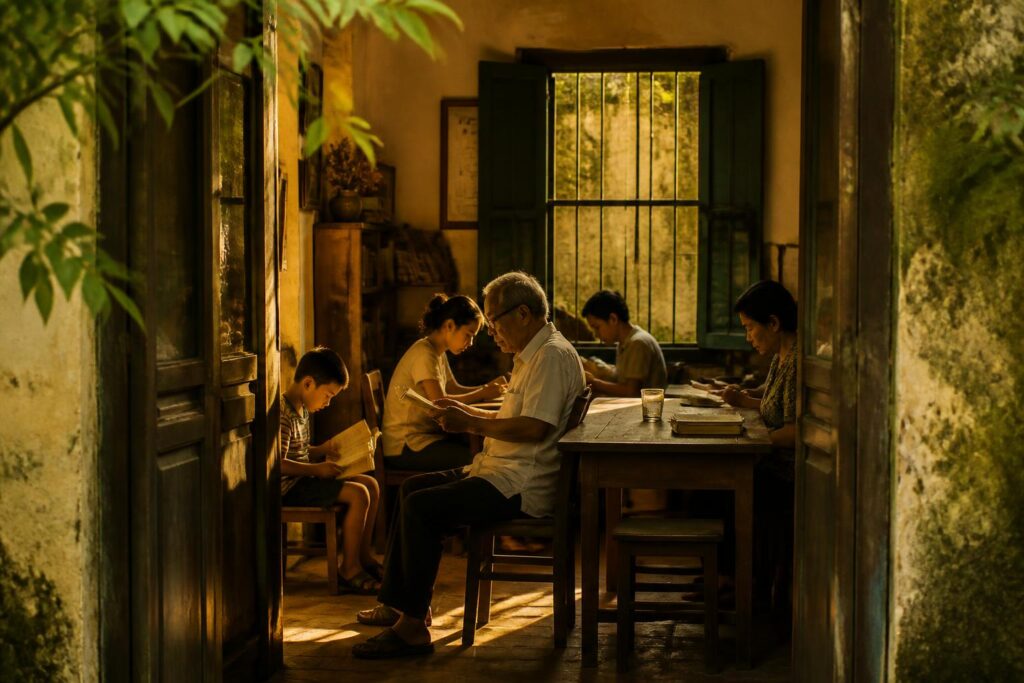
At the end of a small alley, behind a bougainvillea trellis that had faded with age, there was a room with no sign. Its wooden door was usually open from early afternoon until the streetlamp across the road came on. People in the neighborhood called it the room waiting for sunlight, though no one remembered when that name had begun.
The room had once been a storage place for old belongings belonging to a family that had moved elsewhere. Inside were a few low chairs, a long table, a slowly turning ceiling fan, and a window looking out onto a moss-covered wall. There was nothing valuable. And yet, every day, people still stopped by. A schoolboy sat doing his homework, an old woman came to fold paper bags, an unemployed man read old newspapers, and sometimes a young woman simply sat quietly for hours without saying a word to anyone.
The person who kept the key to the room was Mrs. Hanh, a woman in her sixties who lived in the house next door. She did not consider herself the owner of the place. Whenever someone asked what the room was for, she only smiled: “Anyone who needs it can come in. There is no need to say so beforehand.”
A Door That Asked No Questions
Mrs. Hanh had once worked as an accountant for a small garment workshop. After her husband died, she lived with her son and granddaughter. Her life had no major upheavals for others to remember, nor any special achievements to recount at gatherings. She was simply someone who always knew what her household was still lacking: a bag of rice, a few pills, the sound of human voices during an afternoon that was too long.
When the family that owned the storage room moved away, they planned to demolish the wall to widen the driveway. Mrs. Hanh asked to keep the room. She dug into her savings, whitewashed the peeling patches on the walls, and asked a craftsman to make a long table from old planks. She did not buy new tables and chairs because she thought the furnishings in the room should bear traces of time. A scratched chair could still support someone who was tired, no less than a chair that still smelled of paint.
The most special thing about the room was that it asked no questions. No one was asked why they had come, where they lived, what work they did, or why they were sad that day. Those who wanted to talk could talk. Those who only wanted to sit in silence were respected as well. Mrs. Hanh understood that sometimes, even a question arising from concern could make someone who was hurting feel more exhausted. At such times, the kindest thing one could do might simply be to pull a chair closer and let them have peace.
At first, the neighbors did not understand what she was doing. Some said she had too much free time and was making up trouble for herself. Some worried that children would come in and cause damage, or that strangers would take advantage of the room to do something improper. Mrs. Hanh heard it all but did not argue. She only said that if a place was not opened because people feared all the bad things that might happen, then good things would have no chance to enter either.
Those Who Came in the Afternoon
The first person to become attached to the room was Minh, a twelve-year-old boy who lived in the house at the end of the alley. Minh was not good at school and was often reprimanded by his teachers for forgetting his lessons and saying little. His parents sold goods at the market, leaving early in the morning and returning late at night. After school, Minh did not want to go home right away because no one was there yet. He would often sit on the doorstep, kicking pebbles until Mrs. Hanh unlocked the door.
She did not ask Minh whether he had done his homework. She simply placed a glass of water on the table and said: “Today, would you like to sit near the window or near the fan?” Minh chose the spot near the window. From then on, he began bringing his books to the room. Some days he studied a few lines; on other days, he only drew ships on sheets of paper. Mrs. Hanh did not force him to turn the room into a classroom. She believed that before a child could learn anything, he needed to know that he had the right to be in a place where no one mocked him.
A few months later, Minh took the initiative to help her arrange the books. He also made a cardboard box to hold pencils for everyone. The box was lopsided and held together with tape, but it was placed neatly in the middle of the table. Minh did not know that this was what had changed him. He was no longer merely someone who came to receive help. He began to feel that he could do something useful for others.
Then there was Mr. Lam, who had once worked as an electrician. After falling ill, he had to stop working, and he had very little savings left. He came to the room not to look for work but to avoid the afternoons in his cramped house, where the sound of his sighs only made his wife and children more worried. He often sat repairing small things: a jammed lock, a fan with a loose blade, a wobbly chair. Anyone who brought him something broken, he repaired it for free, accepting only a cup of tea.
There was also Mai, a single mother who worked shifts. On days when her shifts changed, she brought her daughter to the room. Little Na sat coloring beside Minh, while Mai took the opportunity to doze in the chair against the wall. No one judged her for sleeping in the middle of the afternoon, and no one asked where the child’s father was. Sometimes, real help is not advice, but allowing a mother to close her eyes for half an hour without having to worry about where her child is.
The Day the Room Nearly Closed
The rainy season that year dragged on. The corrugated metal roof leaked in many places, and water ran down the walls in black streaks. Some people in the neighborhood suggested closing the room because they feared it was dangerous. Mrs. Hanh knew they had a point. She had also thought many times about returning the key, especially when the cost of repairing the roof exceeded what she could afford.
That evening, she sat alone beside the long table, placing in front of her the notebook in which she recorded small expenses. Money for light bulbs, money to replace the lock, money for tea, money for cold medicine for a child. The numbers did not add up to much, but with her meager pension, they were still a burden. She intended to tell everyone the next morning that the room had to close.
But the next morning, before she could say anything, Minh brought a plastic savings box. Inside were coins and a few crumpled bills. He said it was money he had saved to buy a new pair of shoes, but if the room closed, he wanted to contribute it toward repairing the roof. Mrs. Hanh looked at him for a long time, then told him to put the money away. Minh shook his head: “I don’t want to just come here and leave. I want to help keep it too.”
That afternoon, Mr. Lam brought an old tarpaulin. Mai asked for a day off to clean up the room. Minh’s mother cooked a large pot of porridge, while people who had previously only stood outside watching also began to lend a hand. Those who had money contributed money; those who had labor contributed labor; those who had nothing but time came to wipe the tables and sweep the yard. No one organized a fundraiser, and no one took the lead in calling for donations. Each person simply did one small thing, because they knew that the place had quietly held a space for them on some day in the past.
After two days, the room’s roof had been redone. The wall was given another coat of pale-colored limewash. The old fan still turned slowly, and the window still looked out onto the moss-covered wall, but the room seemed larger than before. Perhaps not because it had been repaired, but because many more people now shared responsibility for it.
Sunlight Does Not Come from Only One Direction
Mrs. Hanh had once thought that she was the one bringing the room to everyone. Later, she understood that the room had also brought many things to her. It helped her realize that old age did not mean merely sitting and waiting for one’s children and grandchildren to ask after her. It gave her work that brought no salary but did bring meaning. More importantly, it made her stop viewing loneliness as an illness that only she suffered from.
The people who came to the room gradually changed the way they saw one another as well. They learned that Mr. Lam was not a difficult person; he had simply grown used to hiding his worries behind a gruff manner. They learned that Mai was not indifferent to her child; she simply had too many things to do in a day. They learned that Minh was not lazy at school; he had simply never had a quiet enough place in which to concentrate. When people have the chance to sit beside one another without having to play a role, they often realize that the things they once judged were actually only the visible surface of a much longer story.
The room did not solve poverty, did not immediately find jobs for the unemployed, could not cure every illness, and could not suddenly make families in conflict happy. It only created a pause. But sometimes, a pause at the right moment can stop someone from making a decision in desperation. A quiet place to sit can help someone calm down before returning home. A glass of water placed beside one’s hand can remind a person that they are still being seen.
To this day, the room’s door still opens every afternoon. Minh has grown older and occasionally comes back to help children with their homework. Mr. Lam found a job repairing electrical equipment near his home, but he still keeps the habit of stopping by on his days off. Mai has switched to office hours and sometimes brings some cakes for everyone. As for Mrs. Hanh, she still sits beside the long table, sorting vegetables while keeping an eye on the window.
People call the place the room waiting for sunlight because in the afternoon, a strip of light often passes through the crack in the door, slowly sliding across the tiled floor before stopping beneath the table. Mrs. Hanh says sunlight is never in a hurry. It only comes when its time comes; no one’s urging can make it arrive sooner. People are the same: some need a day, while others need many years to find their way out of a dark season. What matters is that while they wait, they do not have to stand alone outside the door.
Perhaps every neighborhood needs a room like that, though it does not necessarily have to be a real room. It could be a chair always left vacant for someone who is tired, a conversation that does not rush to judgment, a meal with an extra portion for someone who arrives late, or a word of concern spoken without demanding an answer. The light in life often does not begin with grand things. It begins with a door opened at the right moment and someone willing to stay a little longer.
And if one day we feel that we no longer have enough strength to help anyone change their life, we can still do something smaller: keep a seat for them, pour them a glass of water, or sit silently beside them until the sunlight returns.

ARTICLES IN THE SAME CATEGORY
The Bellmaker and the Silent Monsoon
The Lamplighter at the End of the Slope
The Well That Could Hear the Truth
The Bridge That Appears Only When One Knows How to Return
The Lamp by the Desolate Ferry Landing and the Man Who Asked for Nothing in Return
The Well That Does Not Keep Water for Itself
ARTICLES IN THE SAME GENRE
Brown Squirrel’s Raincoat
The Wind Chime Finds Its Chime Again
Stepmother and Stepchild