

 Tiếng Việt
 日本語
日本語 한국어
한국어 中文 (中国)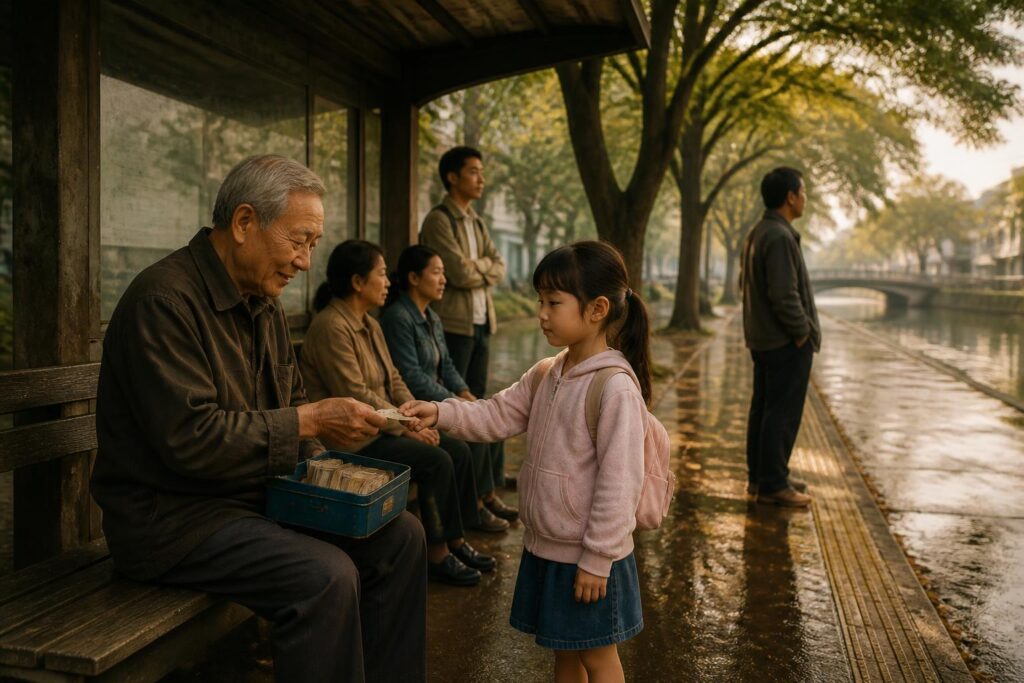
At the end of the road that runs alongside the canal, there was a small bus stop that most people in the city passed by but hardly anyone remembered by name. The stop consisted of nothing more than a corrugated metal shelter, two weathered wooden benches, and a route sign leaning to one side. In the morning, it was filled with the sounds of hurried footsteps, sputtering engines, and conversations cut short by the arrival of a bus. In the afternoon, as the sunlight gradually withdrew from the pavement, the bus stop grew quiet, with only the rustling of tamarind leaves and the smell of damp dust clinging to the benches.
Mr. Lam usually sat on the innermost bench. No one knew exactly how old he was. People only guessed that he was over sixty because his hair was almost entirely gray and he walked slowly, though his eyes were still bright, sometimes even quicker than those of the young people absorbed in their phones. He did not sell tickets, nor did he work for the bus company. He simply came to the stop every day, from the time the first bus passed until the last conductor got off after closing the doors.
What he did was rather strange. Whenever a passenger got off the bus, he would bend down and pick up the paper tickets the wind had blown beneath the benches. Some were still new, some crumpled, and some marked with a streak of water or a shoeprint. He dusted them off very gently and placed them in a blue tin box kept inside a cloth bag. If anyone asked, he would only smile and say, “A bus ticket once took someone somewhere, too.”
The Scraps of Paper Left Behind
At first, everyone assumed that Mr. Lam collected the tickets for some incomprehensible purpose. A student once asked whether he was collecting them. He shook his head. A nearby shopkeeper guessed that he used the tickets to start fires. He shook his head again. Someone laughed and said that he had too much free time and had taken to picking up trash. He did not argue, merely continued picking them up in silence.
In fact, he did not keep every ticket. Those that were too torn or soaking wet went into the trash. He chose only the ones on which the date, time, or route number was still legible. When he got home, he used a small wooden clothespin to clip each ticket to a string stretched across the wall of his living room. Beside every ticket was a piece of white paper. On it, he wrote down what he remembered about the person who had left it behind.
“A girl in a yellow raincoat, got off at the hospital.”
“A boy hugging a box of pastries, staring out the window the entire way.”
“A man who fell asleep and jolted awake only when he reached the final stop.”
He did not know their names, nor did he know where their lives would lead. The notes were not meant to preserve some grand event. They simply held on to a few fleeting figures, proving that someone had been present that morning, on that bus, beneath that shelter.
The first person to truly understand what he was doing was An, a twelve-year-old girl who often took the bus to school. An lived with her mother in a small house on the other side of the canal. Her father had gone away to work many years earlier, while her mother ran a drink stall near the market. Every morning, An arrived at the stop very early, usually sitting beside Mr. Lam and hurriedly eating the baguette her mother had prepared.
One day, An saw him carefully wiping mud from a ticket with a tissue. The departure time was still clearly visible on it. The girl asked:
“What do you keep these for?”
Mr. Lam looked at the ticket in his hand and held it out for An to see.
“To remember that people are always going somewhere.”
An did not understand. To her, taking the bus was simply something she had to do every day. She took it to school, to extra classes, or to the hospital when her mother’s back hurt. She had never thought that a journey could be memorable enough to preserve with a small scrap of paper.
Mr. Lam continued: “Some people get on the bus carrying sadness and get off carrying hope. Others get on because they think they have nowhere left to go, then happen to meet someone who changes their mind. We don’t know about those things, but that doesn’t mean they don’t happen.”
The Bus on a Rainy Day
At the end of that month, the city was hit by a heavy rainstorm. The rain began at noon and lasted until evening, and the water quickly rose along the road beside the canal. The buses moved more slowly than usual. People at the stop pressed close together, their clothes soaked through, everyone’s face weary.
An was not carrying a raincoat that day. Her mother had thought the sky was merely overcast and told her to go to school anyway. When school ended, the girl ran to the stop, soaked from head to toe. Mr. Lam was sitting on the bench and immediately gave her the only dry towel he had.
“You should use it.”
“I’ve been sitting here all day, so I’m dry. Dry your hair first.”
The bus arrived nearly half an hour late. During that time, a woman carrying a child with a high fever ran to the stop. She was making a phone call while staring out at the road, her voice strained with worry. A delivery worker immediately took off his raincoat and gave it to her to cover the child. A young man standing nearby ran to the end of the road to see whether the bus was stuck in the flooded section. Mr. Lam took a clean towel from his bag and handed it to the mother so she could wipe her child’s face.
When the bus arrived, everyone made way for the mother and child to board first. The delivery worker moved aside, while the young man held the bus door until they had safely stepped inside. In just a few minutes, the bus stop, usually full of strangers, suddenly seemed like a shared room. Everyone was occupied with their own worries, but they still had enough attention to notice someone else’s.
The next morning, Mr. Lam found three tickets beneath the bench. One bore marks from the rain, one had been folded in half, and the other was so clean it seemed to have just been placed there. He took all three home. On a piece of white paper, he wrote: “One rainy night, many people stood beneath the same shelter.”
An began visiting his house on weekends. It stood in a quiet alley, with a bougainvillea trellis and an old bicycle out front. Inside the living room, strings covered the walls. Hundreds of tickets formed a strange map of the city, with no street names and no addresses, only departure times, route numbers, and a few lines of notes.
An read each scrap of paper intently. Some stories were sad: a ticket belonging to a woman who went to the hospital to visit her husband, a ticket belonging to a young man leaving his hometown after an argument with his father, a ticket belonging to an old person searching for an old house but eventually unable to remember where to get off. There were happy stories too: a child riding the bus alone for the first time, two friends meeting again after many years, a girl clutching a bouquet throughout the journey because she did not have the courage to give it to its recipient.
“Do you know what happened to them afterward?” An asked.
“I don’t.”
“Then why do you still write them down?”
Mr. Lam pulled a chair over for An to sit and slowly said: “Not everything meaningful needs a clear ending. Sometimes, knowing that someone made it through that day is enough.”
The Unclaimed Ticket
A few months later, Mr. Lam stopped appearing at the bus stop. On the first day, everyone thought he had caught a cold. On the second day, the nearby shopkeeper said he had been hospitalized with chest pains. When An heard this, she asked her mother for permission to visit him. He was lying in a hospital bed, his face pale but still smiling when he saw the girl.
“How was the bus stop today?” he asked.
“Quieter than usual.”
“Did you pick up tickets for me?”
An nodded. She took a carefully folded ticket from her shirt pocket. It was the first ticket she had ever picked up herself. On the back, she had written: “A girl visiting the person who taught her to see other people.”
Mr. Lam read it for a long time. His hand trembled slightly as he gave the ticket back to An.
“Keep it.”
“But this is your job.”
“From now on, it’s your job too.”
Mr. Lam stayed in the hospital for nearly two weeks. During that time, An continued going to the bus stop every morning. She did not just pick up tickets; she also helped old people carry their bags, gave directions to strangers, and reminded children to stand farther inside when the bus arrived. Gradually, people realized that Mr. Lam’s absence did not make the bus stop emptier. Instead, it made them pay closer attention to the things they had previously overlooked.
When he returned, the blue tin box had been placed neatly on the bench. Beside it was a bouquet of paper flowers made by An and several children from the neighborhood. The shopkeeper brought him a pot of hot tea. The delivery worker from the rainy night also stopped by, though no one knew how he had heard the news.
Mr. Lam stood in the middle of the stop and looked at the people waiting for the bus. No one said anything grand. No welcoming ceremony was held. A few people simply smiled together and shifted aside so he could have his familiar seat. But for him, that was enough.
A Place to Pass Through and Pause
From that day on, the ticket box no longer belonged only to Mr. Lam. Anyone who found a ticket in good condition would place it in the box. Some included a few lines of writing; others simply slipped it in and boarded the bus. An grew older, but she continued sitting beside him every morning. She began writing longer stories, not only about bus passengers but also about shopkeepers, drivers, street cleaners, and the people whom the city usually passed by too quickly.
Mr. Lam still did not know the names of most of the characters in those little stories. Nor did he try to find out. He simply believed that every person carried a world of their own, even if that world showed itself for only a few minutes while waiting for a bus. Giving up a seat, asking how someone was, or offering a raincoat at just the right moment might not change an entire life, but it could be enough to make a day feel less cold.
The bus stop at the end of the road beside the canal remained as small as before. The corrugated roof still drummed when the rain fell, the benches still had patches of peeling paint, and the route sign still leaned slightly to one side. Only the people waiting for the bus seemed to have changed. They looked down at their phones less often. They paid attention to the person struggling to find the right stop, the elderly person having trouble standing, and the child who had fallen asleep on their mother’s shoulder.
And whenever a ticket was blown from someone’s hand by the wind, there was always a hand that bent down to pick it up. It might be Mr. Lam. It might be An. Or it might be someone who had never before thought that a small scrap of paper could hold so many stories.
Because in the end, the tickets did not merely record a journey. They reminded people that a city is made up of countless brief encounters, of strangers sharing a shelter, a row of seats, and a moment of concern. Some people got off the bus and disappeared from view. But their traces, even if only an old ticket, could remain long enough to remind someone that they had never truly passed through this life alone.

ARTICLES IN THE SAME CATEGORY
The Room with a Window Overlooking the Backyard
The Clock Repairer and the Forgotten Hours and Minutes
The Scent of Rain on the Old Tile Roof
The Water Carrier Across Windy Hill
The Lamp by the Riverside Landing
The Empty Chair Beside the Veranda
ARTICLES IN THE SAME GENRE
The Seedling Who Knew How to Listen and the Forest That Awoke
Brown Squirrel’s Raincoat
The Wind Chime Finds Its Chime Again
Stepmother and Stepchild