

 Tiếng Việt
 日本語
 한국어
 中文 (中国)
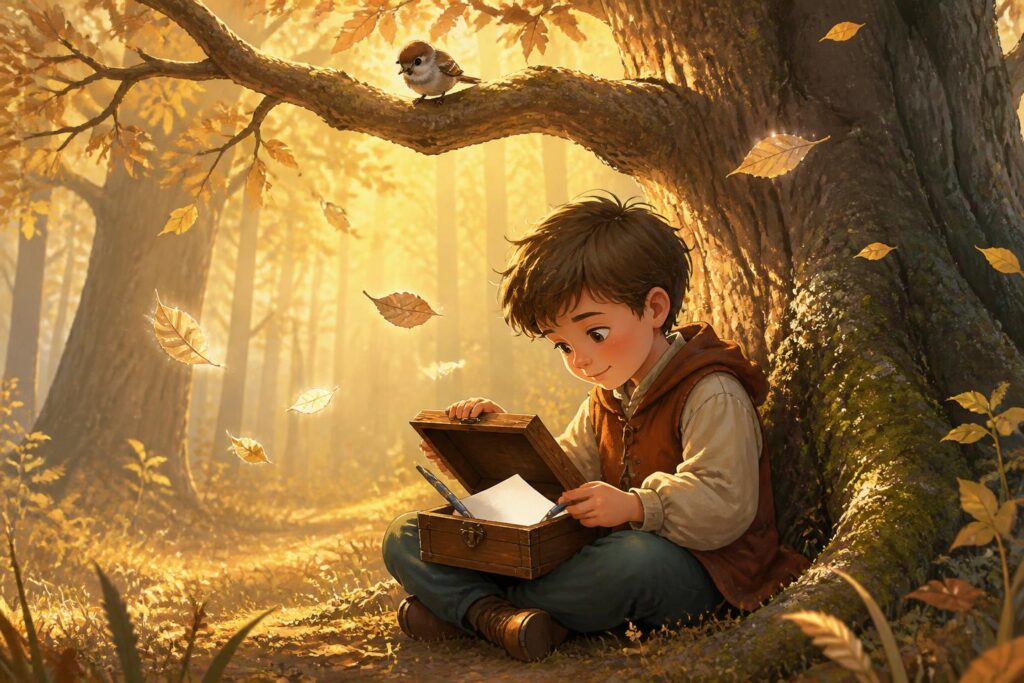
At the end of a winding road, where the yellow chrysanthemums often swayed whenever the wind blew, stood a small house with a blue-tiled roof. In that house, little An lived with his mother and grandmother. An was a gentle boy who liked observing everything around him, but he often procrastinated. He always thought that anything could be done tomorrow.
In the morning, his mother asked An to put the books on the shelf, and An said, “I’ll do it this afternoon.” In the afternoon, his grandmother asked An to take some millet out for the birds, and An replied, “I can do it tomorrow.” In the evening, when his mother reminded An to prepare his schoolbag for the next day’s lesson, he yawned and said, “I’ll prepare it tomorrow, Mom.”
An was not a lazy boy. He still liked helping people; it was just that, in his mind, there was always a tomorrow that was spacious enough, with plenty of time for everything. That tomorrow was always gentler than today, brighter than today, and seemed as though it would never run out of time.
The Box Beneath the Tree
One late-autumn afternoon, after school, An took the path along the fields to return home. On the way, he saw a little sparrow trying to pull a thin string out of a clump of grass. The string was caught around its wing, causing it to jump up and then fall back down.
An set down his schoolbag and gently caught the bird in both hands. Patiently, he untangled each loop of string, then released the sparrow onto a low branch. The bird tilted its head toward An, sang three clear notes, and flew toward the forest.
An thought the story had ended there. However, just as he stepped past an old tree trunk, the sparrow suddenly flew back. It held a dry blade of grass in its beak and, as it flew, kept looking back as if it wanted An to follow. Curious, he walked behind the bird until they reached a patch of ground covered with brown leaves.
Under the tree stood a small wooden box. The box had no lock and no elaborate decorations. On its lid, there was only a very small inscription: For the one who knows how to begin today.
An opened the box. Inside were a blank sheet of paper, a blue pen, and a thin silver leaf as delicate as moonlight. When An touched the leaf, a warm voice came from somewhere:
“Write a letter to tomorrow. But before tomorrow arrives, you must do one good thing for today.”
An looked around. The forest was still silent, except for the rustling of leaves high above. He did not know whose voice it was, but the words made him think for a long time. He sat down beneath the tree, took the pen, and wrote:
“Dear tomorrow, tomorrow I will put away my books, feed the birds, prepare my schoolbag, and help Mom sweep the yard. I will also…”
An stopped writing. He suddenly realized that he had written those things for tomorrow many times, yet each tomorrow passed without anything changing.
The First Good Deed
The sparrow perched on a branch, watching An with bright black eyes. He folded the letter, placed it in the box, and told himself, “If I want to send a letter to tomorrow, I have to do something right now.”
An began with the nearest task. He gathered the dry branches and fallen leaves around the tree and neatly piled them to one side. Then he noticed a bird’s nest that had fallen to the ground. The nest was still intact, but nearby, three baby birds were trembling in the grass.
An climbed onto a low tree trunk and placed the nest in a more secure spot. He used a few soft blades of grass to line the bottom of the nest, then climbed back down. The mother bird flew around, chirping. A little while later, it swooped down beside its chicks.
When An returned home, the sky was already growing dim. His mother was standing in front of the door, looking worried. When she saw him, she hurried out and asked:
“Where have you been, An? Why are you home so late?”
An told her about the sparrow and the nest. His mother listened, then gently patted his head:
“You did a good deed. But next time, remember to let me know if you’re going to be late, all right?”
An nodded. He suddenly remembered the books he had not put away, the schoolbag he had not prepared, and the yard still full of leaves. This time, he did not say, “I’ll do it tomorrow, Mom.” An put down his schoolbag, placed the books on the shelf, prepared his clothes, and helped his mother sweep the yard. The work did not take as long as he had thought. When everything was finished, An still had enough time to sit beside his grandmother and drink a warm cup of tea.
The Letter That Changed Day by Day
That evening, An took another sheet of paper. He wrote:
“Dear tomorrow, today I managed to do one thing before waiting for tomorrow. I understand now that tomorrow is not a bag where I can put all the things I have not done. Tomorrow only comes after today has passed.”
The next morning, An took the letter back to the tree. The wooden box was still beneath the leaves, but the silver leaf inside had grown brighter. The sparrow flew down, took the letter in its beak, and disappeared into the forest.
From that day on, An began a new habit. Every morning, he chose one small task that needed to be completed that day. Some days it was folding his blanket after getting up. Some days it was washing the cup he had used. Some days it was asking after a friend who was feeling sad. He did not try to do everything at once. An simply did one thing at a time, calmly, as soon as he could.
The strange thing was that the earlier he began, the more time An seemed to have. He no longer had to hurry to find his books in the evening. His schoolbag was always prepared before bedtime. His mother no longer had to remind him repeatedly, and his grandmother often smiled when she saw him willingly helping to water the flowerpots by the porch.
But An did not do well every day. One day, he became so absorbed in flying a kite that he forgot his promise to help his mother prepare the vegetables. When he returned, he saw that his mother had finished everything, while her hands were aching with fatigue. Sadly, An stood at the door, thinking that he had failed.
His grandmother looked at An and said:
“Knowing that you forgot is regrettable, but realizing it and making amends is still possible. No one can make every day a perfect day. What matters is that you don’t use one small mistake as a reason to abandon the whole day.”
An took his grandmother’s advice. He apologized to his mother, washed the vegetable basket, wiped the table, and folded the clothes to help her. That evening, he wrote another letter:
“Dear tomorrow, today I did not manage to do everything I promised. But I learned to admit my mistake and correct it. Perhaps that is also one way to prepare for tomorrow.”
What the Box Wanted to Say
Many weeks passed. Late autumn gave way to a clear, crisp winter. One morning, when An went to the tree, he found that the wooden box had disappeared. All that remained was a clean patch of ground and the sparrow perched on a high branch.
An looked up and asked:
“Where is the box?”
The sparrow tilted its head, then flew in a circle around the tree. In the sunlight, An saw countless tiny silver leaves trailing from the bird’s wings. They did not fall to the ground but glittered in midair like fragments of morning light.
Suddenly, the warm voice from that day rang out:
“The box only appears when you need a reminder. Now, that reminder is already in your heart.”
An understood that the box was not a magical object that would do everything for him. It had merely helped him see what he so often forgot: today is the only period of time that is truly in our hands.
From then on, An no longer waited for a perfect tomorrow. When he wanted to do something good, he began with a small action. When he made a mistake, he corrected it as soon as possible. When he faced a difficult task, he did not promise himself that he would do it at some distant time; instead, he asked himself, “Can I take the first step right now?”
Several years later, An still remembered the sparrow and the box beneath the tree. He told the story to the children in the neighborhood, especially those who often put everything off until tomorrow. An did not tell them that they had to become perfect. He only said that each day was like a blank sheet of paper, and we could write on it with one small deed, one kind word, or one attempt to try.
Tomorrow will always be something to look forward to. But for tomorrow to become brighter, we need to give it a gift from today. That gift might be a book put back in its proper place, an apology spoken aloud, a hand raised to offer help, or a quiet good deed that no one sees.
And if sometimes we forget this, we only need to begin again. For every new day opens another opportunity to continue writing the letter to tomorrow.

ARTICLES IN THE SAME CATEGORY
Little Cloud and the Forest That Knew How to Say Thank You
The Seed That Knew How to Listen
The Girl and the Wind Chime
The Little Hedgehog Makes a Coat for the Windy Season
The Little Boy Who Saved a Sunbeam for a Rainy Day
The Boy and the Garden That Knew How to Listen
ARTICLES IN THE SAME GENRE
Bông the Bunny and the Raindrop That Kept Its Promise
The Wind Chime and Brown Squirrel’s Promise
The Boy Who Gathered Laughter for a Wind Chime
The Wind Chime That Awakened the Garden
The Button That Went Looking for Someone Who Keeps Their Word
Tam Cam Part 2: The Vengeful Spirits of the Palace