

 Tiếng Việt
 日本語
 한국어
 中文 (中国)
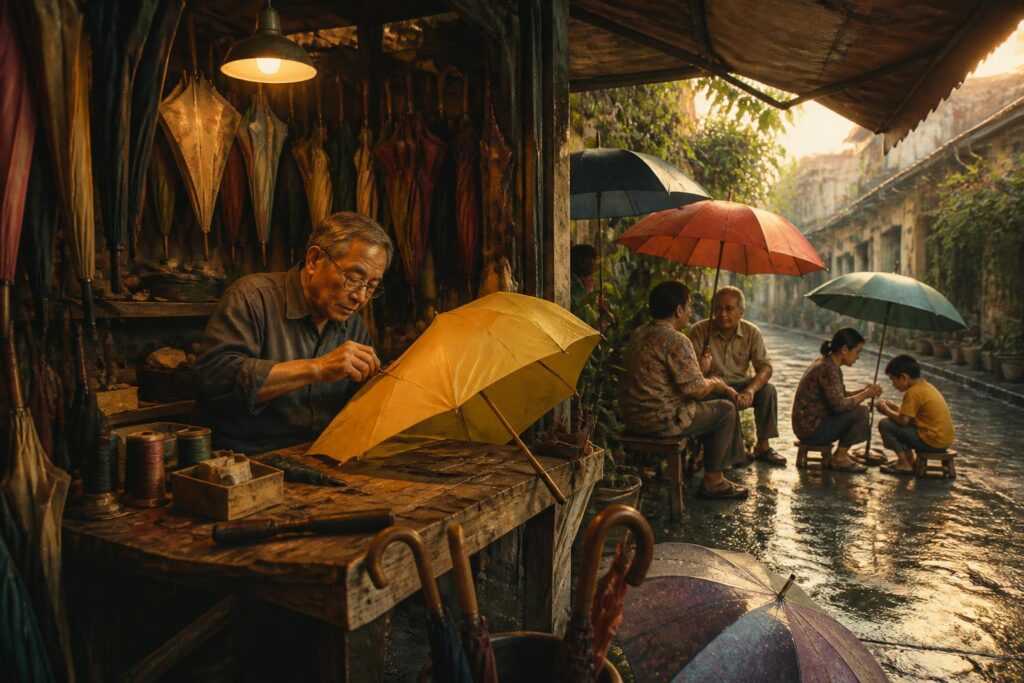
The Umbrella Repair Shop at the End of the Street
At the end of the street stood a small shop tucked beneath a faded awning. The wooden sign out front bore only two words: “Umbrella Repair,” written so simply that passersby often did not bother to look twice. The shop had no gleaming glass display cases, nor did it showcase new umbrellas in every color. Inside there was only a wooden table, a few spools of thread, slender ribs, a sewing needle box, and dozens of old umbrellas hanging on the wall.
The shop’s owner was a man in his sixties named Lâm. His hair was speckled with gray, and his eyes always lingered on the person before him a little longer than usual, as though he wanted to hear even what they had not yet managed to say. He was highly skilled at repairing umbrellas. An umbrella bent by the wind could stand firm again after passing through his hands. A sheet of fabric torn wide open would, after a few strokes of his needle, be mended so neatly that only the sharpest eyes could spot the traces.
Yet what made his shop different from other repair shops was that Lâm never threw away an umbrella that had been forgotten. If someone brought an umbrella in for repair and never returned, he hung it on the wall. If someone left an umbrella outside the shop on a rainy day, he dried it, recorded the date it had been found, and carefully waited for its owner to come back. Some were reclaimed after a few days. Others remained there for years without anyone asking about them.
The Yellow Umbrella
One June afternoon, just after the rain had stopped, a young woman walked into the shop. She was wearing a pale blue shirt and carrying a yellow umbrella with a large section torn away. She placed it on the table and said:
“Uncle, could you repair it for me? I need to pick it up tonight.”
Lâm opened the umbrella. One rib was bent, the fabric had a long tear, and the plastic handle was cracked as well. He asked how much it had originally cost, but the young woman shook her head.
“I don’t know. It belonged to my mother.”
“Where has your mother gone that she had you bring it in for repair?”
The young woman lowered her gaze to the umbrella. Only after a long while did she answer that her mother had died just over a month earlier. In the past, whenever it rained, her mother would stand at the school gate waiting for her to finish classes. The yellow umbrella always tilted toward her daughter, while the mother’s shoulder grew wet. Later, the young woman moved away for work, and her visits home became less frequent. Her mother kept the umbrella on the hook by the door until the day the house had to be cleared out.
“I tore it this morning,” she said. “I was going to throw it away, but when I saw the yellow, I couldn’t bring myself to.”
Lâm asked no more questions. He removed each rib, straightened the bent section, replaced the rotted cord, and found a piece of fabric close in color to the original to patch it. He worked very slowly. By the time night fell, the umbrella could open again, though a small patch remained visible along its body.
The young woman took the umbrella and asked how much she owed him. Lâm only said, “Whenever you see someone standing in the rain without an umbrella, shelter that person for part of the way. Consider that payment.”
The young woman looked up, seemingly unable to understand. Lâm wrapped the umbrella and placed it in her hands, then explained that some things could not be paid for with money. They were preserved by continuing the good deeds once performed by the people who had owned them.
The Unclaimed Umbrellas
The story of the yellow umbrella did not immediately bring more customers to the shop. People in the neighborhood were busy, each with their own concerns. But from that day on, a few began to notice the umbrellas hanging on the wall.
There was a black umbrella missing its tip, beside a note recording that it had been found three years earlier. There was a children’s umbrella printed with blue fish, its fastening strap frayed. There was a transparent umbrella with a bird-shaped handle, with a faded bus ticket still caught inside. Lâm knew little about their owners. He only knew that each object had once kept someone dry, once been held in someone’s hands during some moment of life.
On a day of heavy rain, a boy of about ten ran into the shop. He did not buy anything; he only stood by the entrance to escape the rain. His clothes were soaked through, and his shoes were caked with mud. When he saw the children’s umbrella with the blue fish, he asked to borrow it.
“I’m going to pick up my little sister,” he said. “Our house is on the other side of the bridge, and she’s getting out of school without a raincoat.”
Lâm took the umbrella down, checked the opening mechanism, and handed it to him. He told the boy to bring it back the next day if he remembered how to find his way back. The boy nodded and ran out into the rain.
He really did return the next day. The umbrella had been wiped clean, but there was an additional red string tied around the handle. He said his little sister had tied it there so they would not mistake it for someone else’s umbrella next time. Lâm smiled and hung the umbrella on the wall. From that day on, the boy often stopped by to help him sweep the floor or arrange the spools of thread. He never took payment, and Lâm never called it hired work.
The Customer Who Wanted to Throw Everything Away
Not everyone who came to the shop was looking for something to keep. One morning, a middle-aged man brought in three umbrellas and a cardboard box. He set everything down on the table and told Lâm to throw them away.
“If any umbrella can still be used, you can sell it cheaply to someone. Throw away the rest for me.”
Lâm looked at the three umbrellas. One was brown with a wooden handle, one was red and punctured in several places, and the last was a small folding umbrella with a broken joint. He asked whether they held any meaning for him.
The man gave a dry laugh. He said they were what remained after his father died. His father had worked as a delivery driver and always carried an umbrella, whether the weather was sunny or rainy. The two of them had argued before the last time his father left home. After that, his father died of illness. The son had kept the umbrellas for many years, but the longer he kept them, the angrier he felt. He no longer wanted to look at them.
Lâm did not advise him to forgive his father immediately. He simply took the brown umbrella, wiped the dust from it, and placed it in front of the customer.
“If you throw them away today, you may feel lighter tomorrow. But it’s also possible that one day you’ll want to find them again and they’ll be gone. Before you decide, would you sit here and have a cup of tea?”
The man was about to refuse, but in the end he sat down on the wooden chair beside the door. Lâm poured the tea and said nothing more. Outside, the old rainwater lay in long streaks along the roadside. Inside the shop, the only sounds were the ticking of the clock and the fading noise of vehicles.
After a while, the customer picked up the brown umbrella. He told Lâm that when he was young, whenever he encountered rain after school, his father would wait beneath a tree. The umbrella had been too small then, so the two of them had to walk close together. His father always told him to walk on the inside while he took the rain blowing in from outside. The story lasted only a few minutes, but the man’s voice had changed.
In the end, he did not throw away any of the umbrellas. He asked Lâm to repair the brown and red ones, while asking permission to leave the folding umbrella at the shop. He said he did not know when he would be able to look at it without feeling sad, but at least today he did not want to turn it into trash.
What Was Mended
The umbrella repair shop gradually became a place people visited not only to have things repaired. Some came to borrow an umbrella during a sudden shower. Some brought in a broken umbrella and sat telling stories while they waited. Some merely stood outside the door looking at the old umbrellas, then quietly walked away. Lâm never asked them why they had come. He understood that sometimes a person needed a place to pause, but was not yet ready to name that need.
One late afternoon at the end of the year, the young woman with the yellow umbrella returned. She brought a brand-new umbrella and placed it by the door.
“I bought it to give back to the shop,” she said. “If anyone needs one, please lend it to them.”
Lâm asked how she had been lately. She said she had moved back near her old home and begun sorting through her mother’s room. She kept the yellow umbrella in the corner of the room and no longer used it in the rain for fear of damaging it. But once, she saw an old woman standing outside a hospital with nothing to cover her head, so she opened the umbrella and walked with her for part of the way. Only afterward did she realize that she no longer felt the umbrella belonged solely to a painful memory.
Lâm listened and nodded. He did not say that this was exactly what he had been waiting for. An object was not saved so that it could remain forever on a shelf. A memory was not preserved so that a person could live forever in the past. The most precious thing was that they could move forward, carrying the traces of the hands that had once touched them.
The Rain No One Had Forecast
That night, a sudden downpour poured over the city. Strong gusts tore loose the shop’s canvas awning, and water flooded over the doorstep. Lâm was trying to pull the wooden door closed when he heard someone calling outside. The boy with the blue-fish umbrella was standing there, with his little sister and several neighbors behind him.
Without anyone telling them to, they all ran over to help him secure the awning. The man who had once brought three umbrellas to throw away also appeared. He used the brown umbrella to shield the toolbox from getting wet. The young woman with the yellow umbrella arrived last, her hair already damp, but carrying two more umbrellas to hand out to everyone.
In the flickering light, old umbrellas opened all along the street. Some tilted to one side, some still bore patches, and some matched none of the others in color. But they shielded one person’s shoulders for another, joining distances that no one had ever imagined could be joined.
The next morning, when the rain stopped, the wooden sign in front of the shop had been blown down. As Lâm was about to put it back up, the boy suggested adding another line underneath. He took a pen and carefully wrote: “Available to borrow when it rains.”
Lâm looked at the awkward lettering, then left it as it was. From then on, the shop did more than repair umbrellas. A small rack stood beneath the awning where anyone in need could take an umbrella, and those who had finished using one could return it whenever convenient. No one had to give their name, and no one had to promise anything beyond remembering the umbrella they had once received if, one day, they came across someone else getting soaked in the rain.
People often think that kindness must be truly grand to be worth noticing. But at the end of the street, Lâm understood that kindness sometimes began with straightening a bent rib, stitching a torn piece of fabric closed, or passing an umbrella to someone who was wetter than oneself. Some tears could never disappear completely. Even so, if tended to properly, they could still become signs that an object, like a person, had once been worth someone’s effort to hold on to.

ARTICLES IN THE SAME CATEGORY
The Lighthouse Keeper and the Road That Was Not on the Map
The Empty Chair in the Evening Rice Shop
The Empty Seat Beneath the Station Eaves
The Postman on the Nameless Slope
The Lamp That Never Goes Out at the End of the Slope
The Ferry Landing Behind the Bamboo Grove and the Keeper of Promises
ARTICLES IN THE SAME GENRE
Stepmother and Stepchild